
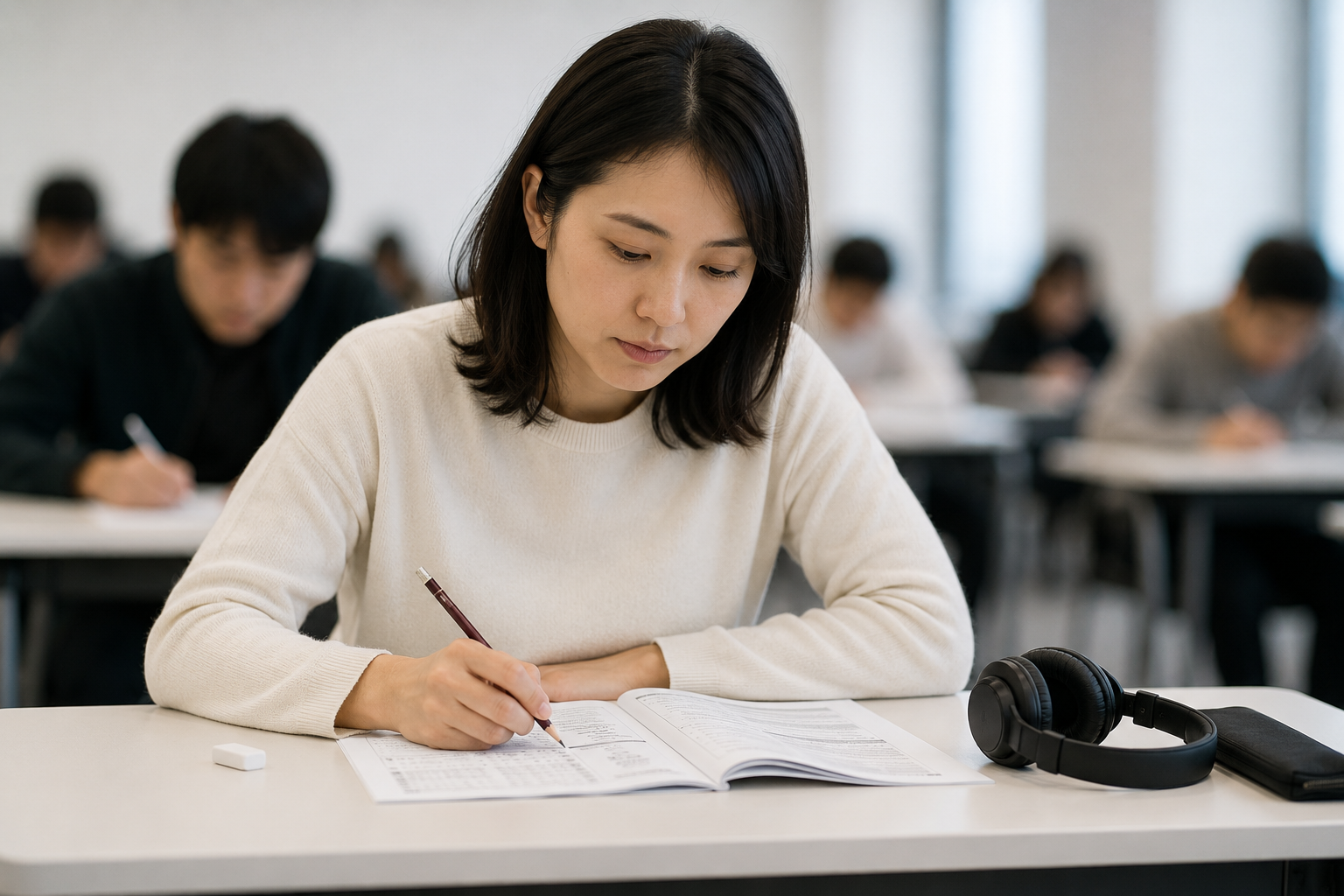
What Can Go Wrong in a TOEIC Test Room? Weird Distractions Serious Test-Takers Should Prepare For
A TOEIC test room is not a perfect laboratory. Phones, coughing, temperature, noise, nerves, and tiny distractions can affect your performance. Here is how serious test-takers can prepare without panicking.
A TOEIC test room should be quiet, organised, and predictable. In reality, it is still a room full of human beings, chairs, bags, pencils, phones, air conditioners, nervous energy, and small distractions that arrive at exactly the wrong moment.
That does not mean test day is chaos. Most TOEIC tests run normally. But serious test-takers should prepare for imperfect conditions because the real test does not happen inside a perfect study app. It happens in a physical room, under time pressure, with other people nearby.
This matters because TOEIC is not only an English test. It is also a concentration test, a recovery test, and a decision-making test. Your score can be affected not only by what you know, but by how well you handle the unexpected.
The Test Room Is Not a Perfect Laboratory
At home, you can choose your desk, your chair, your temperature, your headphones, your light, and your break time. In the test room, you cannot control most of those things.
The room may be hotter than you like. It may be colder than expected. The desk may wobble slightly. The chair may not feel comfortable. The sound may seem a little low. Someone outside the building may be making noise. Someone inside the room may cough, sniff, sigh, tap, erase, shift papers, or move their chair at the worst possible time.
None of these things is usually the main problem by itself. The real problem is how the test-taker reacts. One small distraction can become much larger if the test-taker begins thinking, “This is unfair. I can’t concentrate. My score is ruined.”
That reaction is especially dangerous for Over Thinkers. The distraction may last three seconds, but the internal commentary can last three minutes.
The Phone That Should Have Been Off
One of the most serious test-room problems is also one of the most preventable: a phone alarm or ringtone.
Under official Japanese TOEIC L&R rules, a person whose alarm or ringtone sounds during the test is required to leave the test room immediately. This is not a minor inconvenience or an amusing mistake. It is a serious test-day failure.
The practical advice is simple: do not merely silence your phone. Turn it off properly. Check alarms. Check backup alarms. Check calendar alerts. Check smartwatches. Check anything that thinks it is helpful enough to make noise at the worst possible moment.
For serious test-takers, this is part of preparation. Test-day performance begins before the first listening question. It begins with removing preventable risk.
The deeper lesson is control. You cannot control every person in the room, but you can control your own devices, clothing, route, timing, materials, and routine.
The Human Soundtrack
Every test room has a human soundtrack. Coughing, throat-clearing, pencil tapping, pages turning, erasers rubbing, chairs shifting, bags rustling, and repeated small movements can all become more noticeable during a high-pressure test.
During normal life, these sounds may not matter. During TOEIC Listening, they can feel much larger. When you are trying to catch a key phrase, even a small noise can feel personal.
This is where Passive Listeners and Over Thinkers can struggle for different reasons. A Passive Listener may lose the speaker’s purpose as soon as the sound environment changes. An Over Thinker may become angry at the distraction and continue thinking about it after the sound has already passed.
The answer is not to hope for a perfect room. The answer is to train controlled attention. During practice, occasionally listen through low-level background noise. Do not make the noise extreme. The goal is not suffering. The goal is learning to stay with the speaker even when the room is not perfect.
The Temperature Problem
Temperature sounds like a small issue until you are 40 minutes into the test and your body has become either too warm to focus or too cold to relax.
A room that is too hot can make you sleepy. A room that is too cold can make your body tense. Strong air conditioning can become distracting. A sunny window seat can make the room feel different from the seat across the aisle.
The solution is not complicated, but many test-takers ignore it: dress in layers. Choose clothing that lets you adjust without drawing attention to yourself. Avoid anything too tight, too hot, too cold, or too distracting.
This is not fashion advice. It is performance advice. Physical discomfort uses attention. The more attention your body needs, the less attention you have for Listening and Reading.
For Burnout test-takers, this matters even more. If you arrive already tired, hungry, rushed, or physically uncomfortable, your tolerance for small problems becomes lower. A serious test-taker protects energy before the test begins.
The Wobbly Desk and the Tiny Irritation Problem
A wobbly desk is not a disaster. A wobbly desk that you think about for two hours can become one.
The same is true of a squeaky chair, a strange seat angle, a slightly awkward writing surface, or a person beside you who moves more than you would prefer. These are tiny irritations. The danger is not the irritation itself. The danger is mental fixation.
The Over Thinker may keep returning to the irritation. The Speed Trap test-taker may respond by rushing, trying to finish before the irritation gets worse. The Burnout test-taker may experience it as one more sign that the day is going poorly.
A stronger response is to execute a clear mental reset rule: notice the irritation, adjust your physical position once if possible, and immediately return to the task. Do not spend critical cognitive energy negotiating with the furniture in your head; the desk is not taking the test, you are.
Listening When Something Goes Wrong
TOEIC Listening is unforgiving because the audio does not wait for your emotional recovery. If a distraction happens during one question, the next question still arrives.
This is why listening recovery is a skill. You need a rule for the moment something goes wrong. The rule itself is straightforward: choose, release, and reset. Select the best option available, release the missed moment completely, and re-anchor your attention on the next speaker.
This does not feel natural at first, as most test-takers instinctively try to replay the missed sentence in their minds. However, the real test does not allow that. If you keep chasing the lost answer, you may lose the next one as well.
A serious Listening plan includes recovery practice. During timed practice, do not pause the audio after a mistake. Force yourself to continue. This is not carelessness; it is disciplined test behaviour.
Reading When the Room Becomes Annoying
In Reading, distractions work differently. There is no audio to miss, but irritation can quietly damage timing.
A cough, a chair, a clock, or a cold room may make you reread the same sentence. Then you reread it again because you are annoyed that you had to reread it. Then you check the answer twice because you no longer trust your focus. Suddenly, a small disturbance has taken a full minute.
This is especially dangerous in Part 7. Reading needs rhythm. Once the rhythm breaks, some test-takers slow down too much or start reading every sentence as if danger is hidden inside it.
The answer is not to pretend you are unaffected. The answer is to return to evidence. Ask: What is the question asking? Where is the evidence? Which answer matches it? This brings your attention back to the task instead of the room.
Reading survival is not about being immune to distraction. It is about returning quickly.
The Serious Test-Taker’s Survival Kit
A good test-day survival kit is not complicated. It is mostly about removing avoidable problems.
Prepare your ID and required materials early. Check your route. Arrive with enough time. Turn your phone completely off. Wear adjustable clothing. Bring acceptable writing materials. Eat normally. Do not experiment with strange food, too much coffee, or heroic last-minute study.
Before the test, decide your reset rule. If something happens in Listening, choose, release, reset. If something happens in Reading, return to question, evidence, answer. If the room is uncomfortable, adjust once if possible, then continue.
This kind of preparation may sound boring, but boring is useful on test day. You want fewer decisions, fewer surprises, and fewer emotional reactions.
The best test-takers are not people who demand perfect conditions. They are people who keep functioning when conditions are slightly imperfect.
Practise Imperfect Conditions Carefully
You do not need to make practice miserable. Do not blast noise, freeze yourself, or study in a situation that makes concentration impossible. That is not training. That is punishment.
But occasionally, practise in less-than-perfect conditions. Try Listening once through speakers instead of headphones. Do a short Reading set in a café or a shared space. Practise after work when you are not completely fresh. Sit at a normal desk instead of your ideal study setup.
The purpose is to build flexibility. If you only practise in perfect silence with perfect comfort, test day may feel more fragile than it needs to.
This is especially useful for Over Thinkers. They often want ideal conditions because ideal conditions feel safe. But TOEIC performance needs adaptable focus. The goal is not perfect calm. The goal is controlled performance.
After the Test, Debrief the Distractions
After the test, do a short debrief before the details disappear. Do not only ask, “Was the test hard?” Ask what happened around you and how you responded.
Did a sound distract you? Did you recover quickly? Did the room temperature affect your energy? Did someone nearby interrupt your focus? Did you lose one question or several because of your reaction? Did Reading slow down because you became irritated?
This review matters because distractions reveal learning blocks. A Passive Listener may lose meaning when sound conditions change. An Over Thinker may mentally argue with the situation. A Speed Trap test-taker may rush after being interrupted. A Burnout test-taker may have less emotional tolerance for small problems.
The distraction is not always the main issue. Your reaction to the distraction is often the real diagnostic clue.
Final Thought
Something can always go wrong in a TOEIC test room. A phone can ring. A chair can squeak. Someone can cough at exactly the wrong moment. The air conditioning can become your unexpected enemy. The desk can wobble just enough to steal attention.
You cannot control all of that. You can control your preparation, your reset rule, your recovery, and your ability to return to the task.
That is why test-day readiness is not only about English knowledge. It is about behaviour under imperfect conditions.
The TOEIC Learning Block Diagnostic can help you understand how you are likely to react when the test does not go perfectly. Once you know whether your main block is passive listening, overthinking, translation, speed, memorisation, or burnout, you can prepare not only for the questions, but for the room itself.

Yet Another 10 Questions Nobody Explains About TOEIC
This article answers another 10 quiet TOEIC questions that many serious test-takers ask but few sites explain clearly. The focus is not generic advice, but the hidden behaviours behind confusing score problems.
Some TOEIC questions are easy to find online. How do I improve my score? Which book should I buy? How many hours should I study? How do I get 700 or 800?
Those questions matter, but they are not the only questions test-takers ask. The more interesting questions are often quieter and more specific. They appear when a test-taker has already tried the normal advice but still feels that something does not make sense.
This article continues our long-tail question series. These are the small TOEIC problems that are easy to dismiss but often reveal something important about test behaviour.
The Part 2 Listening Problem
Why is Part 2 sometimes harder than longer listening conversations? This surprises many test-takers because Part 2 looks simple. The questions are short, the answers are short, and there is no long conversation to follow.
That simplicity is exactly the problem. In a longer conversation, you may recover meaning from context. In Part 2, one missed word can change everything. If you miss the question word, the speaker’s intention, or the indirect response, you may have very little time to recover.
Part 2 also punishes passive listening. You cannot relax and wait for the general topic. You must identify the function of the sentence quickly. Is it a request, suggestion, offer, complaint, confirmation, or indirect answer?
A Passive Listener may hear the words but miss the function. A Translator may lose time trying to convert the sentence into Japanese. For Part 2, the habit to train is fast function recognition, not just word-by-word listening.
The Last Questions in Reading
Should I fill in random answers if I run out of time in Reading? The practical answer is that leaving answers blank is usually worse than marking something, but the better question is why you reached that point.
If you have only a few minutes left and many questions unanswered, you need a damage-control rule. Marking something is better than freezing. But if this happens repeatedly, the issue is not the final minute. The issue is the first 70 minutes.
Many test-takers run out of time because they spend too long on early Reading questions. Over Thinkers keep checking low-value answers. Translators process too much Japanese. Some test-takers read Part 7 from the beginning without a clear evidence strategy. Others lose time because Part 5 and Part 6 were not automatic enough.
The goal is not to become better at emergency guessing. The goal is to reduce how often the emergency appears. Guessing is a final safety action, not a reading strategy.
Sleepiness During the Test
Why do I get sleepy during TOEIC even when I care about the score? Sleepiness does not always mean laziness or lack of motivation. It may mean your attention system is overloaded.
TOEIC creates long periods of controlled attention. You listen without stopping, read under pressure, make constant small decisions, and manage uncertainty. That can make the brain tired, especially if you are already sleep-deprived or studying after work.
Sleepiness can also appear when the task is too passive. If you listen without a target, your attention may drift. If you read without a clear purpose, your eyes may move but your mind may not stay engaged.
For a Passive Listener, the solution may be active listening targets. For Burnout, the solution may be better recovery and less late-night overload. For Speed Trap test-takers, the issue may be mental exhaustion after rushing through too many decisions. The real question is not simply “Why am I sleepy?” but “What kind of attention am I asking my brain to maintain?”
Online Practice Versus Paper Practice
Why does online TOEIC practice feel different from paper practice? The difference may not be your English. It may be the medium.
On a screen, you may scroll differently, read differently, or feel less aware of the whole passage. On paper, you may find it easier to move your eyes between question, answer choices, and text. Some test-takers concentrate better on paper. Others prefer the speed and convenience of digital practice.
The problem is assuming the two experiences are identical. If your real test or target format is paper-based, you should not do all your preparation on a phone. If you mostly practise online, include some paper-style timed practice before the test. If you are preparing for an online version, practise reading on a screen under similar conditions.
This is not about which format is “better”. It is about format transfer. The closer your practice is to your actual test experience, the fewer surprises you face on test day.
Changing Right Answers to Wrong Ones
Why do I keep changing correct answers to wrong ones? This is often an Over Thinker problem.
The test-taker chooses an answer, then doubts it. They reread the sentence, check another option, imagine an exception, and then switch. Sometimes the new answer is better. Often, it is not. The problem is not changing answers itself. The problem is changing answers without stronger evidence.
A useful rule is simple: change an answer only when you find clear new evidence. Do not change it because you feel nervous. Do not change it because another option looks sophisticated. Do not change it because silence feels uncomfortable.
This habit matters in Part 5 and Part 7 especially. TOEIC answer choices often create uncertainty. If you chase perfect emotional certainty, you may lose time and accuracy at the same time. The Over Thinker needs an evidence-based decision rule rather than more anxiety.
Workplace English Versus TOEIC Performance
Why can I use English at work but still miss easy TOEIC questions? This question frustrates many adults. They may write emails, attend meetings, or speak with overseas clients, yet still lose points on questions that look simpler than their real work.
The reason is that workplace English and TOEIC performance are not identical. At work, you have context, time, background knowledge, follow-up questions, and real communication purpose. In TOEIC, you have limited time, fixed choices, distractors, and no chance to ask for clarification.
A test-taker may be competent in real communication but still weak at test decisions. They may understand the topic but miss the exact evidence. They may know the vocabulary but fail to process it quickly. They may speak well but still lose time in Reading.
This does not mean workplace English is irrelevant. It means TOEIC needs its own performance layer. The test rewards controlled recognition, timing, and answer discipline.
Score Movement and Question Difficulty
Why does my score not match how hard the test felt? Sometimes a test feels terrible, but the score is acceptable. Sometimes it feels manageable, but the score is disappointing.
Feelings during the test are not always reliable score predictors. A difficult-feeling test may make you more careful. An easy-feeling test may cause careless decisions. A long Part 7 passage may feel awful but only cost a few points if you handled the other sections well. A short Part 2 mistake may feel minor but reveal a pattern.
The score is shaped by the whole performance, not by the emotional memory of one section. This is why post-test feelings can be misleading.
The better approach is to record what actually happened. Did you run out of time? Did you lose focus? Did you guess? Did you panic? Did you finish calmly? Over several tests, those patterns matter more than the emotional label of “easy” or “hard”.
Timer Shock
Why do I forget what I studied when the timer starts? This often happens when practice has been too comfortable.
A test-taker may know grammar rules, vocabulary, or listening patterns during relaxed review. But when the timer starts, the task changes. Now they must retrieve knowledge quickly, choose under uncertainty, and move on before they feel fully ready.
This is not only a knowledge problem. It is a pressure-transfer problem. The skill exists in calm conditions but has not yet been trained under test conditions.
The solution is not to create panic every day. It is to add mild pressure gradually. Use short timed sets, practise no-pause Listening, and review not only whether the answer was right, but whether the decision remained stable under time pressure. For Over Thinkers, timer shock may reveal hesitation. For Memoriser test-takers, it may reveal weak transfer. For Burnout, it may reveal an overloaded nervous system. The timer exposes which testing habits are actually ready.
Japanese Explanations and Slow Decisions
Why do Japanese explanations make me feel better but not faster? Japanese explanations can be useful. They can clarify grammar, vocabulary, and logic. They can reduce confusion. They can make a difficult point feel manageable.
But feeling clear after a Japanese explanation is not the same as making a fast English decision during TOEIC. The explanation happens after the problem. The test decision happens in real time.
This is where the Translator block can appear. The test-taker may depend on Japanese to feel safe. They understand the rule, but only after converting the English into Japanese. During the test, that process is often too slow.
Japanese should support learning, but it should not become the only path to understanding. After using a Japanese explanation, return to the English sentence. Ask yourself what signal you should notice next time. Is it the part of speech? The verb form? The speaker’s purpose? The paraphrase?
The goal is not to ban Japanese. The goal is to transfer the insight back into English recognition.
The Plateau That Does Not Feel Like Failure
Why do I feel stuck even though I am probably improving? Not every improvement appears immediately as a score jump.
A test-taker may be recognising more vocabulary, recovering faster after mistakes, reading with slightly better evidence, or making fewer careless decisions. Those changes matter, but the official score may not move in a clean straight line.
This is why plateau periods are emotionally difficult. The test-taker may be improving parts of the system, but the score has not yet reflected it clearly. If they panic too soon, they may abandon a method that was beginning to work.
The solution is to track behaviour as well as score. Are you finishing more questions? Are your correct answers more confident? Are your wrong answers more understandable? Are you translating less? Are you recovering faster in Listening?
A plateau is not always proof of failure. Sometimes it is the stage where new behaviour is forming but not yet stable.
What These Tail-End Questions Show
These small questions matter because they point to problems that generic TOEIC advice often misses. A test-taker may not need another broad study plan. They may need to understand why Part 2 collapses, why they change correct answers, why the timer damages recall, or why Japanese explanations feel safe but do not improve speed.
That is the purpose of this series. The quiet questions are not random. They reveal the hidden behaviour behind the score.
The TOEIC Learning Block Diagnostic is designed to help you identify which behaviour is most likely holding your score in place. Once you know whether your main block is passive listening, translation, overthinking, speed, memorisation, or burnout, even these small questions become useful signals rather than isolated frustrations.