

Without a Strong Enough Reason, Your TOEIC Target Will Keep Slipping Away...
Many TOEIC test-takers set a target score, but the target keeps slipping away because the reason behind it is too weak. A stronger reason changes study priorities, protects time, and helps adults keep going when life gets busy.
A TOEIC target score can look serious on paper: a company requirement, a promotion target, or a personal goal written neatly in a notebook. But a target score alone is rarely enough. Many test-takers know the exact number they want, but they lack a sufficiently strong reason to protect the study time that number requires.
When work becomes busy, when practice feels boring, when a score does not move, or when fatigue builds up, the target starts slipping away. Not because the test-taker is lazy. Not because they are not intelligent. Often, the reason behind the goal is simply not strong enough to survive real life.
A Target Is Not the Same as a Reason
A target tells you where you want to go. A reason tells you why you will keep moving when the plan becomes inconvenient.
This difference matters. “I want 800” is a target. “I need 800 because I want to apply for an overseas role next year” is a reason. “I should improve my TOEIC score” is vague. “I want to stop avoiding English tasks at work” is much stronger.
The target gives direction, but the reason gives weight. Without that weight, TOEIC study becomes easy to move to tomorrow, then next week, then after the next busy period, then after the next test. This is how many score goals quietly disappear. They are not rejected. They are postponed until they no longer feel real.
Adults Do Not Fail Because They Are Weak
Adult test-takers are not choosing between TOEIC and free time. They are choosing between TOEIC, work, family, commuting, sleep, health, social obligations, and recovery.
That is why vague motivation is weak. A busy adult needs a reason strong enough to compete with real pressure. If TOEIC study has no clear place in the week, it will lose to whatever feels urgent. A late meeting feels urgent. A tired body feels urgent. A family request feels urgent. A deadline feels urgent. TOEIC becomes the thing that can be delayed because nobody is watching.
This is why a serious study plan must start with the reason. The question is not only, “What score do I want?” The better question is, “Why does this score deserve protected space in my life right now?”
Weak Reasons Create Weak Study Decisions
A weak reason creates weak decisions. The test-taker studies when convenient, reviews when they feel like it, changes materials when bored, and takes mock tests only when panic appears. The result is erratic movement without sustainable direction.
This is where many adult test-takers become deeply frustrated. They are constantly executing TOEIC activities, but the activities do not form a cohesive system. A little vocabulary. A few listening tracks. A new app. A practice test. Some grammar review. Then a break. Then guilt. Then another restart.
The problem is not always the material. The problem is that the reason is not strong enough to force better choices. A stronger reason helps the test-taker say, “This matters, so I will review properly.” Or, “This matters, so I will stop buying new books and diagnose the real weakness.” Or, “This matters, so I will protect three short sessions this week instead of pretending I will study every day.”
A Strong Reason Survives a Bad Week
A weak TOEIC goal collapses after a bad week. A strong reason survives it.
This is important because every test-taker has bad weeks. Work gets heavier. Practice scores disappoint. Listening feels like noise. Reading feels slow. The study plan becomes messy.
If the reason is weak, the test-taker may think, “Maybe I am just not good at English.” If the reason is stronger, they are more likely to think, “This week was messy, but the goal still matters. What is the next useful action?”
That difference is not motivational decoration. It changes behaviour. A strong reason does not make study easy. It makes study recoverable. When the plan breaks, the test-taker comes back faster because the reason is still there.
For busy adults, recovery speed matters. The problem is not missing one session. The problem is letting one missed session become three weeks of silence.
The Burnout Block and the Missing Reason
The Burnout block often appears when TOEIC study becomes a heavy obligation with no visible meaning.
The test-taker feels they should study, but the work feels disconnected from daily life. Every practice set becomes another task. Every mistake feels like evidence of failure. Every missed session creates guilt.
A strong reason can reduce that pressure because the study becomes connected to something real. The test-taker is not studying because they vaguely “should”. They are studying because the score supports a career move, a professional identity, a personal reset, or a future option.
This does not remove difficulty. TOEIC still requires work. But it changes the emotional frame. The test-taker is no longer carrying a random obligation. They are building towards something that matters. Burnout often needs a smaller plan, but it also needs a clearer reason.
Your Reason Should Change Your Weekly Plan
A real reason should change how you study.
If your TOEIC target is linked to a job application, your plan should include deadlines, mock tests, review cycles, and score tracking. If your reason is workplace confidence, your plan should include listening purpose, reading stamina, and direct meaning recognition. If your reason is escaping a long plateau, your plan should start with diagnosis, not another random book.
The same target score can require very different preparation systems. Two test-takers may both want 750. One needs it for a company requirement. Another wants it because they are tired of feeling anxious when English appears at work. Those test-takers may need different study systems because their reasons are different.
This is why generic study plans often fail. They start with the target but ignore the person. A better framework begins with the personal reason, identifies the behavioural learning block, and only then chooses the study task.
Turn the Reason Into a Rule
A reason is only useful if it becomes behaviour. “I want to change my career” sounds powerful, but it will not help unless it changes the week. “I want to stop avoiding English” sounds honest, but it will not help unless it changes the next practice session.
Turn the reason into a rule that can guide real study decisions:
If TOEIC matters for my next career step, I protect three study sessions every week.
If I am burned out, I use smaller sessions instead of dramatic restarts.
If I keep translating, I practise direct meaning recognition before adding more vocabulary.
If I overthink, I train decision rules, not just grammar knowledge.
If I lose focus in Reading, I practise stamina instead of blaming vocabulary alone.
The reason gives the rule emotional weight. The rule turns the reason into action.
Do Not Borrow Someone Else’s Reason
A common mistake is borrowing another person’s reason. A colleague needs 800, so you decide you need 800. A YouTuber says TOEIC changed their life, so you try to copy their plan. A friend studies two hours a day, so you feel guilty for doing less.
This creates weak motivation because the goal does not fully belong to you. Your TOEIC reason must fit your life. It may be career-related. It may be practical. It may be emotional. It may be private. It does not need to impress anyone else.
A quiet reason can be strong. “I want to stop feeling embarrassed about English” may be more powerful than a vague dream of a high score. “I want to be ready if a transfer opportunity appears” may be stronger than copying someone else’s timetable. The test-taker who owns the reason is more likely to protect the work.
Before You Choose Another Study Method
Before choosing another book, app, course, or mock test, ask whether your reason is strong enough and clear enough.
If the reason is unclear, you may keep changing methods without changing behaviour. If the reason is clear, you can choose tools more intelligently.
A Passive Listener needs a different plan from a Translator. An Over Thinker needs a different plan from a Speed Trap test-taker. A Memoriser needs a different plan from someone in Burnout. But all of them need the same first question: why does this score matter enough to change how I study?
That question is uncomfortable because it removes excuses. It also makes the plan stronger. A TOEIC target without a reason is easy to delay. A TOEIC target connected to a strong personal reason is harder to ignore.
Final Thought
Your TOEIC target will keep slipping away if the reason behind it is too weak.
That does not mean you need to become obsessed. It means the score must be connected to something real enough to protect time, attention, and honest review.
A strong reason helps you continue after a bad week. It helps you choose better materials. It helps you stop random study. It helps you build a system that fits your actual life.
The TOEIC Learning Block Diagnostic is designed to help you identify the behaviour behind your score. Once you know your learning block and understand why the score matters, your study plan becomes more than a list of tasks. It becomes a system with a reason strong enough to hold.

Yet Another 10 Questions Nobody Explains About TOEIC
This article answers another 10 quiet TOEIC questions that many serious test-takers ask but few sites explain clearly. The focus is not generic advice, but the hidden behaviours behind confusing score problems.
Some TOEIC questions are easy to find online. How do I improve my score? Which book should I buy? How many hours should I study? How do I get 700 or 800?
Those questions matter, but they are not the only questions test-takers ask. The more interesting questions are often quieter and more specific. They appear when a test-taker has already tried the normal advice but still feels that something does not make sense.
This article continues our long-tail question series. These are the small TOEIC problems that are easy to dismiss but often reveal something important about test behaviour.
The Part 2 Listening Problem
Why is Part 2 sometimes harder than longer listening conversations? This surprises many test-takers because Part 2 looks simple. The questions are short, the answers are short, and there is no long conversation to follow.
That simplicity is exactly the problem. In a longer conversation, you may recover meaning from context. In Part 2, one missed word can change everything. If you miss the question word, the speaker’s intention, or the indirect response, you may have very little time to recover.
Part 2 also punishes passive listening. You cannot relax and wait for the general topic. You must identify the function of the sentence quickly. Is it a request, suggestion, offer, complaint, confirmation, or indirect answer?
A Passive Listener may hear the words but miss the function. A Translator may lose time trying to convert the sentence into Japanese. For Part 2, the habit to train is fast function recognition, not just word-by-word listening.
The Last Questions in Reading
Should I fill in random answers if I run out of time in Reading? The practical answer is that leaving answers blank is usually worse than marking something, but the better question is why you reached that point.
If you have only a few minutes left and many questions unanswered, you need a damage-control rule. Marking something is better than freezing. But if this happens repeatedly, the issue is not the final minute. The issue is the first 70 minutes.
Many test-takers run out of time because they spend too long on early Reading questions. Over Thinkers keep checking low-value answers. Translators process too much Japanese. Some test-takers read Part 7 from the beginning without a clear evidence strategy. Others lose time because Part 5 and Part 6 were not automatic enough.
The goal is not to become better at emergency guessing. The goal is to reduce how often the emergency appears. Guessing is a final safety action, not a reading strategy.
Sleepiness During the Test
Why do I get sleepy during TOEIC even when I care about the score? Sleepiness does not always mean laziness or lack of motivation. It may mean your attention system is overloaded.
TOEIC creates long periods of controlled attention. You listen without stopping, read under pressure, make constant small decisions, and manage uncertainty. That can make the brain tired, especially if you are already sleep-deprived or studying after work.
Sleepiness can also appear when the task is too passive. If you listen without a target, your attention may drift. If you read without a clear purpose, your eyes may move but your mind may not stay engaged.
For a Passive Listener, the solution may be active listening targets. For Burnout, the solution may be better recovery and less late-night overload. For Speed Trap test-takers, the issue may be mental exhaustion after rushing through too many decisions. The real question is not simply “Why am I sleepy?” but “What kind of attention am I asking my brain to maintain?”
Online Practice Versus Paper Practice
Why does online TOEIC practice feel different from paper practice? The difference may not be your English. It may be the medium.
On a screen, you may scroll differently, read differently, or feel less aware of the whole passage. On paper, you may find it easier to move your eyes between question, answer choices, and text. Some test-takers concentrate better on paper. Others prefer the speed and convenience of digital practice.
The problem is assuming the two experiences are identical. If your real test or target format is paper-based, you should not do all your preparation on a phone. If you mostly practise online, include some paper-style timed practice before the test. If you are preparing for an online version, practise reading on a screen under similar conditions.
This is not about which format is “better”. It is about format transfer. The closer your practice is to your actual test experience, the fewer surprises you face on test day.
Changing Right Answers to Wrong Ones
Why do I keep changing correct answers to wrong ones? This is often an Over Thinker problem.
The test-taker chooses an answer, then doubts it. They reread the sentence, check another option, imagine an exception, and then switch. Sometimes the new answer is better. Often, it is not. The problem is not changing answers itself. The problem is changing answers without stronger evidence.
A useful rule is simple: change an answer only when you find clear new evidence. Do not change it because you feel nervous. Do not change it because another option looks sophisticated. Do not change it because silence feels uncomfortable.
This habit matters in Part 5 and Part 7 especially. TOEIC answer choices often create uncertainty. If you chase perfect emotional certainty, you may lose time and accuracy at the same time. The Over Thinker needs an evidence-based decision rule rather than more anxiety.
Workplace English Versus TOEIC Performance
Why can I use English at work but still miss easy TOEIC questions? This question frustrates many adults. They may write emails, attend meetings, or speak with overseas clients, yet still lose points on questions that look simpler than their real work.
The reason is that workplace English and TOEIC performance are not identical. At work, you have context, time, background knowledge, follow-up questions, and real communication purpose. In TOEIC, you have limited time, fixed choices, distractors, and no chance to ask for clarification.
A test-taker may be competent in real communication but still weak at test decisions. They may understand the topic but miss the exact evidence. They may know the vocabulary but fail to process it quickly. They may speak well but still lose time in Reading.
This does not mean workplace English is irrelevant. It means TOEIC needs its own performance layer. The test rewards controlled recognition, timing, and answer discipline.
Score Movement and Question Difficulty
Why does my score not match how hard the test felt? Sometimes a test feels terrible, but the score is acceptable. Sometimes it feels manageable, but the score is disappointing.
Feelings during the test are not always reliable score predictors. A difficult-feeling test may make you more careful. An easy-feeling test may cause careless decisions. A long Part 7 passage may feel awful but only cost a few points if you handled the other sections well. A short Part 2 mistake may feel minor but reveal a pattern.
The score is shaped by the whole performance, not by the emotional memory of one section. This is why post-test feelings can be misleading.
The better approach is to record what actually happened. Did you run out of time? Did you lose focus? Did you guess? Did you panic? Did you finish calmly? Over several tests, those patterns matter more than the emotional label of “easy” or “hard”.
Timer Shock
Why do I forget what I studied when the timer starts? This often happens when practice has been too comfortable.
A test-taker may know grammar rules, vocabulary, or listening patterns during relaxed review. But when the timer starts, the task changes. Now they must retrieve knowledge quickly, choose under uncertainty, and move on before they feel fully ready.
This is not only a knowledge problem. It is a pressure-transfer problem. The skill exists in calm conditions but has not yet been trained under test conditions.
The solution is not to create panic every day. It is to add mild pressure gradually. Use short timed sets, practise no-pause Listening, and review not only whether the answer was right, but whether the decision remained stable under time pressure. For Over Thinkers, timer shock may reveal hesitation. For Memoriser test-takers, it may reveal weak transfer. For Burnout, it may reveal an overloaded nervous system. The timer exposes which testing habits are actually ready.
Japanese Explanations and Slow Decisions
Why do Japanese explanations make me feel better but not faster? Japanese explanations can be useful. They can clarify grammar, vocabulary, and logic. They can reduce confusion. They can make a difficult point feel manageable.
But feeling clear after a Japanese explanation is not the same as making a fast English decision during TOEIC. The explanation happens after the problem. The test decision happens in real time.
This is where the Translator block can appear. The test-taker may depend on Japanese to feel safe. They understand the rule, but only after converting the English into Japanese. During the test, that process is often too slow.
Japanese should support learning, but it should not become the only path to understanding. After using a Japanese explanation, return to the English sentence. Ask yourself what signal you should notice next time. Is it the part of speech? The verb form? The speaker’s purpose? The paraphrase?
The goal is not to ban Japanese. The goal is to transfer the insight back into English recognition.
The Plateau That Does Not Feel Like Failure
Why do I feel stuck even though I am probably improving? Not every improvement appears immediately as a score jump.
A test-taker may be recognising more vocabulary, recovering faster after mistakes, reading with slightly better evidence, or making fewer careless decisions. Those changes matter, but the official score may not move in a clean straight line.
This is why plateau periods are emotionally difficult. The test-taker may be improving parts of the system, but the score has not yet reflected it clearly. If they panic too soon, they may abandon a method that was beginning to work.
The solution is to track behaviour as well as score. Are you finishing more questions? Are your correct answers more confident? Are your wrong answers more understandable? Are you translating less? Are you recovering faster in Listening?
A plateau is not always proof of failure. Sometimes it is the stage where new behaviour is forming but not yet stable.
What These Tail-End Questions Show
These small questions matter because they point to problems that generic TOEIC advice often misses. A test-taker may not need another broad study plan. They may need to understand why Part 2 collapses, why they change correct answers, why the timer damages recall, or why Japanese explanations feel safe but do not improve speed.
That is the purpose of this series. The quiet questions are not random. They reveal the hidden behaviour behind the score.
The TOEIC Learning Block Diagnostic is designed to help you identify which behaviour is most likely holding your score in place. Once you know whether your main block is passive listening, translation, overthinking, speed, memorisation, or burnout, even these small questions become useful signals rather than isolated frustrations.

Another 10 TOEIC Questions Nobody Explains Clearly
Not every TOEIC problem fits into simple advice like “study harder” or “learn more vocabulary”. These 10 overlooked questions explore the quiet problems serious test-takers face when generic TOEIC advice stops helping.
Most TOEIC advice answers the obvious questions. How can I improve my score? Which book should I use? How many hours should I study? How can I get 700 or 800?
Those questions matter, but they are not the only questions serious test-takers ask. Many of the most useful questions are smaller, quieter, and more uncomfortable. They appear after a score drop, during a confusing review session, or after a practice test that looked useful but somehow did not change anything.
These questions are easy to ignore because they do not always fit into simple advice. They are not always about vocabulary, grammar, or effort. Often, they reveal a learning block: overthinking, passive listening, translation, speed problems, memorisation without transfer, or burnout.
Here are another 10 TOEIC questions nobody explains clearly.
Score Fluctuations and English Ability
Why can my TOEIC score move up and down even when my English feels the same? A TOEIC score is not only a measure of what English you know. It is also affected by how well you perform on that test day under time pressure. Sleep, focus, test-room condition, pacing, listening recovery, and reading stamina can all affect the final result.
This is why a score can move even when your English ability feels basically unchanged. A lower score does not automatically mean your English became worse. It may mean your test behaviour was less stable.
The important question is not, “Why did this happen to me?” The better question is, “Which part of my performance was unstable?” Did you lose time in Reading? Did you panic after missing a listening answer? Did you guess too much near the end? Did fatigue change your overall decision quality? This question usually connects to the Burnout block or the Over Thinker block because the official score is performance data, not personal identity.
Real-Test Review Without an Answer Key
Why can’t I see exactly which questions I got wrong after the real TOEIC? This is frustrating for serious test-takers. After a practice test, you can check every answer, read explanations, and classify mistakes. After the real test, you receive score information, but you do not receive a normal answer-by-answer review sheet.
That means your real TOEIC review has to be different from your practice review. You cannot rebuild the whole test from memory, and you should not try to. Instead, you need to record your test-day memory as soon as possible after the exam.
Write down where time became difficult, which parts felt unstable, where you guessed, when concentration dropped, and which listening sections caused panic. This is not perfect data, but it is useful data. The mistake is waiting for the official result before doing any review, because by then the details of your performance may already be gone.
The Risk of Reusing Practice Books
Is it bad if I remember the answers in my TOEIC practice book? Remembering answers is not automatically bad, but it quickly becomes a problem when you mistake raw memory for stable skill.
If you repeat the same practice book several times, you may remember the correct choices, the story, or the order of the questions. That can make the practice feel easier. It can also create false confidence because you are no longer solving the problem in the same way a real TOEIC question must be solved.
However, repeated practice can still be useful if you change the purpose. Do not ask, “Can I choose the right answer again?” Ask, “Can I explain why the answer is correct? Can I identify the trap? Can I hear the key phrase without looking? Can I recognise the grammar role quickly? Can I solve a similar new question?” This marks the critical difference between memorisation and flexible skill transfer. The Memoriser block appears when a test-taker stores specific answers instead of building adaptable test behaviour.
Explanation Versus Test Recognition
Why do I understand the explanation but still miss the same type of question later? Understanding an explanation after the fact is not the same as recognising the answer during the test. The explanation is calm. The test is timed. The explanation shows you what mattered. The test asks you to notice it before you know the answer.
This is why many test-takers say, “I understand it now,” but still miss similar questions later. They did not fail to understand the explanation. They failed to build the recognition step.
For example, in Part 5, knowing a grammar rule is useful, but the test-taker must also recognise the answer-choice type, sentence structure, and missing role quickly. In Listening, understanding the script is useful, but the test-taker must hear the clue in real time and stay ready for the next question. This problem often belongs to the Memoriser block or the Speed Trap because the solution is not only more explanation; it is repeated decision training under mild pressure.
The Familiar-Word Trap
Why do familiar words make me choose the wrong answer? TOEIC answer choices often feel familiar. That is part of the difficulty. A word may appear in the passage, sound related to the audio, or seem connected to the topic. But familiar does not mean correct.
Some test-takers choose answers because they recognise words, not because they have evidence. This happens often in Listening when a word from the audio appears in an answer choice. It also happens in Reading when an answer repeats the topic but changes the meaning.
The problem is not vocabulary alone. The problem is evidence discipline. High-performing test-takers do not choose an answer because it feels close. They ask, “Where is the proof?” and “Does this answer match the actual meaning?” This question often reveals the Over Thinker block or the Passive Listener block because the test-taker is reacting to surface familiarity instead of tracking purpose, detail, or logic.
Part 7 and Decision Fatigue
Why does Part 7 feel fine in practice but exhausting in the real test? Part 7 is not only a reading test. It is a reading stamina test at the end of a long exam. Many test-takers can handle one or two Part 7 passages in practice but struggle when the section arrives after Listening, Part 5, and Part 6.
The real problem may not be one passage. It may be accumulated decision fatigue. Every earlier question uses attention. Every hesitation spends energy. Every slow Part 5 answer steals time and mental space from later reading.
This is why Part 7 practice must include stamina and pacing, not only comprehension. A test-taker should sometimes practise Part 7 when slightly tired, after a short grammar set, or inside a timed reading sequence. That does not mean creating panic. It means training the conditions closer to the real test. This problem usually connects to the Speed Trap and Burnout blocks because reading ability matters, but reading stamina matters too.
Listening Recovery Mechanics
Why do I lose the next listening question after missing one answer? This is one of the most common hidden listening problems. The test-taker misses one answer, then keeps thinking about it. While they are still worrying, the next question has already started.
The first mistake costs one point. The reaction to the mistake can cost several more. This is not only a listening problem. It is a recovery problem. TOEIC Listening requires emotional reset speed. You need the ability to say, “That one is gone,” choose or guess, and return to the next speaker immediately.
Many test-takers practise listening accuracy but never practise recovery. They replay audio, pause, check scripts, and review calmly. Those are useful methods, but the real test does not pause for regret. This operational collapse often belongs to the Over Thinker block. The solution is never to become careless, but rather to train a clear recovery rule: answer the current prompt, release the regret, reset your attention, and focus on the next speaker.
Strategy Overload
Why do I get worse when I try to use every TOEIC strategy at once? Strategy is useful, but too many strategies at once can overload attention. A test-taker may try to preview every question, underline mentally, predict answers, avoid traps, manage time, remember grammar rules, and stay relaxed all at the same time.
That is too much to carry during the test. Good TOEIC strategy should reduce decision load, not increase it. If a strategy makes you slower, more tense, or more confused, it may not be ready for test use. It may still be useful in training, but it has not become automatic enough for performance.
The better approach is to choose one or two priority behaviours for each part. For example, Part 5 may focus on answer-choice type and sentence role. Part 3 may focus on speaker purpose and next action. Part 7 may focus on evidence location and time control. This question usually reveals the Over Thinker block because more strategy is not always better strategy.
Vocabulary Growth Without Reading Improvement
Why does my Reading score not improve even though my vocabulary is bigger? Vocabulary helps, but vocabulary alone does not guarantee a stronger Reading score. TOEIC Reading also requires structure recognition, time control, evidence checking, and stamina.
A test-taker may know more words but still read too slowly. They may understand individual sentences but struggle to connect information across a longer passage. They may know the vocabulary in an answer choice but miss how the meaning has been changed. They may spend too long confirming easy questions and lose time for harder ones.
This is why vocabulary study must be connected to reading behaviour. Do not only ask, “Do I know this word?” Ask, “Can I recognise this word quickly in context? Can I understand the sentence without translating every part? Can I use the word to find evidence in the passage?” This problem often connects to the Translator block, Speed Trap, or Memoriser block because the vocabulary may be growing while the test behaviour stays unchanged.
Mock Test Confusion
Why do I feel more confused after taking many mock tests? Mock tests can be useful, but too many mock tests without clear review can create confusion. The test-taker collects scores, mistakes, and emotional reactions, but does not turn them into a study decision.
After several mock tests, they may have too much data and too little diagnosis. One test suggests Listening is weak. Another suggests Reading is weak. One day Part 5 looks fine. Another day it collapses. The test-taker feels busy but not clearer.
The problem is not the mock test itself. The problem is using mock tests as events instead of diagnostic tools. After each mock test, choose one main finding. Was the problem timing? Fatigue? Translation? Panic after missed listening answers? Weak grammar recognition? Poor evidence checking? Then train that behaviour before taking another full test. This question often reveals Burnout and Over Thinker patterns because more testing does not automatically mean better preparation; better review does.
What the Quiet Questions Reveal
The quiet questions matter because they often reveal the real problem. A test-taker may think they need more vocabulary, more books, or more practice tests, but the deeper issue may be timing, recovery, overthinking, passive listening, translation dependence, memorisation without transfer, or burnout.
That is why these questions deserve serious attention. They are not small problems. They are clues that point towards the behaviour behind the score.
The TOEIC Learning Block Diagnostic is designed to help you identify which behaviour is most likely holding your score in place. Once you understand your learning block, your next study decision becomes clearer, more practical, and less emotional.

TOEIC Score Descriptors: What Your Result Is Really Telling You
A TOEIC score can feel like success or failure, but your result contains useful diagnostic information. Score descriptors and abilities measured can help you understand what is really happening in your test performance.
A TOEIC result can feel very personal. When the score is higher than expected, it can feel like proof that the study was working. When the score is lower than expected, it can feel like proof that the test-taker has failed.
That emotional reaction is understandable, but it is not always useful. A TOEIC result is not a personality judgement. It is not a measure of intelligence. It is not a final verdict on your English ability. It is a performance result from one test day, under specific time pressure, with specific listening, reading, attention, and decision-making demands.
This is why the score should not be read only as a number. The number matters, but it is not the whole story. The score descriptors and abilities measured can give useful clues about what happened behind the result. They cannot diagnose everything, but they can help you move from an emotional reaction to a practical, clear review.
Your Score Is Data, Not Identity
Many test-takers attach identity to a score. A 500-level test-taker may start thinking, “I am bad at English.” A 700-level test-taker may think, “I should already be better than this.” A test-taker whose score drops may think, “My study was useless.”
These reactions are common, but they are dangerous because they turn data into self-judgement. Once the score becomes identity, review becomes emotionally difficult. The test-taker either avoids looking at the result or studies harder in a vague, anxious way.
A better approach is to treat the score as information. It tells you something about your current performance, but it does not tell you your future limit. More importantly, it does not explain by itself why the result happened. To understand that, you need to read the result more carefully and connect it to your actual test behaviour.
Score Descriptors Are a Starting Point, Not a Full Diagnosis
Score descriptors can help you understand the general level of performance associated with your result. They may describe the kinds of listening or reading tasks a test-taker at that level can usually handle, and the kinds of tasks that may still be difficult.
This information is useful, but it should not be treated as a complete diagnosis. A score descriptor can tell you the broad area of performance. It cannot tell you exactly what happened in your mind during Part 3, why you lost focus in Part 7, or whether your problem was translation, overthinking, timing, memory, passive listening, or fatigue.
That distinction matters. If you read the descriptor too broadly, you may choose the wrong solution. For example, a reading weakness does not always indicate a vocabulary deficit; it may mean you read too slowly, overthink choices under pressure, lose stamina near the end of Part 7, or fail to recognise paraphrased information quickly. The descriptor gives you a starting clue, but a coaching-style review is what turns that raw data into an actionable study decision.
Abilities Measured Can Show Patterns
Abilities Measured can be especially useful because they break performance into smaller skill areas. Instead of only looking at the total score, the test-taker can begin to ask which kinds of tasks were relatively stronger or weaker.
This does not mean every percentage should be overanalysed. One result is not enough to explain everything. However, if the same weakness appears repeatedly across tests or practice reviews, it becomes more useful.
For example, if listening performance is weaker when the speaker’s meaning is indirect, the issue may not be hearing individual words. It may be recognising intention. If reading performance is weaker when information is spread across a longer passage, the issue may not be grammar. It may be stamina, scanning, or connecting details across the text. The value is not in staring at the numbers, but in asking what kind of test behaviour could have created those numbers.
The Over Thinker Block: When the Result Creates Too Much Analysis
Some test-takers respond to a TOEIC result by analysing everything. They compare every section, every practice score, every small change, and every possible mistake. They are trying to be responsible, but the review becomes heavy and confusing.
This is the Over Thinker block. The test-taker does not lack seriousness. The problem is that they turn the result into too many possible explanations at once. They may think the problem is vocabulary, grammar, listening, timing, concentration, anxiety, and luck all at the same time.
The solution is not to ignore the result. The solution is to simplify the review. Start with one question: what is the most repeated performance problem? Did you understand the English but choose slowly? Did you panic after missing one listening sentence? Did you finish Reading with too little time? Did you get correct answers but feel unsure? A TOEIC result becomes more useful when the test-taker reduces the noise and identifies the strongest pattern.
The Burnout Block: When the Result Feels Like a Personal Failure
Other test-takers respond to a TOEIC result with disappointment, shame, or exhaustion. They may have studied hard, used several books, taken practice tests, and sacrificed personal time. When the score does not move, the emotional impact can be serious.
This is often connected to the Burnout block. The test-taker is not lazy. In many cases, they have been pushing too hard with too little feedback. They study because they feel they must, but the study system does not give them visible progress or a clear reason to continue.
For this test-taker, the result must be handled carefully. The first step is not more pressure. The first step is to separate the score from identity. A disappointing score means the current system needs review. It does not mean the test-taker is incapable. The next study plan should be smaller, clearer, and more diagnostic rather than another anxious restart.
Look Beyond Listening Versus Reading
Many test-takers look at their result and immediately compare Listening and Reading. This is useful, but it can also be too simple.
A lower Listening score may come from several different problems. The test-taker may hear words but miss purpose. They may understand the first half but lose focus during longer talks. They may panic after one missed sentence. They may translate too much and fall behind.
A lower Reading score can also have different causes. The test-taker may lack vocabulary, but they may also read too carefully, spend too long on Part 5, lose energy in Part 7, or fail to identify evidence quickly. Two test-takers with similar Reading scores may need very different study plans, which is why a TOEIC result should be connected to test behaviour. The score shows where the problem appeared, but it does not automatically show why it appeared.
Use the Review Matrix After You Read the Result
After checking your score descriptors and abilities measured, review your recent practice with a simple matrix:
correct and confident
correct but unsure
wrong but understandable
wrong and confused
This matrix helps you avoid a common mistake: treating correct answers as safe and wrong answers as the only problem. In TOEIC, a correct answer can still be a warning sign if it was slow, guessed, or based on weak evidence.
Correct and confident answers show stable skill. Correct but unsure answers show possible risk. Wrong but understandable answers show trainable mistakes. Wrong and confused answers show areas where the test-taker may need clearer input before more timed practice. When this review is combined with the official result information, the study plan becomes more precise because you are no longer only asking, “How can I raise my score?” You are asking, “Which behaviour is most likely holding the score down?”
Turn the Result Into a Study Decision
A TOEIC result should lead to a study decision, not just an emotional reaction. That decision does not need to be complicated.
If the result suggests weak listening detail, choose listening tasks that train purpose, speaker intention, and key information. If the result suggests reading weakness, review whether the problem is vocabulary, timing, stamina, or evidence selection. If the result shows a large gap between practice performance and test-day performance, consider pressure, fatigue, and decision quality.
The important point is to avoid vague conclusions. “My listening is bad” is not a useful diagnosis. “I lose the answer when the speaker changes direction” is more useful. “My reading is slow” is better than “I am bad at Reading”, but “I spend too long confirming answers in Part 5 and lose time for Part 7” is better again. The more specific the behaviour, the easier it becomes to train.
Do Not Let One Result Control the Whole Story
One TOEIC result matters, but it should not control the whole story. Test-day condition, sleep, stress, timing, familiarity, and emotional control can all affect performance. This does not mean the score should be ignored. It means the result should be placed inside a larger review process.
Look for patterns across your score report, practice tests, error log, timing notes, and test-day memory. If the same issue surfaces across multiple touchpoints, it deserves immediate tactical attention. If it only occurred once, treat it as an anomaly before rebuilding your entire routine around it. Ultimately, a good review is neither emotional nor mechanical; it is evidence-based, using the score report as a signal without worshipping the raw number.
Before You Choose Your Next Study Plan
Before choosing another book, app, course, or practice test, read your result as a diagnostic clue. Ask what the score descriptors suggest. Check the abilities measured. Then compare that information with what you remember from the test itself.
Did you lose control of time? Did you translate too much? Did you panic in Listening? Did you know the grammar but hesitate? Did you guess correctly too often in practice? Did you lose energy before the final reading passages?
These questions turn the result into a practical plan. They also protect you from blaming yourself too quickly or studying randomly. Your TOEIC result is not just a number. It is a signal. The better you learn to read that signal, the better your next study decision becomes.
The TOEIC Learning Block Diagnostic is designed to help you connect your result with the behaviour behind it. Once you understand whether your main block is overthinking, burnout, passive listening, translation, memorisation, or speed, your score report becomes more than feedback. It becomes the starting point for a smarter study system.

TOEIC Reference Books: Why Another Book May Not Fix Your Score
TOEIC reference books can be useful, but they cannot diagnose why your score is stuck. Before buying another book, understand whether your real problem is memorisation, burnout, translation, timing, or test behaviour.
Buying a new TOEIC reference book can feel like a fresh start. The cover looks organised. The chapters look clear. The practice questions promise structure. For a few days, it may feel as if the problem has been solved.
But after the excitement fades, many test-takers find themselves in the same place. They complete a few units, check the answers, mark some mistakes, and then quietly lose momentum. Sometimes they buy another book because the first one “did not work”. The cycle repeats.
The problem is not necessarily the book. Many TOEIC reference books are useful. Some explain grammar clearly. Some provide strong practice questions. Some are good for vocabulary, listening, reading, or test format familiarity. The real issue is that a book cannot automatically tell you why your score is stuck; it provides raw material, but it cannot diagnose your learning block.
More Materials Do Not Always Mean Better Preparation
When a TOEIC score stops moving, the natural response is to look for better materials. This is understandable. A new book feels practical. It gives the test-taker something concrete to do.
However, more material does not always create better preparation. If your current study method is weak, a new book may simply give you more chances to repeat the same behaviour. You may answer more questions, but still review them too lightly. You may memorise more vocabulary, but still fail to recognise it quickly in a sentence. You may practise listening every day, but still listen passively instead of listening for purpose, speaker intention, or the next action.
This is why some test-takers own several TOEIC books but still feel unsure during the test. The issue is not lack of effort. The issue is that the study material is not being matched to the actual problem.
Popular Does Not Always Mean Suitable
It is easy to search for the “best TOEIC book” or ask which book everyone else is using. Popular books can be useful, but popularity does not equal fit.
A test-taker who struggles with Part 5 grammar decisions may need a very different resource from someone who loses focus in Part 7. A test-taker who translates every listening question into Japanese may not need another vocabulary book first. A test-taker who burns out after two weeks of intense study may need a lighter and more repeatable system before adding another thick textbook.
The right question is not only, “Is this book good?” A better question is, “Does this book train the behaviour I actually need to improve?” That question changes how you choose materials because it moves the decision from emotion to diagnosis.
The Memoriser Block: When Books Become Storage, Not Training
One common learning block is the Memoriser block. This test-taker works hard to collect information. They underline explanations, copy vocabulary, review grammar rules, and feel safer when they can recognise the answer after seeing the explanation.
The problem appears during the test. TOEIC does not only reward stored knowledge. It rewards quick recognition, flexible use, and decision-making under time pressure.
A Memoriser may know a word on a vocabulary list but fail to recognise it in a Part 7 email. They may understand a grammar point after reading the explanation but still miss the question when answer choices appear quickly. They may redo the same practice questions and feel improvement, but that improvement may not transfer to new questions.
For this test-taker, another reference book may increase stored knowledge without improving test behaviour. The better approach is to use books actively. After each mistake, the test-taker should ask: Did I miss this because I did not know the rule, because I recognised it too slowly, because I translated too much, or because I simply chose the familiar-looking answer? Ultimately, a reference book only becomes useful when it is used as an active training tool rather than a passive information source.
The Burnout Block: When a New Book Becomes an Emotional Reset
Another common block is Burnout. This test-taker may not lack ability. They may lack a sustainable study rhythm.
For them, buying a new TOEIC book can feel like emotional relief. It creates the feeling of starting again. The first few pages are clean. The plan feels possible. The test-taker thinks, “This time I will do it properly.”
But if the schedule is unrealistic, the same pattern returns. The test-taker studies hard for several days, becomes tired, misses sessions, feels guilty, and then stops. Later, they blame themselves or the book.
In this case, the answer is not always a better book. The answer may be a smaller, more repeatable study system. A test-taker with Burnout may need 20 focused minutes, three or four times a week, with clear review targets. They may need fewer materials, not more. A good TOEIC reference book is only useful if the test-taker has enough energy and structure to use it consistently.
How To Choose A TOEIC Book Diagnostically
Before buying another TOEIC book, pause and look at your recent mistakes. Do not only count right and wrong answers. Classify your behaviour.
A simple review matrix can help. After practice, mark answers as:
correct and confident
correct but unsure
wrong but understandable
wrong and confused
This matters because a correct answer is not always proof of strong skill. If you were correct but unsure, you may have guessed well. If you were correct but slow, you may still have a timing problem. If you were wrong but understandable, the mistake may reveal a specific pattern. If you were wrong and confused, you may need clearer input before more timed practice.
This review tells you what kind of material may actually help. If most of your mistakes are wrong and confused, you may need a clearer explanation-based book. If many answers are correct but unsure, you may need targeted review and decision training. If you are often correct but too slow, you may need timed sets rather than another general reference book.
Match The Material To The Learning Block
A Passive Listener may need listening practice that trains prediction, speaker purpose, and answer clues. Simply playing more audio may not be enough.
An Over Thinker may need shorter timed drills that force clean decisions. A long explanation book may sometimes make the hesitation worse if it is used without practice.
A Translator may need materials that train direct meaning recognition, especially in Part 2, Part 5, and Part 7. Translation can help learning, but it should not become the only path to understanding.
A Speed Trap test-taker may need controlled timing practice, not just harder questions. They must learn when to move on, when to trust evidence, and when an answer is good enough.
A Memoriser may need transfer practice: new questions, mixed review, and explanation in their own words.
A Burnout test-taker may need a lighter book, a shorter plan, and a system they can actually continue.
This is why there is no single best book for every TOEIC test-taker. The best material depends on the behaviour that is blocking the score.
Use Books As Tools, Not Proof Of Effort
Owning a TOEIC book does not improve your score. Finishing a book does not automatically improve your score either. Improvement comes from what the book helps you notice, practise, review, and change.
A book is useful when it helps you identify patterns. It is useful when it shows you why you missed a question. It is useful when it helps you practise a weak behaviour repeatedly until it becomes more stable.
A book is less useful when it becomes proof that you are “studying hard” while the real problem remains untouched. This distinction is important for adult test-takers. Many busy professionals do not have unlimited time, so they cannot afford to spend months moving from one book to another without knowing whether the material matches the problem.
Before Buying Another Book, Diagnose First
A new TOEIC reference book may help, but it should not be the first answer to every score problem. Before choosing your next material, ask three questions:
What kind of mistakes am I repeating?
What behaviour is causing those mistakes?
Which learning block does this material actually train?
Those questions make your study more precise. They also reduce the emotional cycle of buying, starting, stopping, and blaming yourself.
The goal is not to avoid books. The goal is to stop expecting books to diagnose problems they were not designed to diagnose. Use good materials, but choose them after you understand the block.
If your TOEIC score is stuck, you may not need another book first. You may need to understand why your current study is not transferring into test performance. The TOEIC Learning Block Diagnostic is designed to help you identify the behaviour behind the score. Once you know whether your main block is memorisation, burnout, translation, overthinking, passive listening, or speed, you can choose materials more intelligently. A better book can certainly help your preparation, but a better behavioural diagnosis should come first.

TOEIC Part 5: Why Fast Test-Takers Do Not Translate Everything
Many TOEIC test-takers lose time in Part 5 because they translate too much. Faster answers often come from recognising structure, not reading every sentence slowly.
TOEIC Part 5 looks simple from the outside. There is a sentence, a blank, and four answer choices. Compared with long reading passages or fast listening conversations, Part 5 can easily seem like the section where careful grammar knowledge alone should be enough.
Yet many test-takers lose time here. They read the whole sentence slowly, translate it into Japanese, compare the answer choices, read the sentence again, check the meaning, doubt the answer, and then finally choose. The answer may be correct, but the process is too slow. Over many questions, that lost time becomes expensive.
Fast Part 5 test-takers do not usually translate everything. They read with a job. They look for grammar signals, sentence structure, word function, and the role of the blank. They do not ignore meaning, but they do not treat full translation as the first step for every question.
At My TOEIC Coach, we see Part 5 as a decision-making section. English knowledge matters, but the speed and order of your decisions matter too.
Translation Feels Safe, But It Can Slow the Decision
For many Japanese test-takers, translation feels safe. If you can turn the sentence into Japanese, the meaning becomes clearer and more controlled. During study, this can be useful. It helps you confirm grammar, check vocabulary, and understand why an answer works.
The problem appears during timed performance. If every Part 5 sentence must be translated before you choose, your process becomes heavy. Some questions do need meaning. But many Part 5 questions can be approached first through structure.
For example, the blank may need a noun, adjective, adverb, verb form, preposition, conjunction, or pronoun. If you can identify the role of the blank quickly, you can often eliminate wrong answers before translating the full sentence.
This is not about banning Japanese from study. It is about not letting translation become the only path to an answer. The Translator block often appears when a test-taker understands Part 5 during review but cannot move quickly enough during the test.
Part 5 Is Often About Function
A fast Part 5 test-taker asks a different first question. Instead of asking, “What does this whole sentence mean in Japanese?” they ask, “What job does the blank need to do?” That question changes the process because it turns the sentence into a structure problem before it becomes a full translation problem.
If the blank sits before a noun, perhaps the answer needs to describe the noun. If the blank follows an article or adjective, perhaps a noun is needed. If the answer choices are all from the same word family, the question may be testing part of speech. If the choices are different verb forms, the key may be tense, voice, or grammar relationship.
This does not mean meaning is unimportant. Meaning still matters, especially for vocabulary, prepositions, conjunctions, and context-based choices. But structure often gives you the first cut. It reduces the number of choices before you spend time thinking deeply.
Fast test-takers are not magically reading everything faster. Often, they are asking a better first question.
The Over Thinker Problem in Part 5
The Over Thinker can be strong at grammar but weak at timed decisions. This test-taker may understand the explanation, know the rule, and even teach the logic back later. But during the test, they hesitate.
They check too many possibilities. They reread the sentence even after seeing the clue. They worry that a simple answer might be a trap. They spend extra time trying to feel certain.
This is dangerous because Part 5 can quietly steal time from the rest of Reading. A few slow decisions may not feel serious, but the total cost becomes visible later, especially when Part 7 begins to feel rushed.
The Over Thinker does not need to become careless. They need decision rules. If the answer choices clearly test part of speech, solve the part-of-speech problem first. If the grammar clue is visible, use it. If two choices remain, then check meaning more carefully.
The goal is not speed at any cost. The goal is enough evidence to choose without endless checking.
The Speed Trap Problem in Part 5
Some test-takers make the opposite mistake. They know Part 5 is timed, so they try to go fast. They look at the answer choices, recognise a familiar word, choose quickly, and move on.
That may feel efficient, but it can become the Speed Trap. Part 5 rewards fast decisions only when those decisions are controlled. If you answer quickly without checking the grammar role, sentence structure, or nearby clues, you may simply be guessing faster. Speed without evidence is not strategy.
This is common when answer choices look familiar. A word may seem correct because you have seen it many times before. But the sentence may require a different form, a different function, or a different connection between clauses.
Fast test-takers do not choose quickly because they are rushing. They choose quickly because they know what they are checking.
The Memoriser Problem in Part 5
Memorisation helps Part 5, but it can also create false confidence. A test-taker may remember many vocabulary words, grammar rules, and common expressions, yet still choose the wrong answer when the sentence changes.
This is the Memoriser block. The learner recognises a word or rule but does not apply it flexibly in context.
For example, remembering the Japanese meaning of a word does not tell you whether it is a noun, verb, adjective, or adverb in that sentence. Knowing a grammar rule does not guarantee that you can recognise its clue quickly. Seeing a familiar phrase does not prove it fits the sentence.
Part 5 review should not stop at “I know this now.” A stronger review asks, “What signal did I miss?” Maybe the signal was the noun after the blank, the preposition before it, the verb tense, the subject, or the relationship between two clauses.
The goal is not to collect more explanations. The goal is to recognise usable signals faster.
A Better First Step for Part 5
Before translating the full sentence, look at the answer choices. They often tell you what kind of problem you are facing.
If the choices are different forms of the same word, it may be a word-family or part-of-speech question. If the choices are different verb forms, check subject, tense, voice, and surrounding grammar. If the choices are prepositions, look at the phrase and relationship. If the choices are conjunctions or transition words, check the logic between ideas.
Then look at the blank and the words around it. The sentence often gives local clues. You may not need to understand every word to know that the blank needs an adverb, a noun, or a conjunction.
Only after that should you use broader meaning if needed. This order matters because translation is not removed; it is moved to the correct place in the decision process.
How to Review Part 5 Like a Coach
A weak Part 5 review says, “The answer is B. I understand now.” That is not enough.
A coach-style review asks why the decision failed. Did you miss the grammar role? Did you translate too much? Did you choose a familiar word? Did you ignore the words before and after the blank? Did you overthink a simple structure? Did you rush because you wanted to protect time?
These causes matter because each one needs a different correction. A vocabulary gap needs vocabulary review. A part-of-speech error needs structure training. A slow correct answer needs speed and confidence work. A rushed wrong answer needs controlled checking.
Also review correct-but-unsure answers. If you got the answer right but were not confident, that is useful data. The official score may count it as correct, but your timing and confidence system may still need work.
Part 5 improvement comes from making the cause visible.
A Simple Part 5 Practice Method
Try this method with a short set of Part 5 questions.
Before answering, look at the answer choices and identify the question type. After answering, categorise your performance using the same diagnostic matrix used in stronger TOEIC review: correct and confident, correct but unsure, wrong but understandable, or wrong and confused.
During review, write one short cause note for any question that was wrong, slow, or uncertain. The cause note might say:
I translated before checking structure.
I missed the part of speech.
I chose a familiar word.
I ignored the noun after the blank.
I overchecked a simple grammar clue.
I rushed without evidence.
This takes more time than simply checking the answer, but it gives better information. You are not just practising Part 5. You are training the behaviour that Part 5 requires.
Fast Does Not Mean Careless
Fast Part 5 test-takers are not careless. They are selective.
They know when structure is enough. They know when meaning is needed. They know when a question deserves a little more time and when it should be solved quickly. They do not translate every sentence from start to finish because that is not always the most efficient path to the answer.
If your Part 5 feels slow, the answer may not be “learn more grammar” first. It may be “change the order of your decision process.”
Start with the role of the blank. Use nearby clues. Check the answer choices. Use meaning when needed. Then review the cause of mistakes carefully.
Before you add another grammar book or repeat another set of questions, take the TOEIC Learning Block Diagnostic and find out whether translation, overthinking, speed pressure, or memorisation is affecting your Part 5 performance.

TOEIC 800 Is Not About Knowing More English
Many test-takers near TOEIC 800 already know a lot of English. The next score movement often comes from better timing, fewer traps, and more stable test behaviour.
TOEIC 800 is a common goal, but many test-takers misunderstand what the final gap requires. They assume that if their score is stuck below 800, they simply need more vocabulary, more grammar, more listening practice, or more study hours.
Sometimes they do need more English. But often, especially near the higher score range, the problem becomes more specific. The test-taker may already know enough English to answer many questions correctly during review. The issue is that their performance is not stable under time pressure.
At My TOEIC Coach, we do not look at TOEIC 800 as only an English knowledge problem. We look at it as a performance problem. The question is not just “How much English do you know?” The question is “Can you use what you know quickly, accurately, and consistently during the test?” That distinction matters because a test-taker can understand the explanation after the test and still lose the point during the test.
A test-taker can know the vocabulary but choose the trap. They can understand the grammar rule but spend too long checking it. They can read the passage but run out of energy before the final questions. TOEIC 800 is not about becoming perfect. It is about reducing the leaks.
The Problem Changes as Your Score Gets Higher
At lower score levels, more basic English knowledge may create visible improvement. Learning common vocabulary, grammar patterns, listening phrases, and question types can make a clear difference.
But as the score rises, the problem often changes. The easy gains become smaller. Mistakes become more expensive. A few moments of overthinking, rushing, poor stamina, or weak review can hold the score down.
This is why some test-takers feel stuck around the same range for months. They are still studying, but the study does not match the new problem. They continue adding input when the real issue is performance control.
At this stage, you need to stop asking only, “What English do I not know?” You also need to ask, “Where is my test behaviour leaking points?” TOEIC 800 requires English knowledge, but it also requires reliable execution.
The Over Thinker Near 800
The Over Thinker often has enough knowledge to answer many questions, but loses points through hesitation. This test-taker knows grammar, understands explanations, and can often justify the correct answer after review. During the test, however, they spend too long trying to feel completely certain.
This creates two problems. First, they lose time. A question that should take 20 seconds may take 50 seconds. Second, they carry mental noise into the next question. Even if they eventually choose correctly, the decision has cost too much energy.
Near TOEIC 800, this matters. Higher scores require not only correct answers but efficient correct answers. If you need too much time to prove every choice, you may protect one difficult question while sacrificing several easier ones later.
The Over Thinker does not need to become careless. They need decision rules. What is enough evidence? When should I move on? Which questions deserve more time, and which do not? At higher levels, confidence is not a feeling. It is a trained decision process.
The Speed Trap Near 800
Some test-takers know they are too slow, so they try to fix the problem by going faster. This can help if the speed is controlled. But it can also create the Speed Trap.
The Speed Trap learner rushes, grabs familiar words, chooses before checking the evidence, or skims without a clear purpose. Their practice may feel more energetic, and they may finish more questions, but accuracy becomes unstable.
Near TOEIC 800, unstable accuracy is dangerous. The test-taker may not be making huge mistakes. They may be losing points through small, avoidable decisions: missing a contrast word, choosing an answer that is almost right, ignoring a change in speaker intention, or failing to check the exact evidence in Part 7.
The answer is not simply “slow down.” The answer is controlled speed. You need to know which questions can be answered quickly and which require a deliberate check. You need to move fast without becoming careless, because speed is useful only when it protects accuracy.
The Translator Near 800
The Translator may have strong English knowledge, but the processing route is too slow. They can understand a sentence after translating it carefully, but TOEIC does not give enough time for full translation of every important sentence.
This is especially common in Reading, but it can also appear in Listening. The test-taker hears a sentence, begins converting it into Japanese, and loses the next clue. Or they read a passage, understand each line slowly, but cannot finish the section with enough time.
Near TOEIC 800, this delay becomes expensive. The issue is not that Japanese explanations are bad. They can be useful during study. The issue is whether Japanese is the only path to meaning.
The Translator needs direct recognition of common TOEIC situations: schedule changes, requests, complaints, instructions, delays, comparisons, reasons, and next actions. The goal is not to ban Japanese from study. The goal is to reduce dependence on translation during timed performance. At higher levels, faster meaning recognition can matter as much as more vocabulary.
The Memoriser Near 800
The Memoriser works hard and often has a strong knowledge base. They know vocabulary, grammar rules, answer patterns, and explanations. But they may still lose points when the test changes the context.
This is because memorised knowledge must become flexible. A word on a list is not the same as a word inside a business email. A grammar rule in isolation is not the same as a fast Part 5 decision. A listening phrase repeated during study is not the same as catching the speaker’s purpose in a moving conversation.
Near TOEIC 800, the Memoriser may feel frustrated because they are doing serious study, yet still missing questions that seem understandable during review. The missing piece is often transfer. Can you use the knowledge in a new sentence, under time pressure, without relying on memory of the practice item?
This learner needs stronger review, not just more repetition. After each mistake, ask: did I fail because I did not know the English, or because I could not use it quickly in context?
The Burnout Problem Near 800
Burnout can hide behind discipline. A test-taker aiming for TOEIC 800 may study hard, complete practice tests, review vocabulary, and keep pushing because the goal feels close. From the outside, the routine looks serious, but the quality of attention may be falling.
Burnout changes test behaviour. Reading becomes less careful. Listening recovery gets weaker. Part 5 decisions become more emotional. The test-taker becomes more reactive to mistakes and less able to maintain stable performance across the whole test.
This is one reason scores can fluctuate. The learner may have the ability to perform well, but not the energy system to repeat that performance consistently.
Near TOEIC 800, recovery and routine matter. You may not need more pressure. You may need cleaner study cycles, better rest, and more useful review. A tired brain can turn known English into missed points.
TOEIC 800 Requires Fewer Weak Decisions
A common mistake is to think that TOEIC 800 requires knowing everything. It does not. It requires fewer weak decisions.
A weak decision may be choosing because a word feels familiar. It may be spending too long on a question you should skip. It may be panicking after one missed listening sentence. It may be translating too much. It may be ignoring evidence in the passage. It may be taking another practice test without reviewing the last one properly.
These decisions are small, but they accumulate. The closer you get to a higher score, the more these small leaks matter. You do not need to fix your entire English ability at once. You need to find the recurring behaviours that cost points and train them directly.
That is why diagnosis becomes more important as the score rises.
How to Study Differently for TOEIC 800
If you are aiming for TOEIC 800, do not only add more study. Make the study more diagnostic.
Review correct answers that felt uncertain. They show unstable skill. Track questions that took too long, even if you answered correctly. They show timing risk. Separate mistakes caused by English knowledge from mistakes caused by rushing, overthinking, fatigue, translation, or weak evidence checking.
Use timed practice, but do not worship speed. Use vocabulary review, but connect words to context. Use listening practice, but listen for purpose, speaker intention, and next action. Use mock tests, but only when you are ready to review them seriously.
A better study question is not “How do I reach 800?” It is “Which behaviour is stopping me from performing at that level consistently?” Once you can answer that, your study becomes much clearer.
The Real Shift
TOEIC 800 is not just a knowledge milestone. It is a stability milestone.
You need enough English, but you also need enough control. You need to make good decisions when the test is moving, when the audio cannot be replayed, when the passage is long, when two answers feel close, and when your energy is dropping.
This is why some smart, hardworking learners stay stuck. They keep adding English when the real gap is test behaviour. At My TOEIC Coach, we do not start by assuming you need more pressure or another pile of materials. We start by looking for the block: passive listening, overthinking, translation, speed pressure, memorisation, or burnout.
Before you decide that you simply need “more English,” take the TOEIC Learning Block Diagnostic and find out which behaviour may be stopping you from reaching a stable higher score.

TOEIC Study Hours: Why 200 Hours Can Still Fail
Study hours matter, but they are not enough. If your TOEIC score is stuck, the problem may be what your study time is training you to do.
Many TOEIC test-takers ask the same question: “How many hours do I need to improve my score?” It is a reasonable question. Adults are busy, and study time has to compete with work, commuting, family, sleep, and everything else that already fills the week.
The problem is that study hours are easy to count but difficult to understand. One learner may study for 50 hours and improve because the practice is focused, reviewed, and connected to a clear weakness. Another learner may study for 200 hours and stay stuck because the same weak behaviour is repeated again and again. The raw number of hours is not the real point; the more important question is what those hours are training you to do.
At My TOEIC Coach, we look at TOEIC as a decision-making test under time pressure. English knowledge matters, but so do listening behaviour, reading stamina, timing, review habits, emotional control, and the ability to choose without overthinking. If your study hours do not train those behaviours, more time may not produce the result you expect.
Why Study Hours Feel Reassuring
Counting hours feels safe because it gives you a clear number. If you study for two hours, you can say you worked. If you study every day, you can say you were consistent. If you reach 100 or 200 hours, it feels like the effort should produce a visible result.
This is understandable. A busy test-taker wants a simple equation: more hours equals higher score. But TOEIC progress does not always work that cleanly.
An hour of focused review is not the same as an hour of passive listening. An hour of timed Part 5 practice is not the same as an hour of slowly reading explanations. An hour spent identifying the cause of mistakes is not the same as an hour spent repeating questions you already remember. Time is the container; behaviour is the content. If the behaviour inside the study hour is weak, the session may still look productive from the outside while quietly reinforcing the wrong habit.
The Problem with “More Study”
“Study more” is not always bad advice, but it is often incomplete advice. More study helps when the study is aimed at the right problem. It can fail when the learner does not know what problem they are actually trying to solve.
For example, a test-taker may believe their Listening score is low because they need more audio exposure. They listen every day, but without a clear target. They hear English, but they do not practise identifying speaker, place, purpose, problem, or next action. More listening then becomes more passive exposure.
Another test-taker may believe their Reading score is low because they need more vocabulary. They review word lists for months, but still choose wrong answers because they do not check evidence in the passage. In both cases, the learner is working and the effort is real, but the study is not aimed at the behaviour that is costing them points.
When 200 Hours Trains the Wrong Habit
The danger of long study hours is not only wasted time. The deeper danger is repeated training of the wrong reaction.
A Translator may spend hundreds of hours converting English into Japanese and then wonder why the test still feels too fast. An Over Thinker may spend hundreds of hours reading explanations carefully and then still freeze between two answer choices. A Memoriser may repeat vocabulary and answer keys until they feel familiar, but still fail to use that knowledge in a new context.
The Speed Trap learner may take many timed sets and become faster, but not more accurate. The Passive Listener may listen during commuting every day, but still miss the answer because the listening has no target. The Burnout learner may study for many hours because they feel guilty, but the study becomes low-quality, tired, and emotionally heavy.
This is why study hours alone can mislead you. They tell you how much time passed. They do not tell you whether your TOEIC behaviour improved.
What a Useful Study Hour Looks Like
A useful study hour has a job. It is not just “TOEIC study.” It is connected to a specific problem.
For example, the job might be:
I am practising Part 5 speed without rushing.
I am listening for next actions in Part 3.
I am reviewing correct-but-unsure answers.
I am training late-section Reading stamina.
I am checking whether translation is slowing me down.
I am identifying why I chose the wrong answer.
A useful study hour also ends with a small piece of information. You should know something about your behaviour that you did not know before. Maybe you discovered that you rush when answer choices look familiar. Maybe you realised that you understand Listening during review but not while the audio is moving. Maybe you saw that your mistakes increase after 30 minutes of Reading. That kind of information is valuable because it tells you what the next study hour should do.
Review Is Where the Hour Becomes Valuable
Many learners spend most of their time answering questions and too little time reviewing them. This is a problem because the answer itself is only the surface.
If you got the question wrong, why? Was it vocabulary, grammar, timing, translation, a trap, fatigue, or overthinking? If you got it right, were you confident, or did you guess? If you understood during review, why did you not understand during the test?
Without review, study hours can become a performance without learning. You answer, check, feel good or bad, and then move on. The next session repeats the same pattern.
A better review does not need to be complicated. After a practice set, write one useful sentence: “I missed this because...” That sentence forces the brain to look at cause, not just result. The more clearly you can name the cause, the more useful your next hour becomes.
Busy Adults Need Better Hours, Not Just More Hours
For adult test-takers, time is not unlimited. A university student on holiday and a full-time employee after a long workday do not have the same energy. A parent studying late at night does not have the same mental state as someone practising on a quiet weekend morning.
This matters because TOEIC study is not only about available time. It is also about available attention.
A tired learner may not need a two-hour session. They may need 25 minutes of focused review and a clear stopping point. A learner with a free weekend may not need to take another full test. They may need to review the last test properly before creating more data.
Burnout often begins when learners judge themselves only by study hours. They think, “I did not study enough,” when the better question is, “Did the study I did actually train the right thing?” A realistic study plan respects both time and energy.
How to Audit Your TOEIC Study Hours
If your score is stuck, do not only count your hours. Audit them.
One simple way to do this is to record a few short notes after each session:
What did I practise?
What behaviour was I trying to train?
What did I learn from the review?
What might I adjust next time?
This kind of audit turns time into information. You may discover that most of your hours are going into comfortable tasks. You may find that you are avoiding timed practice, skipping review, repeating the same material too soon, or doing Listening without a clear target.
That discovery is not a failure. It is useful data. Once you can see where the hours are going, you can redesign them. The goal is not to make every session longer. The goal is to make each session more connected to the real reason your score is not moving.
Match the Hour to the Block
Different learning blocks need different kinds of study time.
The Passive Listener needs listening hours with targets, not just more audio. The Translator needs direct meaning-recognition practice, not only slow explanation. The Over Thinker needs decision rules and timed choices, not endless checking. The Speed Trap learner needs controlled speed, not rushing. The Memoriser needs context and transfer, not just repetition. The Burnout learner needs smaller, cleaner study cycles, not more guilt.
This is why copying another person’s study schedule can fail. Their block may not be your block. Their 200 hours may train something useful for them but not for you.
A good TOEIC plan does not simply ask how much time you have. It asks what that time must fix.
The Better Question
“How many hours do I need?” is not the wrong question, but it is not enough.
A better question is: “What should my next hour train?” That question changes everything. It forces you to connect study time to behaviour. It stops you from hiding behind completed pages, app streaks, or repeated practice tests. It also protects you from blaming yourself when the real issue is poor study design.
Study hours matter, but they only matter when they are pointed in the right direction.
Before you add another 50 or 100 hours to the same routine, take the TOEIC Learning Block Diagnostic and find out which block your study time needs to target.

Official TOEIC Materials Are Not the Problem — How You Use Them Is
Official TOEIC materials are often a sensible choice, but they cannot fix weak review habits by themselves. The real issue may be how you use them.
Official TOEIC materials are usually a sensible place to start. They help test-takers become familiar with question style, timing, answer choices, and the feeling of the real test. For many learners, they are more reliable than random online questions or disconnected study content.
But official materials are not magic. A strong book or practice test can still produce weak results if you use it passively. The material may be good, but the study behaviour around it may be poor.
This is why some test-takers feel confused. They buy better materials, study seriously, complete practice sets, check the answers, and still do not see the score movement they expected. The problem may not be the book. It may be the way the book is being used.
At My TOEIC Coach, we do not ask only, “What are you studying?” We also ask, “How are you reviewing it?”
Good Materials Cannot Replace Good Review
A practice question gives you a result: correct or incorrect. A good review explains why that result happened. These are different functions. If you answer a question, check the answer, read the explanation, and move on, you may feel that you have studied, but you may not have changed the behaviour that caused the mistake. You may simply have understood that one question after the pressure disappeared.
This matters because TOEIC is not just a memory test. It is a timed decision-making test. You need to know English, but you also need to choose under pressure, recover from uncertainty, manage time, and avoid traps. Official materials can show you the test, but they cannot automatically show you your learning block. That part requires active review.
The Repetition Trap
Repeating official practice questions can be useful, but it can also become a trap. If you redo the same questions too soon, you may remember the answer rather than solve the question again.
That feels like improvement because your score goes up. But it may not transfer to a new question. This is the Memoriser block. The learner remembers words, answers, explanations, or patterns from the practice material, but the underlying decision behaviour does not change. They feel more comfortable with the same set, but a fresh test still exposes the same weakness.
A better question is not “Did I get it right the second time?” The better question is “Did I solve it for the right reason?”
If you repeat official material, leave enough time between attempts and change the purpose of the second attempt. Do not simply chase a higher score. Check whether you can identify the grammar role faster, listen for the speaker’s intention more clearly, or avoid the trap that caught you before.
The Explanation Trap
Explanations are useful, but they can also create an illusion of progress. After reading an explanation, the answer often seems obvious. You may think, “I understand it now.” That may be true, but it does not prove you could have made the decision during the test.
This is especially important for Over Thinkers and Translators. The Over Thinker may understand the explanation slowly and carefully, but still hesitate under time pressure. The Translator may understand the Japanese explanation perfectly, but still process the original English too slowly in the test.
A good explanation should not be the end of review. It should be the beginning of a better question: what did I fail to notice when I answered? Did you miss the part of speech? Did you ignore the sentence structure? Did you choose a familiar word? Did you translate too much? Did you fail to hear the next action? Did you panic because one phrase disappeared?
Understanding the explanation is useful. Understanding your mistake is more useful.
Correct Answers Can Also Be a Warning
Many test-takers review only the questions they got wrong. That is a mistake.
Some correct answers are strong. You understood the question, chose confidently, and could explain why the other options were wrong. Those answers probably need little review.
But other correct answers are unstable. You guessed. You were unsure. You used elimination without understanding. You chose the right answer slowly. You picked something that felt familiar but could not fully justify it. These answers are warnings. The score sheet says correct, but the behaviour is not yet reliable.
When using official materials, track confidence as well as accuracy. One simple method is to separate answers into practical groups such as: correct and confident, correct but unsure, wrong but understandable, and wrong with no clear reason yet. The exact labels matter less than the habit itself. You need to know not only whether the answer was right, but how stable the decision was.
The “correct but unsure” group is especially valuable because it shows where your score may be supported by luck, slow thinking, or incomplete understanding.
Full Tests Are Not Always the Best Tool
Official practice tests are useful, but not every study session should be a full test. A full test gives you broad data. It can show stamina, timing, and overall readiness. But if you already know your main weakness, a full test may be too blunt.
For example, if you keep losing control in Part 5, you may need short timed grammar sets with careful review. If you collapse near the end of Reading, you may need late-section stamina practice. If Listening feels like noise, you may need targeted listening practice for speaker, problem, purpose, and next action.
Burnout learners are especially at risk here. They may take more and more practice tests to prove they are working hard, but each test adds pressure without fixing the system. The result is fatigue, frustration, and shallow review.
Use full tests to measure your current performance. Use focused practice to train specific behaviour. Both matter, but they serve different purposes.
How to Use Official Materials Like a Coach
Before opening the book or starting the practice test, choose a purpose. Do not simply say, “I will study TOEIC today.” That is too vague.
A better purpose might be:
I will check whether I rush Part 5.
I will practise listening for next actions.
I will review correct-but-unsure answers.
I will test my Reading stamina after 30 minutes.
I will classify every mistake by cause.
After the practice, review the behaviour behind the result. For every mistake, ask: was this vocabulary, grammar, timing, translation, trap recognition, listening focus, fatigue, or overthinking?
This turns official material into diagnostic material. The question is not only “What is the correct answer?” The better question is “What did this question reveal about my test behaviour?”
That is the difference between studying like a learner and reviewing like a coach.
Match the Material to the Block
Different learning blocks need different uses of official materials.
The Passive Listener should use Listening sections to practise specific targets: speaker, place, problem, purpose, and next action. Simply replaying the audio is not enough.
The Over Thinker should use timed sets to practise decision rules. The goal is not endless certainty. The goal is enough evidence to choose and move on.
The Translator should practise recognising meaning directly from English, especially common TOEIC situations such as requests, delays, instructions, and schedule changes.
The Speed Trap learner should review whether fast answers were actually controlled. Speed is only useful when accuracy and evidence remain stable.
The Memoriser should avoid simply remembering repeated questions. They need to explain why the answer works and why the wrong answers fail.
The Burnout learner should use smaller, cleaner sessions. More full tests may not help if the study system is already creating fatigue.
The same material can help different learners in different ways. The block decides the use.
The Material Is Not the Coach
Official TOEIC materials can be valuable. They can show the test format, provide useful practice, and help you understand the types of decisions you will need to make. Used properly, they can be an important part of your study system.
But they cannot do the whole job alone. They cannot know whether you were confident, rushed, tired, translating, guessing, panicking, or overchecking. They cannot see whether you understood during the test or only during review. They also cannot automatically tell you which learning block is controlling your score; identifying that behavioural pattern is your job during review.
Before buying another book or repeating the same practice test again, ask a more useful question: what is this material showing me about my test behaviour?
If you are not sure, take the TOEIC Learning Block Diagnostic and find out which block may be affecting the way you use your study materials.

TOEIC Apps Are Useful — But They Cannot Diagnose Your Real Problem
TOEIC apps are convenient, but correct and incorrect answers do not tell the whole story. To improve your score, you need to understand why mistakes keep happening.
TOEIC apps can be useful. They are convenient, easy to open, and often helpful for building study habits. You can practise vocabulary on the train, answer grammar questions during a lunch break, listen to short audio while walking, or review mistakes without carrying heavy books.
For busy adult test-takers, that convenience matters. A study tool you actually use is better than a perfect textbook that stays closed on your desk.
But there is a problem. An app can usually tell you whether your answer was right or wrong. It may show your score, your streak, your weak part, or your accuracy rate. That data can be helpful, but it does not always explain why the same mistakes keep happening.
If your TOEIC score is stuck, the issue may not be the app. The issue may be that the app is giving you practice when what you really need is diagnosis.
Practice Is Not the Same as Diagnosis
Practice gives you more chances to answer questions. Diagnosis explains what is happening inside those answers.
Two test-takers can both get the same TOEIC question wrong for completely different reasons. One may not know the vocabulary. Another may know the vocabulary but translate too slowly. Another may understand the grammar but overthink the answer. Another may rush because they are afraid of running out of time.
From the outside, the result looks identical: a wrong answer. However, the solution is different for each learner. This is where app-based study can become limited. Many apps are designed to deliver practice, track performance, and keep you engaged. Those functions are useful, but they may not reveal whether the root cause is passive listening, overthinking, translation, speed pressure, memorisation, or burnout. A score report shows the result; a good diagnosis shows the cause.
When TOEIC Apps Help
TOEIC apps are not the enemy. Used well, they can support strong study routines.
They are especially useful for repetition. Vocabulary review, short grammar drills, listening exposure, and quick question sets can all fit into small gaps in the day. For adults with work, family, commuting, and limited energy, this matters.
Apps can also reduce friction. If opening a book feels too heavy after work, opening an app for 10 minutes may be enough to keep the study habit alive. That can be valuable, especially for Burnout learners who need a smaller, more realistic routine.
Apps are also useful for building awareness. If you keep missing the same question type, or your accuracy drops when the timer is on, that information is worth noticing. The problem begins when the app becomes the whole study system. If you only answer questions, check the answer, and move on, you may be repeating mistakes instead of fixing them.
The Memoriser Trap
Many app users fall into the Memoriser block. They review vocabulary, repeat questions, remember correct answers, and feel that they are studying seriously. In one sense, they are making real effort. However, TOEIC does not reward memory alone; a word is useful only if you can understand how it works in a specific sentence, workplace situation, conversation, or answer choice.
Apps can sometimes make memorisation feel like progress because progress is easy to count. Streaks, completed lessons, correct answers, and review totals all look encouraging. But those numbers may not show whether your test behaviour is improving.
If you keep thinking, “I know this word, but I still chose the wrong answer,” the issue is probably not more memorisation. It may be contextual understanding, evidence checking, or decision speed.
The question is not only “Did I review this?” The better question is “Can I use this under test pressure?”
The Speed Trap
Apps can also create a Speed Trap. Many apps encourage quick answers. This can be useful because TOEIC is timed, but speed without control can damage accuracy. A test-taker may begin tapping answers quickly, chasing a high score, or trying to finish sets faster than before.
That can feel productive, but it may train rushing. In the actual test, rushing creates familiar problems: missing a key word, choosing from memory instead of evidence, ignoring the sentence structure, or losing control near the end of Reading.
Good speed is not panic speed. Good speed is controlled speed. You know which questions should be quick, which questions need evidence, and when to move on. If an app only trains you to answer faster, you need to add a review habit that checks whether the speed is clean.
After a timed app session, ask yourself a direct question: did I answer quickly because I understood, or quickly because I wanted to escape the pressure of the timer? That difference matters because the official test rewards controlled decisions, not just fast reactions.
The Translator Problem
For many Japanese test-takers, apps can accidentally support translation-heavy study. This is not because translation is bad. Japanese explanations can be useful, especially when learning new grammar or vocabulary.
The problem is when translation becomes the only path to meaning. If you always read an explanation in Japanese, translate the sentence, understand it slowly, and then move on, the study may feel clear. But TOEIC Listening and Reading require faster recognition. You often need to understand the role of a sentence before you have time to translate every part.
This is why some learners feel confused. They study with an app and understand the explanations, but their test score does not change enough. The missing skill is not always knowledge. It may be speed of meaning recognition.
Use Japanese explanations when they help you learn. But also practise recognising common TOEIC situations directly: requests, schedule changes, complaints, delays, reasons, conditions, comparisons, and next actions. An app can explain, but you still need to train the behaviour.
The Passive Listener Problem
Listening apps can give you a lot of audio, but more audio is not always better listening.
A Passive Listener hears English without a clear target. They may play audio many times, shadow sentences, or listen during commuting, but still miss answers in test conditions. The problem is not always exposure. It is often attention.
Before listening, your brain needs a job. Are you listening for who is speaking, where they are, what the problem is, why someone is calling, or what action will happen next?
If the app lets you replay audio many times, be careful. Repetition can help during study, but the test does not reward unlimited replay. You need some practice where you listen once, make a decision, and then review why you missed the answer. Listening improvement does not come only from hearing more. It comes from listening with better purpose.
The Burnout Risk
Apps are convenient, but they can also make it too easy to study without rest. A test-taker may open the app whenever they feel guilty, answer a few questions, get a small sense of progress, and then repeat the same pattern every day without a clear plan.
That can become tiring. Burnout does not always look dramatic. Sometimes it looks like low-quality consistency: many small sessions, little reflection, no visible improvement, and growing frustration.
If you are using an app every day but your score is not moving, check the quality of your routine. Are you reviewing mistakes properly? Are you choosing tasks based on your real weakness? Are you resting enough before harder practice? Are you using the app because it helps, or because it temporarily reduces guilt?
A good study tool should support your system. It should not become a way to avoid asking harder questions.
How to Use TOEIC Apps More Intelligently
You do not need to delete your app. You may simply need to use it with a better review system.
Before each session, choose one purpose. For example: today I am practising Part 5 speed, listening for next actions, reviewing vocabulary in context, or checking whether I rush under time pressure.
After the session, do not only record your score. Write one short sentence about the cause of your mistakes. For example: “I chose a familiar word without checking the sentence,” “I translated too slowly,” “I panicked after missing one listening phrase,” or “I guessed correctly but was not confident.”
Also review correct-but-uncertain answers. These are important because they show unstable skill. A correct guess may protect your app score, but it does not prove reliable test behaviour.
The app gives you practice. Your review gives you diagnosis.
The App Is a Tool, Not the Coach
A TOEIC app can be part of a good study system. It can help you practise, repeat, and stay connected to English when time is limited. Used well, it can be valuable.
But an app cannot fully see your behaviour unless you are honest about how you are using it. It may know what you clicked. It may not know why you clicked it, and that difference is important.
If your score is stuck, do not simply ask, “Which app should I use?” Ask a more useful question: “What problem am I trying to solve?”
If the problem is vocabulary, an app may help. If the problem is overthinking, translation, passive listening, speed pressure, memorisation without transfer, or burnout, the app needs to be part of a larger diagnostic system.
Before you download another app or restart the same one with more effort, take the TOEIC Learning Block Diagnostic and find out which block may be affecting your score.

10 TOEIC Questions Nobody Asks — But Should
The most useful TOEIC questions are not always the most popular ones. These quiet questions can reveal the real learning block behind a stuck score.
Most TOEIC advice focuses on the obvious questions: how to get 700, how to get 800, which app to use, which book to buy, or how many hours to study. Those questions are useful, but they are also crowded; everyone asks them, and almost every test-prep site tries to answer them. The quieter questions are often more important because they represent what serious test-takers ask when they are genuinely stuck.
These questions are not always high-volume search terms. They may not look impressive in a keyword tool. But they often reveal the real problem: passive listening, overthinking, translation, speed pressure, weak review, or burnout.
At My TOEIC Coach, we pay attention to these quiet questions because they show how a test-taker is really behaving under pressure. A stuck score is rarely just a lack of effort. It is usually a signal that something in the study system or test behaviour is not working.
Here are 10 TOEIC questions more test-takers should ask.
1. Why do I understand the script but miss the answer in the test?
This is one of the most important listening questions. If you understand the script during review, it does not automatically mean your listening is strong enough under test conditions. Reading a script slowly and recognising meaning while the audio is moving are different skills.
This usually points to one of two blocks. The first is the Passive Listener block. You may hear English, but you are not listening with a clear target such as speaker, place, problem, purpose, or next action. The second is the Translator block. You may understand the meaning after converting it into Japanese, but the test moves faster than that process.
During review, do not only ask, “Do I understand this now?” Ask, “What was I listening for during the test?” If the answer is “I was just trying to hear everything,” that is the real problem.
2. Why did my TOEIC score drop after studying more?
A score drop after extra study feels unfair, but it happens. It does not always mean the study was useless. It may mean the study changed your behaviour in a way that was not yet stable.
For example, you may have learned new grammar rules but started overchecking Part 5. You may have done more listening practice but become more aware of what you do not understand, which made you tense during the test. You may have taken too many practice tests without enough review and gone into the real test tired.
This is often a Burnout or Over Thinker problem. More study is not automatically better study. If your score drops, look at your timing, fatigue, hesitation, and confidence before blaming your English ability. The useful question is not “Why did I fail?” It is “What changed in my test behaviour?”
3. Should I review questions I got right but guessed?
Yes. Correct answers can still hide weak behaviour. If you guessed and got the question right, the score sheet treats it as correct, but your study system should not. A guessed correct answer may mean you recognised a familiar word, eliminated one option, followed your instinct, or simply got lucky. None of those are bad, but they are not the same as a reliable skill.
This matters especially for Over Thinkers and Memorisers. The Over Thinker may get the answer right but take too long. The Memoriser may recognise vocabulary but not fully understand the sentence or conversation. In both cases, the result looks fine, but the behaviour is still risky.
In your review, mark three types of answers: correct and confident, correct but unsure, and incorrect. The middle group is valuable because it shows where your score may be supported by luck rather than stable decision-making.
4. Why do I panic after missing one listening sentence?
Many test-takers lose more than one question because of one missed sentence. The real damage is not the sentence itself. The damage comes from chasing it.
In TOEIC Listening, once a phrase is gone, it is gone. If you keep thinking about it, you stop listening to the next clue. This is how one small miss becomes a larger collapse.
This is usually an Over Thinker or Passive Listener problem. The Over Thinker wants to recover certainty before moving on. The Passive Listener may not have a clear structure to follow, so one missed phrase makes the whole conversation feel lost.
You need a recovery rule: if you miss a phrase, return to the situation. Ask who is speaking, what the problem is, and what action is likely next. You do not need to recover every word. You need to rejoin the meaning as quickly as possible, because good listening includes recovery.
5. Why do I remember vocabulary but still choose the wrong answer?
Vocabulary is necessary, but it is not enough. TOEIC does not simply ask whether you have seen a word before. It tests whether you can understand how that word works in context.
This is why familiar words can be dangerous. A test-taker sees or hears a word they know, feels relief, and chooses too quickly. But the answer may depend on the speaker’s intention, the grammar role, the surrounding sentence, or a contrast later in the text.
This is often the Memoriser block. The learner has stored words, but the words are not yet flexible. They exist as meanings on a list, not as tools inside real sentences, emails, notices, conversations, or answer choices.
When you review vocabulary mistakes, do not only write the Japanese meaning. Write the whole phrase or sentence pattern. Ask, “How was this word used?” That question is more useful than “Did I know this word?”
6. Why are my practice scores higher than my real TOEIC score?
Practice scores can be higher for many reasons. You may take practice tests in a quieter room, at a better time of day, with less pressure. You may pause, review, check answers too soon, or feel more relaxed because the result does not matter as much.
The real test adds pressure. It also adds fatigue, waiting time, room conditions, nerves, and the knowledge that the score will count. These factors can change timing and judgement.
This does not mean your practice score is fake. It means your practice environment may not be training the same performance state as the real test.
This question often connects to Burnout, Speed Trap, or Over Thinker behaviour. If your official score is consistently lower than practice, do not simply study more content. Add mild pressure to practice: timed sets, no pausing, full-section stamina work, and honest review of guesses. You are not only training English. You are training test behaviour.
7. What should I do if I only have 20 minutes after work?
A 20-minute session can be useful if it has a clear job. It is not enough for everything, but it is enough for one focused training cycle. The mistake is trying to turn 20 minutes into a full study programme, because that usually creates frustration.
One practical version is simple. Spend the first few minutes reviewing one recent mistake, then use the main part of the session for one focused task: five Part 5 questions with review, one short listening set, one vocabulary recall cycle, or one paragraph of Part 7 with timing. Finish by writing one sentence: “Today I missed this because...”
This approach is especially useful for Burnout learners. Small, structured sessions rebuild trust by proving that effective study can fit into adult life without becoming another source of pressure. A short session is only weak when its purpose is vague.
8. Why does translating feel safer even though it slows me down?
Translation feels safe because it gives certainty. When you translate into Japanese, the English becomes more familiar and controlled. During study, that can be helpful. During the test, it can become too slow.
The Translator block is not about “Japanese is bad” or “translation is wrong.” That is too simple. The issue is whether translation is your only way to understand English. If every sentence must pass through Japanese before you can decide, TOEIC will feel faster than your processing system.
The goal is not to ban Japanese from study. The goal is to build direct recognition for common TOEIC situations: schedule changes, requests, complaints, instructions, delays, reasons, and next actions.
Use Japanese when it helps you learn. But during timed practice, train yourself to recognise meaning chunks directly. The question is not “Should I translate?” The better question is “Can I understand this without needing to translate everything?”
9. Why do I always lose focus near the end of Reading?
Losing focus near the end of Reading is not always a vocabulary problem. It is often a stamina and decision-load problem.
Part 7 requires long attention. You have to read, search, compare, eliminate, and decide many times. If your early timing is poor, the final section becomes harder because you are not only reading English; you are reading English while tired, rushed, and annoyed with yourself.
This often connects to the Speed Trap and Burnout blocks. The Speed Trap makes you rush without control. Burnout makes your attention thin before the section is finished.
To improve this, do not only practise more Reading. Practise late-section Reading. Do timed sets when you are slightly tired. Review mistakes from the final third of practice sessions separately. Ask whether the error came from English knowledge, time pressure, fatigue, or poor evidence checking. The end of Reading is where weak systems are often exposed.
10. Is it bad to skip a TOEIC question?
No. Skipping is not automatically bad. Uncontrolled skipping is bad. Refusing to skip can also be bad.
Some test-takers lose too much time trying to solve one uncertain question perfectly. They protect one point and sacrifice several easier points later. This is usually an Over Thinker problem. Other test-takers skip too quickly because they feel pressure and want to keep moving. That is the Speed Trap.
The skill is controlled skipping. You need a simple rule: if you cannot find a path to the answer after a reasonable amount of time, mark it, move on, and protect the rest of the section. Skipping should be a decision, not a panic reaction.
TOEIC is not a test of emotional attachment to every question. It is a test of total performance under time pressure. Sometimes the best decision is to stop fighting one question and keep your whole test alive.
The Quiet Questions Matter
These questions may not be the biggest search terms. They may not appear at the top of every keyword tool. But they are serious questions from serious test-takers, and they matter because they reveal behaviour.
A test-taker who asks, “Why do I understand the script but miss the answer?” is not lazy. A test-taker who asks, “Should I review questions I guessed correctly?” is already thinking like a coach. A test-taker who asks, “Why did my score drop after studying more?” is looking for diagnosis, not excuses.
That is where better TOEIC study begins. Before you choose another app, buy another book, or blame yourself for being “bad at TOEIC,” ask the quieter question: what is really happening in my test behaviour?
If you are not sure, take the TOEIC Learning Block Diagnostic and find out which block may be controlling your score.
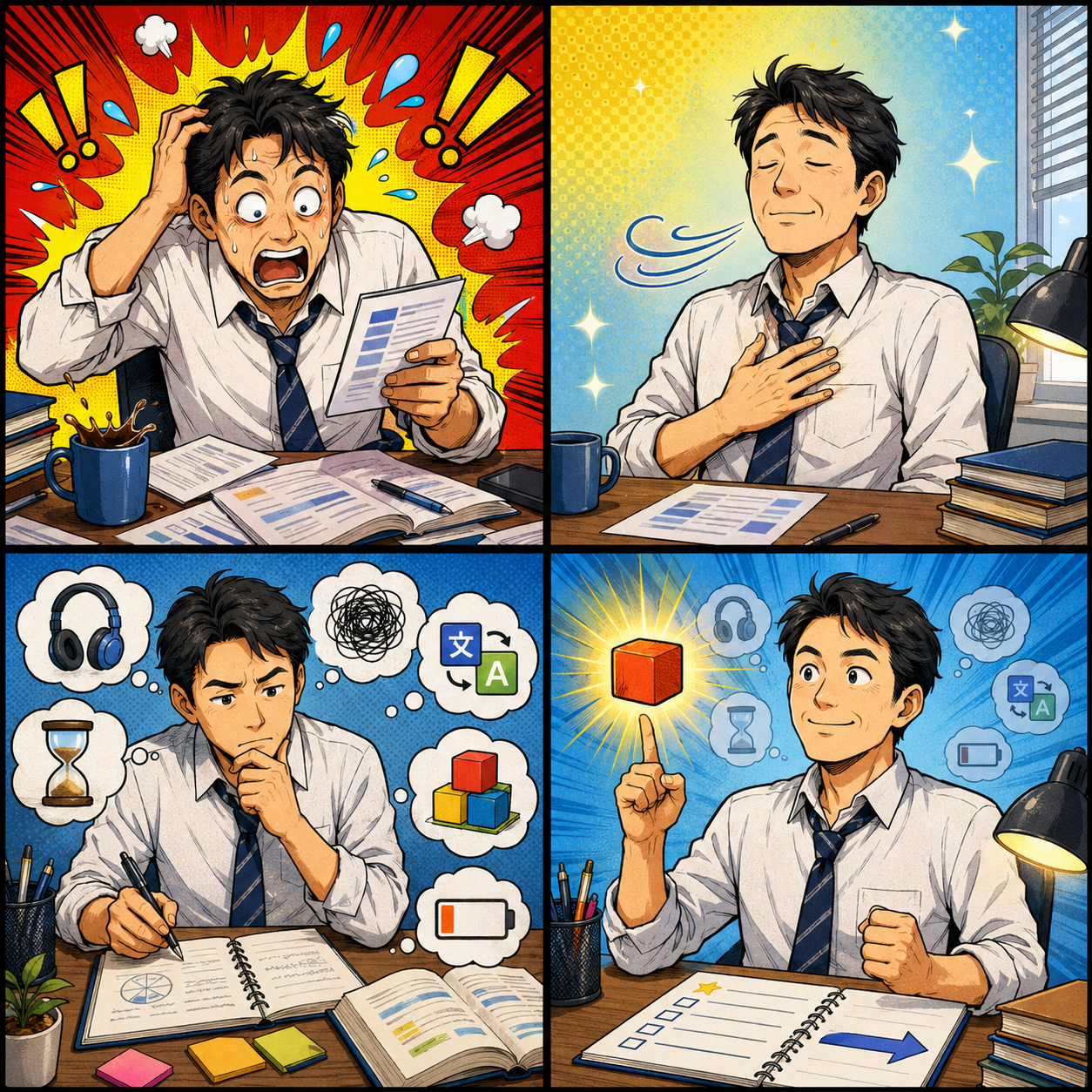
Bad TOEIC Result? What to Do Before You Panic
A bad TOEIC result does not mean you are lazy or incapable. Before you panic, use the score as information and look for the test behaviour that broke down.
A bad TOEIC result can hit hard. You open the result, look at the score, and immediately feel your stomach drop. Perhaps you studied harder this time, changed textbooks, used an app, watched videos, or forced yourself through long practice sessions after work. Yet the score did not move. Or worse, it went down.
Before you panic, stop for a moment. A disappointing result is painful, but it is not proof that you are bad at English. It is not proof that you are lazy, too old, too busy, or not talented enough. A score is data. It is not your identity.
The problem is that many test-takers react to a bad score emotionally before they review it clearly. They blame themselves, buy another book, change their whole study plan, or decide they need to “study harder” without knowing what actually went wrong. That reaction is understandable, but it is not very useful.
The first job after a bad result is not panic. It is diagnosis.
Do Not Make a New Study Plan Immediately
The day you receive a disappointing result is usually not the best day to redesign your whole TOEIC plan. Your judgement is probably noisy. You may feel embarrassed, angry, tired, or desperate to fix the problem quickly. That emotional pressure can push you toward random decisions: another textbook, another app, another test date, another promise to study every night.
This is how many test-takers create a bad loop. They get a disappointing score, react emotionally, start a new plan too quickly, repeat the same hidden mistake, and then feel even worse next time.
Instead, give yourself one simple rule: do not change the plan until you understand the problem. That does not mean doing nothing. It means reviewing calmly before taking action.
First, Separate the Feeling from the Facts
It is completely normal to feel disappointed, and you do not need to pretend the result does not matter. However, processing your emotions and analysing the result are two different tasks. To separate the feeling from the facts, start by writing two short lists.
First, write what you feel:
I am disappointed.
I am frustrated.
I feel embarrassed.
I expected more.
I am worried about my deadline.
Then write what you actually know:
My score did not improve.
Listening felt difficult.
Reading felt rushed.
I guessed many questions at the end.
I lost focus in the second half.
I understood some answers during review, but not during the test.
The first list is emotional truth. The second list is useful data. Both are real, but only the second list can help you improve your next study cycle.
Ask: What Broke During the Test?
A bad TOEIC result is rarely caused by only one problem. Usually, however, one or two behaviours caused the most damage. The useful question is not “Why am I bad at TOEIC?” The useful question is “What broke during the test?”
If you heard many words but missed the answer, that may suggest a Passive Listener problem. You were exposed to English, but you were not listening with clear targets such as speaker, place, purpose, problem, or next action.
If you understood the question but spent too long choosing, that may suggest an Over Thinker problem. You had knowledge, but your decision process was too slow or uncertain under pressure.
If you translated too much in your head, that may suggest a Translator problem. You may understand English during relaxed review, but the test requires faster meaning recognition.
If you rushed and made careless mistakes, that may suggest a Speed Trap problem. You tried to go faster, but speed without control damaged accuracy.
If you remembered vocabulary but still chose the wrong answer, that may suggest a Memoriser problem. You knew words or rules, but could not use them flexibly in context.
If you felt tired, flat, or mentally finished before the test ended, that may suggest a Burnout problem. Your study system may be creating fatigue instead of performance.
This is why one score does not tell the whole story. The score tells you that something happened. Your review tells you what happened.
A Bad Score Does Not Always Mean You Need More English
Many TOEIC test-takers assume that a bad result means they simply need more vocabulary, more grammar, or more listening hours. Sometimes that is true. But not always.
At My TOEIC Coach, we treat TOEIC as both a language test and a performance task. English knowledge matters, but so do timing, attention, stamina, review habits, and decision control. A test-taker can know the grammar and still lose points by hesitating. A test-taker can understand the audio during review and still miss the answer during the test. A test-taker can know many words and still fall into traps because they guessed from familiar vocabulary instead of checking evidence.
That is why “more study” is not always the best first answer. Better study begins with better diagnosis.
Review the Result Without Punishing Yourself
Self-criticism feels serious, but it is often useless. Saying “I am terrible at listening” does not tell you what to practise. Saying “I always fail Reading” does not tell you whether the problem is vocabulary, timing, translation, fatigue, or question strategy.
A coach-style review is more precise. Instead of saying, “I am bad at Listening,” say, “In Part 3 and Part 4, I often heard the topic but missed the speaker’s intention.” Instead of saying, “I am too slow,” say, “I spent too much time on uncertain questions and lost control near the end.” Instead of saying, “My vocabulary is weak,” say, “I recognised some words but did not understand how they worked in context.”
Precision matters. A vague problem creates vague study. A clear problem creates useful training.
What to Do in the First 30 Minutes
After a disappointing TOEIC result, do not start with a huge plan. Start with a short debrief. The goal is not to solve everything immediately. The goal is to stop the result becoming emotional fog.
Use these questions:
Which section felt worse: Listening or Reading?
Where did I lose control of time?
Did I guess because I did not know the English, or because I ran out of time?
Did I understand more during review than during the test?
Did I feel calm, rushed, tired, or mentally noisy?
What mistake have I made before?
Which learning block does this result suggest?
This should take about 30 minutes. It gives you a first map of the problem before you rush into another study plan.
Then Choose One Block to Work On
The biggest mistake after a bad score is trying to fix everything at once. That usually creates more stress and less consistency. Choose one main block for the next study cycle.
If you are a Passive Listener, practise listening with specific targets. If you are an Over Thinker, practise faster decision rules. If you are a Translator, practise direct meaning recognition. If you are caught in the Speed Trap, practise controlled speed, not rushing. If you are a Memoriser, improve your error review. If you are in Burnout, reduce noise and rebuild a realistic routine.
This is not a complete TOEIC plan. It is the starting point for a better one.
The Score Is Feedback, Not a Final Judgement
A disappointing TOEIC result can feel final, but it is not. It is feedback from one test on one day, under one set of conditions. It shows you something about your current study system and test behaviour. It does not define your future ability.
The important question is what you do next. You can panic, blame yourself, and repeat the same loop. Or you can treat the result as information.
At My TOEIC Coach, we do not start by asking test-takers to study harder. We start by asking what the result is trying to show.
Before you buy another book, change your whole plan, or blame yourself for the score, take the TOEIC Learning Block Diagnostic and find out which block may be behind the result.

The Six TOEIC Learning Blocks: Why Your Score Is Not Moving
If your TOEIC score is stuck, the problem may not be effort. It may be one of six learning blocks affecting how you listen, read, review, and make decisions under time pressure.
You are studying, doing practice questions, watching videos, using apps, reading explanations, and maybe buying another book because the last one did not fix the problem. Yet your TOEIC score is still not moving.
That is frustrating, but it does not automatically mean you are lazy. It does not mean you are bad at English. It does not mean you are not intelligent. Often, the real problem is more specific: one learning block may be controlling your test behaviour.
At My TOEIC Coach, we look at TOEIC as a decision-making test under time pressure. English knowledge matters, of course. But during the test, your score is also shaped by how you listen, how quickly you choose, how you handle uncertainty, how you review mistakes, and how much energy you have left near the end.
That is why “study harder” is often weak advice. If the wrong behaviour is repeated for another month, more effort may simply make the wrong habit stronger. A better first question is: what is blocking your score?
There are six common TOEIC learning blocks.
1. The Passive Listener
The Passive Listener hears English, but does not listen with a clear target. This test-taker may spend many hours listening to podcasts, YouTube, dramas, shadowing, or TOEIC audio. But during the test, the sound still feels fast, blurry, or difficult to hold in memory.
The problem is not always the ears. Often, the problem is listening without a job. In TOEIC Listening, you are not listening just to enjoy the sound. You are listening for information: who is speaking, where they are, what the problem is, what will probably happen next, or why the speaker says something.
Passive listening feels like this: “I understood some words, but I missed the answer.” Active listening feels like this: “I know what kind of information I am waiting for.”
A Passive Listener needs more than exposure. They need listening targets. Instead of trying to catch every word, they should practise noticing purpose, situation, speaker relationship, problem, and next action. The goal is not perfect hearing. The goal is useful listening.
2. The Over Thinker
The Over Thinker often knows more English than their score suggests. This test-taker studies grammar carefully, checks explanations, wants to be accurate, and does not like guessing. That can be positive, but TOEIC does not give unlimited time.
In the test, the Over Thinker gets trapped between choices. They reread too much, second-guess correct answers, and spend too long trying to prove every detail. The result is painful: they may answer difficult questions correctly, then lose easier points later because they run out of time.
In our coaching work, this pattern often appears around grammar and longer reading tasks, such as Part 5 and Part 7. It can also affect Listening. The test-taker hears the clue, doubts it, keeps thinking, and then misses the next sentence.
The Over Thinker needs decision rules. For example: what grammar point is being tested? Is this a vocabulary question or a structure question? Is there direct evidence in the text? Am I solving the question, or just trying to feel certain?
TOEIC rewards good judgement under pressure. It does not reward endless checking.
3. The Translator
The Translator tries to turn too much English into Japanese before deciding. Translation can be useful during study. It can help with vocabulary, grammar, and meaning. The problem begins when translation becomes the only way to process English.
TOEIC is too fast for full translation. In Listening, the Translator may still be converting the first sentence while the second sentence is already moving. In Reading, they may understand each sentence slowly, but lose time across the whole section.
This creates a strange feeling. The test-taker may think, “When I review later, I understand it. Why couldn’t I answer during the test?”
The answer is often the speed of language processing under test conditions. Understanding a sentence during a relaxed review is different from recognising its meaning quickly during the test.
The Translator needs to build direct meaning recognition. That means training the eyes and ears to recognise common patterns without converting everything first: appointment changes, delivery problems, staff meetings, customer complaints, schedule conflicts, requests and responses, cause and result.
The aim is not to ban Japanese from study. The aim is to stop Japanese from becoming a bottleneck during the test.
4. The Speed Trap
The Speed Trap test-taker knows they are too slow, so they try to go faster. This sounds logical, but speed without control creates new mistakes.
The test-taker rushes, misses key words, chooses answers too early, or stops checking evidence. They may finish more questions, but accuracy falls. Then they slow down again, lose confidence, and the cycle repeats.
The Speed Trap is not only a reading problem. In Listening, some test-takers panic when they miss one phrase. They mentally chase the missed phrase and lose the next clue. In Reading, they skim without a purpose and then have to reread anyway.
The real skill is not simply speed. It is controlled speed. Controlled speed means knowing where to slow down and where to move quickly. Move quickly through easy grammar questions. Slow down when answer choices are very similar. Skim for structure before hunting for details. Do not reread a whole paragraph if only one sentence contains the evidence.
Fast test-takers are not fast because they rush. They are fast because they waste less motion.
5. The Memoriser
The Memoriser works hard. They collect vocabulary, review answer explanations, repeat questions, and remember many words, phrases, and grammar rules. But their score does not move enough.
Why?
Because TOEIC rarely rewards memory alone. The test checks whether you can use English in context. A memorised word is useful only if you recognise how it works in a sentence, a conversation, a notice, an email, or an answer choice.
The Memoriser often reviews the correct answer, but not the reason they missed it. That means they may remember the answer to one question without improving the behaviour that caused the mistake.
A stronger review question is: “Why did I choose the wrong answer?”
Possible answers include: I translated too slowly. I ignored the grammar role. I guessed from a familiar word. I missed the speaker’s intention. I did not check the evidence. I was tired and rushed. I understood later, but not under time pressure.
Memorisation is not bad. But memorisation without diagnosis is weak preparation.
6. The Burnout Learner
The Burnout Learner may look unmotivated from the outside, but often they are not lazy. They are tired.
They have studied for months. They have taken the test several times. They have watched their score move slowly, stop, or even drop. They may feel embarrassed, bored, or quietly angry with themselves.
Burnout changes test behaviour. A tired test-taker reads less carefully, avoids review, and chooses easier study tasks because real practice feels uncomfortable. They may buy another book because starting something new feels better than facing the same mistake again.
Burnout also damages confidence. The learner begins to think, “Maybe I just can’t do this.” That belief is dangerous because it turns a temporary study problem into an identity problem.
A TOEIC score is data. It is not your identity.
The Burnout Learner needs a smaller, cleaner system. Not more pressure. Not another vague promise to study every day. They need realistic practice, useful review, and visible progress. Sometimes the best TOEIC plan begins by reducing noise.
Why the Block Matters
Two test-takers can have the same score but completely different problems. One may need listening targets. Another may need faster grammar decisions. Another may need to stop translating everything. Another may need better review. Another may need rest and a more realistic study rhythm.
This is why copying someone else’s study plan often fails. Their problem may not be your problem.
Before choosing another app, book, course, or study schedule, it is worth asking a more useful question: which block is controlling my TOEIC behaviour?
Once you know the block, the solution becomes clearer. You do not need to fix everything at once. You need to find the behaviour that is costing you the most points, then train that behaviour with focus.
A Better Way to Read Your Score
A stuck score is not just a bad result. It is information.
It may be telling you that your listening practice is too passive, your grammar knowledge is not becoming fast decisions, translation is slowing your processing, your reading speed is uncontrolled, your review is too focused on answers instead of causes, or your study system is creating fatigue instead of progress.
That is not failure. That is diagnosis.
And diagnosis is the beginning of coaching.
At My TOEIC Coach, we do not start by assuming you need more pressure. We start by looking for the block. Once the block is visible, your study can become more specific, more efficient, and less frustrating.
Before you study harder, take the TOEIC Learning Block Diagnostic and find out which block is really holding your score back.