

What Can Go Wrong in a TOEIC Test Room? Weird Distractions Serious Test-Takers Should Prepare For
A TOEIC test room is not a perfect laboratory. Phones, coughing, temperature, noise, nerves, and tiny distractions can affect your performance. Here is how serious test-takers can prepare without panicking.
A TOEIC test room should be quiet, organised, and predictable. In reality, it is still a room full of human beings, chairs, bags, pencils, phones, air conditioners, nervous energy, and small distractions that arrive at exactly the wrong moment.
That does not mean test day is chaos. Most TOEIC tests run normally. But serious test-takers should prepare for imperfect conditions because the real test does not happen inside a perfect study app. It happens in a physical room, under time pressure, with other people nearby.
This matters because TOEIC is not only an English test. It is also a concentration test, a recovery test, and a decision-making test. Your score can be affected not only by what you know, but by how well you handle the unexpected.
The Test Room Is Not a Perfect Laboratory
At home, you can choose your desk, your chair, your temperature, your headphones, your light, and your break time. In the test room, you cannot control most of those things.
The room may be hotter than you like. It may be colder than expected. The desk may wobble slightly. The chair may not feel comfortable. The sound may seem a little low. Someone outside the building may be making noise. Someone inside the room may cough, sniff, sigh, tap, erase, shift papers, or move their chair at the worst possible time.
None of these things is usually the main problem by itself. The real problem is how the test-taker reacts. One small distraction can become much larger if the test-taker begins thinking, “This is unfair. I can’t concentrate. My score is ruined.”
That reaction is especially dangerous for Over Thinkers. The distraction may last three seconds, but the internal commentary can last three minutes.
The Phone That Should Have Been Off
One of the most serious test-room problems is also one of the most preventable: a phone alarm or ringtone.
Under official Japanese TOEIC L&R rules, a person whose alarm or ringtone sounds during the test is required to leave the test room immediately. This is not a minor inconvenience or an amusing mistake. It is a serious test-day failure.
The practical advice is simple: do not merely silence your phone. Turn it off properly. Check alarms. Check backup alarms. Check calendar alerts. Check smartwatches. Check anything that thinks it is helpful enough to make noise at the worst possible moment.
For serious test-takers, this is part of preparation. Test-day performance begins before the first listening question. It begins with removing preventable risk.
The deeper lesson is control. You cannot control every person in the room, but you can control your own devices, clothing, route, timing, materials, and routine.
The Human Soundtrack
Every test room has a human soundtrack. Coughing, throat-clearing, pencil tapping, pages turning, erasers rubbing, chairs shifting, bags rustling, and repeated small movements can all become more noticeable during a high-pressure test.
During normal life, these sounds may not matter. During TOEIC Listening, they can feel much larger. When you are trying to catch a key phrase, even a small noise can feel personal.
This is where Passive Listeners and Over Thinkers can struggle for different reasons. A Passive Listener may lose the speaker’s purpose as soon as the sound environment changes. An Over Thinker may become angry at the distraction and continue thinking about it after the sound has already passed.
The answer is not to hope for a perfect room. The answer is to train controlled attention. During practice, occasionally listen through low-level background noise. Do not make the noise extreme. The goal is not suffering. The goal is learning to stay with the speaker even when the room is not perfect.
The Temperature Problem
Temperature sounds like a small issue until you are 40 minutes into the test and your body has become either too warm to focus or too cold to relax.
A room that is too hot can make you sleepy. A room that is too cold can make your body tense. Strong air conditioning can become distracting. A sunny window seat can make the room feel different from the seat across the aisle.
The solution is not complicated, but many test-takers ignore it: dress in layers. Choose clothing that lets you adjust without drawing attention to yourself. Avoid anything too tight, too hot, too cold, or too distracting.
This is not fashion advice. It is performance advice. Physical discomfort uses attention. The more attention your body needs, the less attention you have for Listening and Reading.
For Burnout test-takers, this matters even more. If you arrive already tired, hungry, rushed, or physically uncomfortable, your tolerance for small problems becomes lower. A serious test-taker protects energy before the test begins.
The Wobbly Desk and the Tiny Irritation Problem
A wobbly desk is not a disaster. A wobbly desk that you think about for two hours can become one.
The same is true of a squeaky chair, a strange seat angle, a slightly awkward writing surface, or a person beside you who moves more than you would prefer. These are tiny irritations. The danger is not the irritation itself. The danger is mental fixation.
The Over Thinker may keep returning to the irritation. The Speed Trap test-taker may respond by rushing, trying to finish before the irritation gets worse. The Burnout test-taker may experience it as one more sign that the day is going poorly.
A stronger response is to execute a clear mental reset rule: notice the irritation, adjust your physical position once if possible, and immediately return to the task. Do not spend critical cognitive energy negotiating with the furniture in your head; the desk is not taking the test, you are.
Listening When Something Goes Wrong
TOEIC Listening is unforgiving because the audio does not wait for your emotional recovery. If a distraction happens during one question, the next question still arrives.
This is why listening recovery is a skill. You need a rule for the moment something goes wrong. The rule itself is straightforward: choose, release, and reset. Select the best option available, release the missed moment completely, and re-anchor your attention on the next speaker.
This does not feel natural at first, as most test-takers instinctively try to replay the missed sentence in their minds. However, the real test does not allow that. If you keep chasing the lost answer, you may lose the next one as well.
A serious Listening plan includes recovery practice. During timed practice, do not pause the audio after a mistake. Force yourself to continue. This is not carelessness; it is disciplined test behaviour.
Reading When the Room Becomes Annoying
In Reading, distractions work differently. There is no audio to miss, but irritation can quietly damage timing.
A cough, a chair, a clock, or a cold room may make you reread the same sentence. Then you reread it again because you are annoyed that you had to reread it. Then you check the answer twice because you no longer trust your focus. Suddenly, a small disturbance has taken a full minute.
This is especially dangerous in Part 7. Reading needs rhythm. Once the rhythm breaks, some test-takers slow down too much or start reading every sentence as if danger is hidden inside it.
The answer is not to pretend you are unaffected. The answer is to return to evidence. Ask: What is the question asking? Where is the evidence? Which answer matches it? This brings your attention back to the task instead of the room.
Reading survival is not about being immune to distraction. It is about returning quickly.
The Serious Test-Taker’s Survival Kit
A good test-day survival kit is not complicated. It is mostly about removing avoidable problems.
Prepare your ID and required materials early. Check your route. Arrive with enough time. Turn your phone completely off. Wear adjustable clothing. Bring acceptable writing materials. Eat normally. Do not experiment with strange food, too much coffee, or heroic last-minute study.
Before the test, decide your reset rule. If something happens in Listening, choose, release, reset. If something happens in Reading, return to question, evidence, answer. If the room is uncomfortable, adjust once if possible, then continue.
This kind of preparation may sound boring, but boring is useful on test day. You want fewer decisions, fewer surprises, and fewer emotional reactions.
The best test-takers are not people who demand perfect conditions. They are people who keep functioning when conditions are slightly imperfect.
Practise Imperfect Conditions Carefully
You do not need to make practice miserable. Do not blast noise, freeze yourself, or study in a situation that makes concentration impossible. That is not training. That is punishment.
But occasionally, practise in less-than-perfect conditions. Try Listening once through speakers instead of headphones. Do a short Reading set in a café or a shared space. Practise after work when you are not completely fresh. Sit at a normal desk instead of your ideal study setup.
The purpose is to build flexibility. If you only practise in perfect silence with perfect comfort, test day may feel more fragile than it needs to.
This is especially useful for Over Thinkers. They often want ideal conditions because ideal conditions feel safe. But TOEIC performance needs adaptable focus. The goal is not perfect calm. The goal is controlled performance.
After the Test, Debrief the Distractions
After the test, do a short debrief before the details disappear. Do not only ask, “Was the test hard?” Ask what happened around you and how you responded.
Did a sound distract you? Did you recover quickly? Did the room temperature affect your energy? Did someone nearby interrupt your focus? Did you lose one question or several because of your reaction? Did Reading slow down because you became irritated?
This review matters because distractions reveal learning blocks. A Passive Listener may lose meaning when sound conditions change. An Over Thinker may mentally argue with the situation. A Speed Trap test-taker may rush after being interrupted. A Burnout test-taker may have less emotional tolerance for small problems.
The distraction is not always the main issue. Your reaction to the distraction is often the real diagnostic clue.
Final Thought
Something can always go wrong in a TOEIC test room. A phone can ring. A chair can squeak. Someone can cough at exactly the wrong moment. The air conditioning can become your unexpected enemy. The desk can wobble just enough to steal attention.
You cannot control all of that. You can control your preparation, your reset rule, your recovery, and your ability to return to the task.
That is why test-day readiness is not only about English knowledge. It is about behaviour under imperfect conditions.
The TOEIC Learning Block Diagnostic can help you understand how you are likely to react when the test does not go perfectly. Once you know whether your main block is passive listening, overthinking, translation, speed, memorisation, or burnout, you can prepare not only for the questions, but for the room itself.

TOEIC Test Date Coming Soon? How to Build a 30-Day Plan
When your TOEIC test date is coming soon, the answer is not panic studying. A strong 30-day plan should diagnose your weak behaviour, organise review, protect energy, and train timing before test day.
A TOEIC test date can help or hurt your study. For some test-takers, the date creates useful pressure. It gives the month a clear shape and makes study feel more concrete. For others, the date creates panic. They start adding more books, more apps, more mock tests, and more late-night study sessions without asking whether any of it is solving the real problem.
A 30-day plan should not be a punishment programme. It should be a decision system. You are not trying to become a completely different English user in one month; rather, you are trying to improve the specific test behaviours that are most likely to affect your next score. This means your preparation must begin with diagnosis rather than panic.
A Test Date Should Create Structure, Not Fear
When the test is far away, study can become vague. When the test is close, study can become emotional. Neither is ideal.
A useful test date sits between those two problems. It creates a real deadline, but it should also force better choices. You cannot study everything in 30 days. You cannot repair every weakness. You cannot become completely flawless across listening, reading, grammar, vocabulary, timing, stamina, and execution control all at once. That is not a failure; it is simply planning reality.
The essential question is never how to fix everything simultaneously, but rather identifying which specific behaviours are costing you the most points right now. This is where many test-takers make their first mistake. They build a plan around topics instead of behaviour. They decide to “do vocabulary”, “study grammar”, or “take mock tests”. Those tasks may help, but only if they connect to the real cause of lost points.
Start With a Diagnostic Reset
Before you build the 30-day plan, take one short diagnostic reset. This does not need to be a full mock test. In fact, for many busy adults, a full mock test at the beginning can create more stress than clarity.
A diagnostic reset can be simple. Choose one short Listening set, one short Reading set, and one Part 5 or Part 6 grammar set. Time them honestly. Do not pause the audio. Do not give yourself extra time. Do not check the answers halfway through.
After the practice, classify your answers using a simple review matrix:
correct and confident
correct but unsure
wrong but understandable
wrong and confused
This gives you better information than right or wrong alone. Correct but unsure answers show risk. Wrong but understandable answers show trainable mistakes. Wrong and confused answers show places where you may need clearer input before more timed practice.
The diagnostic reset should answer one question: what kind of problem am I dealing with? If you are slow but accurate, the issue may be overthinking or translation. If you understand explanations but miss similar questions later, the issue may be transfer. If Listening collapses after one missed answer, the issue may be recovery. If Reading weakens near the end, the issue may be stamina.
Choose the Main Behaviour
The first part of your 30-day plan should focus on choosing the main behaviour to train. This is where My TOEIC Coach’s learning blocks become useful.
A Passive Listener may need to stop simply hearing English and start listening for purpose, relationship, problem, and next action. A Translator may need to reduce Japanese processing during timed tasks. An Over Thinker may need to simplify decision rules and stop checking every answer repeatedly. A Speed Trap test-taker may need to slow down enough to use evidence instead of jumping at early answers. A Memoriser may need transfer practice instead of more stored explanations. A Burnout test-taker may need a plan that protects energy instead of relying on pressure.
Do not choose five main behaviours. Choose one or two. A 30-day plan becomes weak when it tries to fix everything.
For example, a practical main focus could be: “I will reduce overthinking in Part 5 and protect time for Part 7.” Another could be: “I will train Listening recovery after missed answers.” Another could be: “I will stop translating every Reading sentence and practise direct meaning recognition.”
The more specific the behaviour, the more useful the month becomes.
Build Review Cycles
The middle of the month should not be filled with random practice. It should be organised around review cycles.
A review cycle has three parts: practise, classify, adjust. First, you do a focused TOEIC task. Then you classify the result. Finally, you decide what the next session should train.
This sounds simple, but many test-takers skip the third step. They practise, check the answers, feel good or bad, and then move to the next set. That is not review. That is answer checking.
A useful review asks why the answer happened. Did you miss the vocabulary? Did you misread the question? Did you lose time? Did you choose a familiar word instead of evidence? Did you understand the explanation but fail under pressure? Did fatigue change your judgement?
In a 30-day plan, every practice session should create one small adjustment. That may mean changing your Part 5 order, setting a time limit for Part 7 passages, reviewing paraphrase patterns, practising one-listen recovery, or reducing the number of tasks in a session so that the review becomes sharper.
Add Timing Without Creating Panic
Timing must be trained before test day, but timing practice is often done badly. Some test-takers suddenly force everything under strict time pressure and then become discouraged when their accuracy drops. Others avoid timing completely because it feels uncomfortable. Neither extreme approach is operationally sound.
Timing parameters should be introduced gradually. Start with controlled micro-pressure: a short Part 5 set with a realistic time window, a single Part 7 passage with a clear cutoff, or a Listening set without pausing. The objective is not to induce panic. The objective is to make timed decision-making feel normal.
This calibration is vital for Over Thinkers. These test-takers frequently possess more English knowledge than their score shows, but they leak points because they hesitate over low-value decisions, re-translate prompts, recheck answer choices, and chase an illusion of absolute certainty.
For Speed Trap test-takers, the problem is different. They may move too quickly, react to familiar words, and choose before checking evidence. Their timing practice should not encourage more speed. It should train controlled speed: fast enough to finish, but disciplined enough to confirm the answer.
TOEIC does not reward panic, hesitation, or careless speed. It rewards controlled decisions under time pressure.
Protect Energy and Recovery
The final part of the month should protect energy. Many test-takers do the opposite. They study harder and harder as the test approaches, then arrive on test day tired, tense, and overloaded.
This is a Burnout pattern. It feels responsible, but it often damages performance.
A better final stage reduces noise. Keep the tasks familiar. Review known weak patterns. Practise timing, but do not create panic. Do not start three new books. Do not rebuild your entire method in the final week. Do not take mock test after mock test if you are no longer learning from them.
Recovery is part of preparation. Sleep, light review, and calm confidence from completed practice cycles are not luxuries. They are part of test readiness.
For adult test-takers with work, family, and limited study time, this matters even more. A good TOEIC plan must fit real life. A beautiful study calendar that collapses after four days is not a plan. It is decoration.
Use a Simple 30-Day Shape
A practical 30-day TOEIC plan can be built like this.
First, diagnose. Use short timed sets and the review matrix to identify the main behaviour that is costing points.
Next, stabilise. Spend several sessions training that behaviour with focused practice. Keep the review narrow and useful.
Then, add pressure. Use timed sets, no-pause Listening, and controlled Reading practice to make performance more realistic.
Finally, reduce noise. Review known patterns, protect energy, and avoid adding new systems too close to the test.
This structure is more useful than simply saying, “Study every day.” Daily study can help, but only if the tasks are chosen well. A tired 90-minute session full of vague practice may be less valuable than a focused 25-minute session with one clear review point.
Stop Adding Noise Before the Test
A 30-day plan is not only about what to add. It is also about what to stop.
Stop buying new materials every time you feel anxious. Stop taking mock tests without reviewing them properly. Stop treating every wrong answer as a disaster. Stop translating everything during timed practice if translation is what slows you down. Stop using easy review as proof that the skill is ready for the real test.
Also stop judging the whole month by one bad session. Some days will be messy. That does not mean the plan has failed. It means you need to look at the behaviour, adjust the next session, and continue.
A good plan should reduce emotional noise. If your plan makes you feel constantly behind, constantly guilty, and constantly unsure what to do next, it is probably too large or too vague.
Before You Start the Month
Before you begin your 30-day TOEIC plan, ask three questions.
What behaviour is most likely holding my score down?
What kind of practice trains that behaviour?
How will I review my answers so the next session becomes smarter?
These questions matter more than a perfect calendar. The calendar tells you when to study. Diagnosis tells you what to study. Review tells you whether the study is working.
The TOEIC Learning Block Diagnostic is designed to help you identify the behaviour behind your score. If your test date is coming soon, do not start by panicking. Start by finding the block. Once you know whether the issue is passive listening, overthinking, translation, speed, memorisation, or burnout, your 30-day plan becomes clearer and more useful.

TOEIC Score Descriptors: What Your Result Is Really Telling You
A TOEIC score can feel like success or failure, but your result contains useful diagnostic information. Score descriptors and abilities measured can help you understand what is really happening in your test performance.
A TOEIC result can feel very personal. When the score is higher than expected, it can feel like proof that the study was working. When the score is lower than expected, it can feel like proof that the test-taker has failed.
That emotional reaction is understandable, but it is not always useful. A TOEIC result is not a personality judgement. It is not a measure of intelligence. It is not a final verdict on your English ability. It is a performance result from one test day, under specific time pressure, with specific listening, reading, attention, and decision-making demands.
This is why the score should not be read only as a number. The number matters, but it is not the whole story. The score descriptors and abilities measured can give useful clues about what happened behind the result. They cannot diagnose everything, but they can help you move from an emotional reaction to a practical, clear review.
Your Score Is Data, Not Identity
Many test-takers attach identity to a score. A 500-level test-taker may start thinking, “I am bad at English.” A 700-level test-taker may think, “I should already be better than this.” A test-taker whose score drops may think, “My study was useless.”
These reactions are common, but they are dangerous because they turn data into self-judgement. Once the score becomes identity, review becomes emotionally difficult. The test-taker either avoids looking at the result or studies harder in a vague, anxious way.
A better approach is to treat the score as information. It tells you something about your current performance, but it does not tell you your future limit. More importantly, it does not explain by itself why the result happened. To understand that, you need to read the result more carefully and connect it to your actual test behaviour.
Score Descriptors Are a Starting Point, Not a Full Diagnosis
Score descriptors can help you understand the general level of performance associated with your result. They may describe the kinds of listening or reading tasks a test-taker at that level can usually handle, and the kinds of tasks that may still be difficult.
This information is useful, but it should not be treated as a complete diagnosis. A score descriptor can tell you the broad area of performance. It cannot tell you exactly what happened in your mind during Part 3, why you lost focus in Part 7, or whether your problem was translation, overthinking, timing, memory, passive listening, or fatigue.
That distinction matters. If you read the descriptor too broadly, you may choose the wrong solution. For example, a reading weakness does not always indicate a vocabulary deficit; it may mean you read too slowly, overthink choices under pressure, lose stamina near the end of Part 7, or fail to recognise paraphrased information quickly. The descriptor gives you a starting clue, but a coaching-style review is what turns that raw data into an actionable study decision.
Abilities Measured Can Show Patterns
Abilities Measured can be especially useful because they break performance into smaller skill areas. Instead of only looking at the total score, the test-taker can begin to ask which kinds of tasks were relatively stronger or weaker.
This does not mean every percentage should be overanalysed. One result is not enough to explain everything. However, if the same weakness appears repeatedly across tests or practice reviews, it becomes more useful.
For example, if listening performance is weaker when the speaker’s meaning is indirect, the issue may not be hearing individual words. It may be recognising intention. If reading performance is weaker when information is spread across a longer passage, the issue may not be grammar. It may be stamina, scanning, or connecting details across the text. The value is not in staring at the numbers, but in asking what kind of test behaviour could have created those numbers.
The Over Thinker Block: When the Result Creates Too Much Analysis
Some test-takers respond to a TOEIC result by analysing everything. They compare every section, every practice score, every small change, and every possible mistake. They are trying to be responsible, but the review becomes heavy and confusing.
This is the Over Thinker block. The test-taker does not lack seriousness. The problem is that they turn the result into too many possible explanations at once. They may think the problem is vocabulary, grammar, listening, timing, concentration, anxiety, and luck all at the same time.
The solution is not to ignore the result. The solution is to simplify the review. Start with one question: what is the most repeated performance problem? Did you understand the English but choose slowly? Did you panic after missing one listening sentence? Did you finish Reading with too little time? Did you get correct answers but feel unsure? A TOEIC result becomes more useful when the test-taker reduces the noise and identifies the strongest pattern.
The Burnout Block: When the Result Feels Like a Personal Failure
Other test-takers respond to a TOEIC result with disappointment, shame, or exhaustion. They may have studied hard, used several books, taken practice tests, and sacrificed personal time. When the score does not move, the emotional impact can be serious.
This is often connected to the Burnout block. The test-taker is not lazy. In many cases, they have been pushing too hard with too little feedback. They study because they feel they must, but the study system does not give them visible progress or a clear reason to continue.
For this test-taker, the result must be handled carefully. The first step is not more pressure. The first step is to separate the score from identity. A disappointing score means the current system needs review. It does not mean the test-taker is incapable. The next study plan should be smaller, clearer, and more diagnostic rather than another anxious restart.
Look Beyond Listening Versus Reading
Many test-takers look at their result and immediately compare Listening and Reading. This is useful, but it can also be too simple.
A lower Listening score may come from several different problems. The test-taker may hear words but miss purpose. They may understand the first half but lose focus during longer talks. They may panic after one missed sentence. They may translate too much and fall behind.
A lower Reading score can also have different causes. The test-taker may lack vocabulary, but they may also read too carefully, spend too long on Part 5, lose energy in Part 7, or fail to identify evidence quickly. Two test-takers with similar Reading scores may need very different study plans, which is why a TOEIC result should be connected to test behaviour. The score shows where the problem appeared, but it does not automatically show why it appeared.
Use the Review Matrix After You Read the Result
After checking your score descriptors and abilities measured, review your recent practice with a simple matrix:
correct and confident
correct but unsure
wrong but understandable
wrong and confused
This matrix helps you avoid a common mistake: treating correct answers as safe and wrong answers as the only problem. In TOEIC, a correct answer can still be a warning sign if it was slow, guessed, or based on weak evidence.
Correct and confident answers show stable skill. Correct but unsure answers show possible risk. Wrong but understandable answers show trainable mistakes. Wrong and confused answers show areas where the test-taker may need clearer input before more timed practice. When this review is combined with the official result information, the study plan becomes more precise because you are no longer only asking, “How can I raise my score?” You are asking, “Which behaviour is most likely holding the score down?”
Turn the Result Into a Study Decision
A TOEIC result should lead to a study decision, not just an emotional reaction. That decision does not need to be complicated.
If the result suggests weak listening detail, choose listening tasks that train purpose, speaker intention, and key information. If the result suggests reading weakness, review whether the problem is vocabulary, timing, stamina, or evidence selection. If the result shows a large gap between practice performance and test-day performance, consider pressure, fatigue, and decision quality.
The important point is to avoid vague conclusions. “My listening is bad” is not a useful diagnosis. “I lose the answer when the speaker changes direction” is more useful. “My reading is slow” is better than “I am bad at Reading”, but “I spend too long confirming answers in Part 5 and lose time for Part 7” is better again. The more specific the behaviour, the easier it becomes to train.
Do Not Let One Result Control the Whole Story
One TOEIC result matters, but it should not control the whole story. Test-day condition, sleep, stress, timing, familiarity, and emotional control can all affect performance. This does not mean the score should be ignored. It means the result should be placed inside a larger review process.
Look for patterns across your score report, practice tests, error log, timing notes, and test-day memory. If the same issue surfaces across multiple touchpoints, it deserves immediate tactical attention. If it only occurred once, treat it as an anomaly before rebuilding your entire routine around it. Ultimately, a good review is neither emotional nor mechanical; it is evidence-based, using the score report as a signal without worshipping the raw number.
Before You Choose Your Next Study Plan
Before choosing another book, app, course, or practice test, read your result as a diagnostic clue. Ask what the score descriptors suggest. Check the abilities measured. Then compare that information with what you remember from the test itself.
Did you lose control of time? Did you translate too much? Did you panic in Listening? Did you know the grammar but hesitate? Did you guess correctly too often in practice? Did you lose energy before the final reading passages?
These questions turn the result into a practical plan. They also protect you from blaming yourself too quickly or studying randomly. Your TOEIC result is not just a number. It is a signal. The better you learn to read that signal, the better your next study decision becomes.
The TOEIC Learning Block Diagnostic is designed to help you connect your result with the behaviour behind it. Once you understand whether your main block is overthinking, burnout, passive listening, translation, memorisation, or speed, your score report becomes more than feedback. It becomes the starting point for a smarter study system.

TOEIC Part 5: Why Fast Test-Takers Do Not Translate Everything
Many TOEIC test-takers lose time in Part 5 because they translate too much. Faster answers often come from recognising structure, not reading every sentence slowly.
TOEIC Part 5 looks simple from the outside. There is a sentence, a blank, and four answer choices. Compared with long reading passages or fast listening conversations, Part 5 can easily seem like the section where careful grammar knowledge alone should be enough.
Yet many test-takers lose time here. They read the whole sentence slowly, translate it into Japanese, compare the answer choices, read the sentence again, check the meaning, doubt the answer, and then finally choose. The answer may be correct, but the process is too slow. Over many questions, that lost time becomes expensive.
Fast Part 5 test-takers do not usually translate everything. They read with a job. They look for grammar signals, sentence structure, word function, and the role of the blank. They do not ignore meaning, but they do not treat full translation as the first step for every question.
At My TOEIC Coach, we see Part 5 as a decision-making section. English knowledge matters, but the speed and order of your decisions matter too.
Translation Feels Safe, But It Can Slow the Decision
For many Japanese test-takers, translation feels safe. If you can turn the sentence into Japanese, the meaning becomes clearer and more controlled. During study, this can be useful. It helps you confirm grammar, check vocabulary, and understand why an answer works.
The problem appears during timed performance. If every Part 5 sentence must be translated before you choose, your process becomes heavy. Some questions do need meaning. But many Part 5 questions can be approached first through structure.
For example, the blank may need a noun, adjective, adverb, verb form, preposition, conjunction, or pronoun. If you can identify the role of the blank quickly, you can often eliminate wrong answers before translating the full sentence.
This is not about banning Japanese from study. It is about not letting translation become the only path to an answer. The Translator block often appears when a test-taker understands Part 5 during review but cannot move quickly enough during the test.
Part 5 Is Often About Function
A fast Part 5 test-taker asks a different first question. Instead of asking, “What does this whole sentence mean in Japanese?” they ask, “What job does the blank need to do?” That question changes the process because it turns the sentence into a structure problem before it becomes a full translation problem.
If the blank sits before a noun, perhaps the answer needs to describe the noun. If the blank follows an article or adjective, perhaps a noun is needed. If the answer choices are all from the same word family, the question may be testing part of speech. If the choices are different verb forms, the key may be tense, voice, or grammar relationship.
This does not mean meaning is unimportant. Meaning still matters, especially for vocabulary, prepositions, conjunctions, and context-based choices. But structure often gives you the first cut. It reduces the number of choices before you spend time thinking deeply.
Fast test-takers are not magically reading everything faster. Often, they are asking a better first question.
The Over Thinker Problem in Part 5
The Over Thinker can be strong at grammar but weak at timed decisions. This test-taker may understand the explanation, know the rule, and even teach the logic back later. But during the test, they hesitate.
They check too many possibilities. They reread the sentence even after seeing the clue. They worry that a simple answer might be a trap. They spend extra time trying to feel certain.
This is dangerous because Part 5 can quietly steal time from the rest of Reading. A few slow decisions may not feel serious, but the total cost becomes visible later, especially when Part 7 begins to feel rushed.
The Over Thinker does not need to become careless. They need decision rules. If the answer choices clearly test part of speech, solve the part-of-speech problem first. If the grammar clue is visible, use it. If two choices remain, then check meaning more carefully.
The goal is not speed at any cost. The goal is enough evidence to choose without endless checking.
The Speed Trap Problem in Part 5
Some test-takers make the opposite mistake. They know Part 5 is timed, so they try to go fast. They look at the answer choices, recognise a familiar word, choose quickly, and move on.
That may feel efficient, but it can become the Speed Trap. Part 5 rewards fast decisions only when those decisions are controlled. If you answer quickly without checking the grammar role, sentence structure, or nearby clues, you may simply be guessing faster. Speed without evidence is not strategy.
This is common when answer choices look familiar. A word may seem correct because you have seen it many times before. But the sentence may require a different form, a different function, or a different connection between clauses.
Fast test-takers do not choose quickly because they are rushing. They choose quickly because they know what they are checking.
The Memoriser Problem in Part 5
Memorisation helps Part 5, but it can also create false confidence. A test-taker may remember many vocabulary words, grammar rules, and common expressions, yet still choose the wrong answer when the sentence changes.
This is the Memoriser block. The learner recognises a word or rule but does not apply it flexibly in context.
For example, remembering the Japanese meaning of a word does not tell you whether it is a noun, verb, adjective, or adverb in that sentence. Knowing a grammar rule does not guarantee that you can recognise its clue quickly. Seeing a familiar phrase does not prove it fits the sentence.
Part 5 review should not stop at “I know this now.” A stronger review asks, “What signal did I miss?” Maybe the signal was the noun after the blank, the preposition before it, the verb tense, the subject, or the relationship between two clauses.
The goal is not to collect more explanations. The goal is to recognise usable signals faster.
A Better First Step for Part 5
Before translating the full sentence, look at the answer choices. They often tell you what kind of problem you are facing.
If the choices are different forms of the same word, it may be a word-family or part-of-speech question. If the choices are different verb forms, check subject, tense, voice, and surrounding grammar. If the choices are prepositions, look at the phrase and relationship. If the choices are conjunctions or transition words, check the logic between ideas.
Then look at the blank and the words around it. The sentence often gives local clues. You may not need to understand every word to know that the blank needs an adverb, a noun, or a conjunction.
Only after that should you use broader meaning if needed. This order matters because translation is not removed; it is moved to the correct place in the decision process.
How to Review Part 5 Like a Coach
A weak Part 5 review says, “The answer is B. I understand now.” That is not enough.
A coach-style review asks why the decision failed. Did you miss the grammar role? Did you translate too much? Did you choose a familiar word? Did you ignore the words before and after the blank? Did you overthink a simple structure? Did you rush because you wanted to protect time?
These causes matter because each one needs a different correction. A vocabulary gap needs vocabulary review. A part-of-speech error needs structure training. A slow correct answer needs speed and confidence work. A rushed wrong answer needs controlled checking.
Also review correct-but-unsure answers. If you got the answer right but were not confident, that is useful data. The official score may count it as correct, but your timing and confidence system may still need work.
Part 5 improvement comes from making the cause visible.
A Simple Part 5 Practice Method
Try this method with a short set of Part 5 questions.
Before answering, look at the answer choices and identify the question type. After answering, categorise your performance using the same diagnostic matrix used in stronger TOEIC review: correct and confident, correct but unsure, wrong but understandable, or wrong and confused.
During review, write one short cause note for any question that was wrong, slow, or uncertain. The cause note might say:
I translated before checking structure.
I missed the part of speech.
I chose a familiar word.
I ignored the noun after the blank.
I overchecked a simple grammar clue.
I rushed without evidence.
This takes more time than simply checking the answer, but it gives better information. You are not just practising Part 5. You are training the behaviour that Part 5 requires.
Fast Does Not Mean Careless
Fast Part 5 test-takers are not careless. They are selective.
They know when structure is enough. They know when meaning is needed. They know when a question deserves a little more time and when it should be solved quickly. They do not translate every sentence from start to finish because that is not always the most efficient path to the answer.
If your Part 5 feels slow, the answer may not be “learn more grammar” first. It may be “change the order of your decision process.”
Start with the role of the blank. Use nearby clues. Check the answer choices. Use meaning when needed. Then review the cause of mistakes carefully.
Before you add another grammar book or repeat another set of questions, take the TOEIC Learning Block Diagnostic and find out whether translation, overthinking, speed pressure, or memorisation is affecting your Part 5 performance.
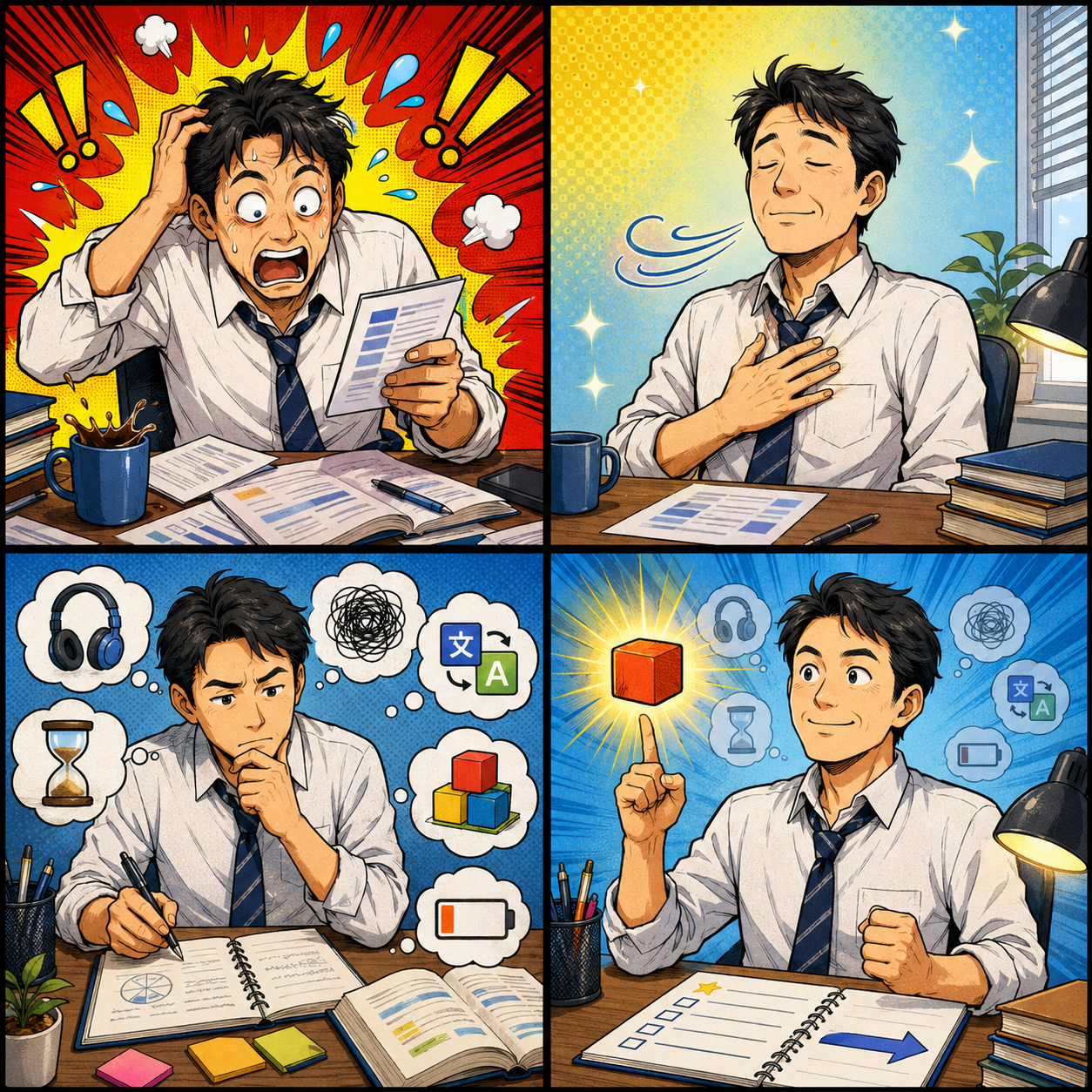
Bad TOEIC Result? What to Do Before You Panic
A bad TOEIC result does not mean you are lazy or incapable. Before you panic, use the score as information and look for the test behaviour that broke down.
A bad TOEIC result can hit hard. You open the result, look at the score, and immediately feel your stomach drop. Perhaps you studied harder this time, changed textbooks, used an app, watched videos, or forced yourself through long practice sessions after work. Yet the score did not move. Or worse, it went down.
Before you panic, stop for a moment. A disappointing result is painful, but it is not proof that you are bad at English. It is not proof that you are lazy, too old, too busy, or not talented enough. A score is data. It is not your identity.
The problem is that many test-takers react to a bad score emotionally before they review it clearly. They blame themselves, buy another book, change their whole study plan, or decide they need to “study harder” without knowing what actually went wrong. That reaction is understandable, but it is not very useful.
The first job after a bad result is not panic. It is diagnosis.
Do Not Make a New Study Plan Immediately
The day you receive a disappointing result is usually not the best day to redesign your whole TOEIC plan. Your judgement is probably noisy. You may feel embarrassed, angry, tired, or desperate to fix the problem quickly. That emotional pressure can push you toward random decisions: another textbook, another app, another test date, another promise to study every night.
This is how many test-takers create a bad loop. They get a disappointing score, react emotionally, start a new plan too quickly, repeat the same hidden mistake, and then feel even worse next time.
Instead, give yourself one simple rule: do not change the plan until you understand the problem. That does not mean doing nothing. It means reviewing calmly before taking action.
First, Separate the Feeling from the Facts
It is completely normal to feel disappointed, and you do not need to pretend the result does not matter. However, processing your emotions and analysing the result are two different tasks. To separate the feeling from the facts, start by writing two short lists.
First, write what you feel:
I am disappointed.
I am frustrated.
I feel embarrassed.
I expected more.
I am worried about my deadline.
Then write what you actually know:
My score did not improve.
Listening felt difficult.
Reading felt rushed.
I guessed many questions at the end.
I lost focus in the second half.
I understood some answers during review, but not during the test.
The first list is emotional truth. The second list is useful data. Both are real, but only the second list can help you improve your next study cycle.
Ask: What Broke During the Test?
A bad TOEIC result is rarely caused by only one problem. Usually, however, one or two behaviours caused the most damage. The useful question is not “Why am I bad at TOEIC?” The useful question is “What broke during the test?”
If you heard many words but missed the answer, that may suggest a Passive Listener problem. You were exposed to English, but you were not listening with clear targets such as speaker, place, purpose, problem, or next action.
If you understood the question but spent too long choosing, that may suggest an Over Thinker problem. You had knowledge, but your decision process was too slow or uncertain under pressure.
If you translated too much in your head, that may suggest a Translator problem. You may understand English during relaxed review, but the test requires faster meaning recognition.
If you rushed and made careless mistakes, that may suggest a Speed Trap problem. You tried to go faster, but speed without control damaged accuracy.
If you remembered vocabulary but still chose the wrong answer, that may suggest a Memoriser problem. You knew words or rules, but could not use them flexibly in context.
If you felt tired, flat, or mentally finished before the test ended, that may suggest a Burnout problem. Your study system may be creating fatigue instead of performance.
This is why one score does not tell the whole story. The score tells you that something happened. Your review tells you what happened.
A Bad Score Does Not Always Mean You Need More English
Many TOEIC test-takers assume that a bad result means they simply need more vocabulary, more grammar, or more listening hours. Sometimes that is true. But not always.
At My TOEIC Coach, we treat TOEIC as both a language test and a performance task. English knowledge matters, but so do timing, attention, stamina, review habits, and decision control. A test-taker can know the grammar and still lose points by hesitating. A test-taker can understand the audio during review and still miss the answer during the test. A test-taker can know many words and still fall into traps because they guessed from familiar vocabulary instead of checking evidence.
That is why “more study” is not always the best first answer. Better study begins with better diagnosis.
Review the Result Without Punishing Yourself
Self-criticism feels serious, but it is often useless. Saying “I am terrible at listening” does not tell you what to practise. Saying “I always fail Reading” does not tell you whether the problem is vocabulary, timing, translation, fatigue, or question strategy.
A coach-style review is more precise. Instead of saying, “I am bad at Listening,” say, “In Part 3 and Part 4, I often heard the topic but missed the speaker’s intention.” Instead of saying, “I am too slow,” say, “I spent too much time on uncertain questions and lost control near the end.” Instead of saying, “My vocabulary is weak,” say, “I recognised some words but did not understand how they worked in context.”
Precision matters. A vague problem creates vague study. A clear problem creates useful training.
What to Do in the First 30 Minutes
After a disappointing TOEIC result, do not start with a huge plan. Start with a short debrief. The goal is not to solve everything immediately. The goal is to stop the result becoming emotional fog.
Use these questions:
Which section felt worse: Listening or Reading?
Where did I lose control of time?
Did I guess because I did not know the English, or because I ran out of time?
Did I understand more during review than during the test?
Did I feel calm, rushed, tired, or mentally noisy?
What mistake have I made before?
Which learning block does this result suggest?
This should take about 30 minutes. It gives you a first map of the problem before you rush into another study plan.
Then Choose One Block to Work On
The biggest mistake after a bad score is trying to fix everything at once. That usually creates more stress and less consistency. Choose one main block for the next study cycle.
If you are a Passive Listener, practise listening with specific targets. If you are an Over Thinker, practise faster decision rules. If you are a Translator, practise direct meaning recognition. If you are caught in the Speed Trap, practise controlled speed, not rushing. If you are a Memoriser, improve your error review. If you are in Burnout, reduce noise and rebuild a realistic routine.
This is not a complete TOEIC plan. It is the starting point for a better one.
The Score Is Feedback, Not a Final Judgement
A disappointing TOEIC result can feel final, but it is not. It is feedback from one test on one day, under one set of conditions. It shows you something about your current study system and test behaviour. It does not define your future ability.
The important question is what you do next. You can panic, blame yourself, and repeat the same loop. Or you can treat the result as information.
At My TOEIC Coach, we do not start by asking test-takers to study harder. We start by asking what the result is trying to show.
Before you buy another book, change your whole plan, or blame yourself for the score, take the TOEIC Learning Block Diagnostic and find out which block may be behind the result.