
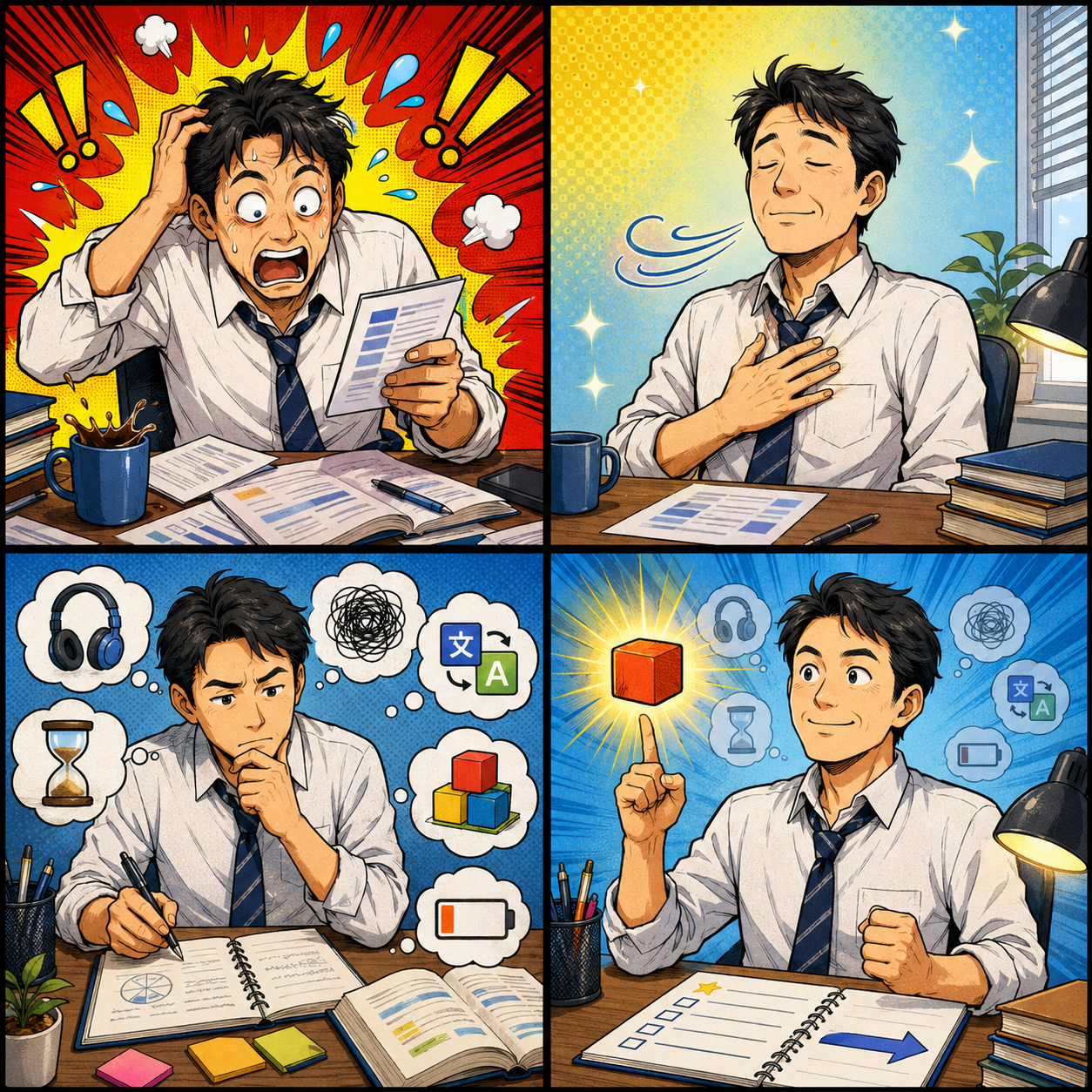
Bad TOEIC Result? What to Do Before You Panic
A bad TOEIC result does not mean you are lazy or incapable. Before you panic, use the score as information and look for the test behaviour that broke down.
A bad TOEIC result can hit hard. You open the result, look at the score, and immediately feel your stomach drop. Perhaps you studied harder this time, changed textbooks, used an app, watched videos, or forced yourself through long practice sessions after work. Yet the score did not move. Or worse, it went down.
Before you panic, stop for a moment. A disappointing result is painful, but it is not proof that you are bad at English. It is not proof that you are lazy, too old, too busy, or not talented enough. A score is data. It is not your identity.
The problem is that many test-takers react to a bad score emotionally before they review it clearly. They blame themselves, buy another book, change their whole study plan, or decide they need to “study harder” without knowing what actually went wrong. That reaction is understandable, but it is not very useful.
The first job after a bad result is not panic. It is diagnosis.
Do Not Make a New Study Plan Immediately
The day you receive a disappointing result is usually not the best day to redesign your whole TOEIC plan. Your judgement is probably noisy. You may feel embarrassed, angry, tired, or desperate to fix the problem quickly. That emotional pressure can push you toward random decisions: another textbook, another app, another test date, another promise to study every night.
This is how many test-takers create a bad loop. They get a disappointing score, react emotionally, start a new plan too quickly, repeat the same hidden mistake, and then feel even worse next time.
Instead, give yourself one simple rule: do not change the plan until you understand the problem. That does not mean doing nothing. It means reviewing calmly before taking action.
First, Separate the Feeling from the Facts
It is completely normal to feel disappointed, and you do not need to pretend the result does not matter. However, processing your emotions and analysing the result are two different tasks. To separate the feeling from the facts, start by writing two short lists.
First, write what you feel:
I am disappointed.
I am frustrated.
I feel embarrassed.
I expected more.
I am worried about my deadline.
Then write what you actually know:
My score did not improve.
Listening felt difficult.
Reading felt rushed.
I guessed many questions at the end.
I lost focus in the second half.
I understood some answers during review, but not during the test.
The first list is emotional truth. The second list is useful data. Both are real, but only the second list can help you improve your next study cycle.
Ask: What Broke During the Test?
A bad TOEIC result is rarely caused by only one problem. Usually, however, one or two behaviours caused the most damage. The useful question is not “Why am I bad at TOEIC?” The useful question is “What broke during the test?”
If you heard many words but missed the answer, that may suggest a Passive Listener problem. You were exposed to English, but you were not listening with clear targets such as speaker, place, purpose, problem, or next action.
If you understood the question but spent too long choosing, that may suggest an Over Thinker problem. You had knowledge, but your decision process was too slow or uncertain under pressure.
If you translated too much in your head, that may suggest a Translator problem. You may understand English during relaxed review, but the test requires faster meaning recognition.
If you rushed and made careless mistakes, that may suggest a Speed Trap problem. You tried to go faster, but speed without control damaged accuracy.
If you remembered vocabulary but still chose the wrong answer, that may suggest a Memoriser problem. You knew words or rules, but could not use them flexibly in context.
If you felt tired, flat, or mentally finished before the test ended, that may suggest a Burnout problem. Your study system may be creating fatigue instead of performance.
This is why one score does not tell the whole story. The score tells you that something happened. Your review tells you what happened.
A Bad Score Does Not Always Mean You Need More English
Many TOEIC test-takers assume that a bad result means they simply need more vocabulary, more grammar, or more listening hours. Sometimes that is true. But not always.
At My TOEIC Coach, we treat TOEIC as both a language test and a performance task. English knowledge matters, but so do timing, attention, stamina, review habits, and decision control. A test-taker can know the grammar and still lose points by hesitating. A test-taker can understand the audio during review and still miss the answer during the test. A test-taker can know many words and still fall into traps because they guessed from familiar vocabulary instead of checking evidence.
That is why “more study” is not always the best first answer. Better study begins with better diagnosis.
Review the Result Without Punishing Yourself
Self-criticism feels serious, but it is often useless. Saying “I am terrible at listening” does not tell you what to practise. Saying “I always fail Reading” does not tell you whether the problem is vocabulary, timing, translation, fatigue, or question strategy.
A coach-style review is more precise. Instead of saying, “I am bad at Listening,” say, “In Part 3 and Part 4, I often heard the topic but missed the speaker’s intention.” Instead of saying, “I am too slow,” say, “I spent too much time on uncertain questions and lost control near the end.” Instead of saying, “My vocabulary is weak,” say, “I recognised some words but did not understand how they worked in context.”
Precision matters. A vague problem creates vague study. A clear problem creates useful training.
What to Do in the First 30 Minutes
After a disappointing TOEIC result, do not start with a huge plan. Start with a short debrief. The goal is not to solve everything immediately. The goal is to stop the result becoming emotional fog.
Use these questions:
Which section felt worse: Listening or Reading?
Where did I lose control of time?
Did I guess because I did not know the English, or because I ran out of time?
Did I understand more during review than during the test?
Did I feel calm, rushed, tired, or mentally noisy?
What mistake have I made before?
Which learning block does this result suggest?
This should take about 30 minutes. It gives you a first map of the problem before you rush into another study plan.
Then Choose One Block to Work On
The biggest mistake after a bad score is trying to fix everything at once. That usually creates more stress and less consistency. Choose one main block for the next study cycle.
If you are a Passive Listener, practise listening with specific targets. If you are an Over Thinker, practise faster decision rules. If you are a Translator, practise direct meaning recognition. If you are caught in the Speed Trap, practise controlled speed, not rushing. If you are a Memoriser, improve your error review. If you are in Burnout, reduce noise and rebuild a realistic routine.
This is not a complete TOEIC plan. It is the starting point for a better one.
The Score Is Feedback, Not a Final Judgement
A disappointing TOEIC result can feel final, but it is not. It is feedback from one test on one day, under one set of conditions. It shows you something about your current study system and test behaviour. It does not define your future ability.
The important question is what you do next. You can panic, blame yourself, and repeat the same loop. Or you can treat the result as information.
At My TOEIC Coach, we do not start by asking test-takers to study harder. We start by asking what the result is trying to show.
Before you buy another book, change your whole plan, or blame yourself for the score, take the TOEIC Learning Block Diagnostic and find out which block may be behind the result.