
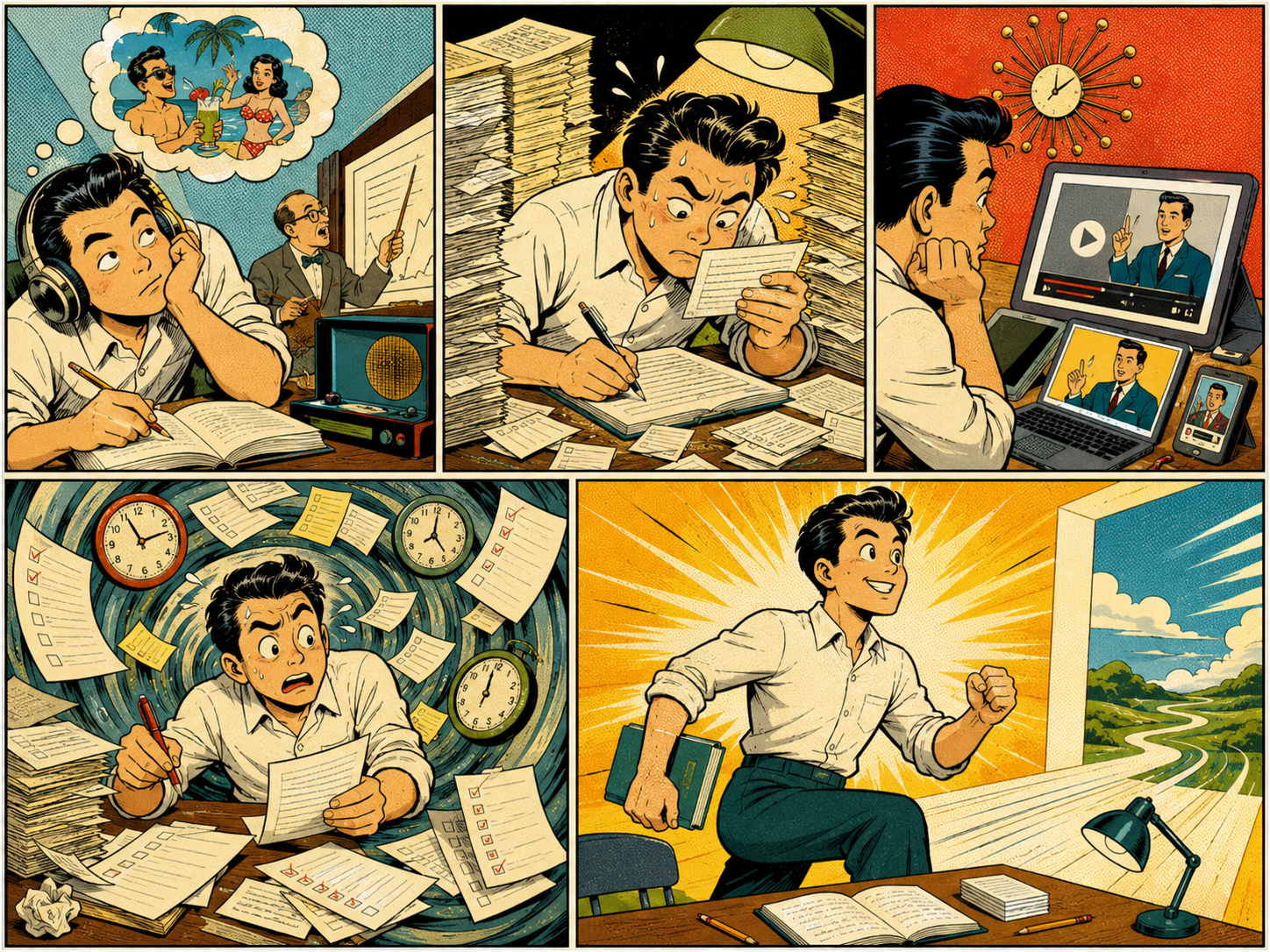
Time-Wasting TOEIC Habits That Quietly Hurt Your Score
Not every TOEIC study habit is useful. Some habits feel responsible, but they do not change listening, reading, timing, or review behaviour. Here is how to spot the habits that quietly waste your study time.
Some TOEIC study habits look responsible from the outside. You sit at the desk. You open the book. You listen to the audio. You copy notes. You review vocabulary. You take another practice test.
The problem is that not all study changes the score.
A habit can feel productive while doing very little to change listening behaviour, reading behaviour, timing behaviour, or review behaviour. This is one reason many adult test-takers become frustrated. They are not doing nothing. They are often doing quite a lot. But the wrong kind of effort keeps the score in the same place.
The issue is not laziness. The issue is poor feedback. If a study habit does not show you what is breaking under TOEIC pressure, it may be using time without producing progress.
Productive Feeling Is Not the Same as Productive Study
A study habit can feel productive because it is familiar, comfortable, or easy to measure. Finishing a page feels productive. Listening for 30 minutes feels productive. Writing vocabulary in a notebook feels productive. Taking a mock test feels productive.
But TOEIC does not reward the feeling of effort. It rewards accurate decisions under time pressure.
This is why MTC treats TOEIC as a decision-making test, not just an English knowledge test. The important question is not only, “Did I study today?” The better question is, “Did today’s study change the behaviour that is costing me points?”
If the answer is no, the habit may need to be adjusted.
Passive Listening That Never Becomes Active
Many test-takers spend hours listening to English without becoming better TOEIC listeners.
They play audio while commuting. They repeat tracks. They listen again and again. This can help with familiarity, but it is not enough if the listener remains passive.
A Passive Listener may hear sounds, recognise some words, and still fail to track the speaker’s purpose. They may understand individual phrases but miss the change in direction. They may feel that the audio is familiar, but still lose the answer when the test asks for intention, implication, or detail.
Better listening practice needs a task. Before the answer choices even appear, ask what the speaker wants, what has changed, or what the listener is expected to do next. After the question, ask where your attention broke. Did you miss the sound? Did you miss the meaning? Did you understand the words but fail to connect them quickly enough? Listening time becomes useful when it creates active attention.
Vocabulary Collection Without Transfer
Vocabulary study is necessary, but vocabulary collection can become a trap.
Many test-takers write long word lists, copy meanings, highlight unknown words, and feel they have worked hard. The notebook grows, but the score does not move much.
This often happens to the Memoriser. The word exists in the notebook, but it does not appear quickly enough inside a live TOEIC question. The test-taker may recognise the word after the test, but not while reading under time pressure or listening at natural speed.
The problem is not vocabulary itself. The problem is lack of transfer.
A better habit is to test words in context. Can you recognise the word quickly inside a sentence? Can you understand how it changes the meaning of the answer choice? Can you hear it without seeing it? Can you use it to eliminate a wrong answer? Can you recognise related forms, such as a noun, verb, adjective, or phrase? A word list is only useful when it returns to the test.
Rereading Explanations Without Testing Yourself
Reading explanations can feel safe because the explanation makes the answer seem obvious. The danger is that understanding an explanation after the question is not the same as recognising the answer during the test.
This is a common problem for Over Thinkers and Memoriser-type test-takers. They read the explanation, agree with it, and move on too quickly. Later, they miss a similar question because the pattern did not become usable.
A stronger review habit is to close the explanation and explain the answer yourself. Why is the correct answer correct? Why are the wrong answers wrong? What clue should you have noticed earlier? What behaviour caused the mistake?
This turns review from passive agreement into active recall. If you cannot explain the answer without looking, you may not have learned it yet. You may have only recognised the explanation.
Mock Tests Without Proper Review
Mock tests are useful, but only if they produce information. Taking test after test without serious review can waste a large amount of time.
A mock test should not only tell you the score. It should show where the score breaks.
Did Listening fall apart after one missed question? Did Reading slow down in Part 7? Did Part 5 mistakes come from grammar, vocabulary, overthinking, or speed? Did fatigue appear halfway through the test? Did you guess because you lacked knowledge, or because your time management collapsed?
Without this review, the mock test becomes an emotional event rather than a diagnostic tool. A good result creates temporary relief. A bad result creates panic. Neither response is enough because the value of a mock test is not the number alone. The value is the pattern behind the number.
Changing Materials Too Often
Changing materials can feel like progress because it gives the test-taker a fresh start. A new book, new app, new course, or new video series can create energy for a few days.
But changing materials too often can hide the real problem.
If the test-taker is translating too much, the new material will not automatically fix that. If the test-taker rushes answer choices, the new app will not automatically create better evidence checking. If the test-taker avoids review, a new book may simply provide more questions to avoid reviewing properly.
The material may change while the behaviour remains the same. This does not mean you should never change materials. Sometimes you should. But the change should be based on diagnosis, not boredom. Ask what the current material cannot provide. Do you need better explanations, more timed practice, more listening variety, or more realistic review? If you cannot answer that, the new material may only be a distraction.
Studying Favourite Sections
Most test-takers have sections they prefer. Some like vocabulary. Some like grammar. Some prefer Listening because it feels faster. Others prefer Reading because it feels more controllable.
The danger is spending too much time on the section that feels comfortable.
If you always study what you like, your weakest behaviour may stay untouched. A Passive Listener may avoid deep listening review. An Over Thinker may avoid timed practice. A Burnout test-taker may avoid anything that exposes how inconsistent the routine has become. A Memoriser may keep returning to word lists because memorising feels clear and measurable.
Useful study is not always comfortable. It should not be miserable, but it should reveal something. A balanced routine includes some maintenance work and some uncomfortable diagnostic work. The maintenance keeps skills alive, while the diagnostic work moves the score.
Copying Notes That Never Change Decisions
Copying notes can look impressive. A notebook full of neat grammar rules, vocabulary, and explanations can feel like evidence of serious study.
But notes do not improve your score unless they change future decisions.
If you write a grammar rule, can you recognise it quickly in a Part 5 question? If you copy a vocabulary item, can you identify it in a listening passage? If you write a mistake explanation, can you avoid the same trap next time?
A useful note should point to action. Instead of only writing the correct answer, write the decision problem. For example: “I chose too quickly because I recognised a familiar word.” Or, “I understood the explanation but did not notice the clue under time pressure.” Or, “I translated too much and lost the sentence structure.” That kind of note is less decorative, but more useful.
Watching Strategy Content Instead of Practising
Strategy content can be useful. A good explanation can save time, clarify a problem, or show a test-taker what to notice.
But watching strategy content can also become avoidance.
It feels easier to watch another video than to do a timed set. It feels easier to read another article than to review 20 mistakes honestly. It feels easier to search for a better method than to face the repeated pattern in your own answers.
The question is whether the strategy becomes action. After watching or reading, what changed in your next practice session? Did you make better decisions? Did you review more clearly? Did you manage time differently? Did you identify your learning block more accurately? If the answer is no, the content may have become entertainment, not training.
Overchecking Low-Value Questions
Some test-takers waste time not because they are careless, but because they are too careful in the wrong places.
The Over Thinker may spend too long checking questions that were already clear enough. They reread, compare, hesitate, and search for perfect certainty. This feels responsible, but it can quietly damage the whole test.
TOEIC rewards good enough evidence under time pressure. That does not mean careless guessing. It means knowing when the evidence is sufficient and moving on.
A better habit is to classify decisions. Some questions need careful checking. Some questions need a fast, confident answer. Some questions are uncertain but must be controlled because time is limited. The Over Thinker needs rigid, predefined decision rules rather than endless checking loops. The objective is not to become reckless; the objective is to stop spending premium exam time on low-value hesitation.
Better Study Starts With Diagnosis
The fastest way to reduce wasted study time is to diagnose the behaviour behind the mistake.
Do not ask only, “What was the correct answer?” Ask what happened. Did you listen passively? Did you translate too much? Did you rush? Did you overthink? Did you memorise without transfer? Did burnout reduce your concentration?
Once you know the behaviour, the study plan becomes clearer.
A Passive Listener needs active listening tasks. A Translator needs direct meaning practice. An Over Thinker needs decision limits. A Speed Trap test-taker needs evidence checking. A Memoriser needs transfer practice. A Burnout test-taker needs a smaller, sustainable routine.
That is much more useful than adding more hours to a weak system.
Final Thought
Time-wasting TOEIC habits are dangerous because they often look like real study.
You may be listening, reading, copying, reviewing, testing, highlighting, and planning. But if those habits do not change the behaviour that is costing you points, they may only create the feeling of progress.
The solution is not to stop working. The solution is to make the work more diagnostic.
The TOEIC Learning Block Diagnostic is designed to help you identify which behaviour is wasting the most study time. Once you know whether your main block is passive listening, overthinking, translation, speed, memorisation, or burnout, you can stop feeding weak habits and start building practice that actually moves your score.