
Build faster TOEIC decisions through context
SRC reconnects vocabulary with realistic workplace situations, then trains you to recognise evidence, choose efficiently and return to weak decisions later.
Build faster TOEIC decisions through context
SRC combines vocabulary, workplace reading, TOEIC-style questions, feedback and later review. It helps you practise recognising useful English and choosing evidence under time pressure.
Do not try to translate every word. Train a decision process you can repeat.
 WORKPLACE CONTEXT
A word is easier to use when it belongs to a situation
A vocabulary list gives you a meaning. A situation connects the word to a person, an action, a place and a result. Those connections give you more ways to recognise the language later.
SRC repeatedly brings the same useful language back inside realistic workplace situations.
 WORDS INSIDE A SITUATION
Learn the 12 words that will drive the situation
First, learn the target words and distinctions. Then practise recognising and using them before entering the SRC reading activity.
A real Vocabulary activity uses 12 target terms. This tour shows only a few examples.
 VOCABULARY PREPARATION
The 12-second timer adds controlled pressure
Learn first. Then use the Final Challenge to check whether the word can be recognised quickly enough to support TOEIC reading. The timer creates useful pressure; it is not a punishment.
Understanding comes first. Faster retrieval is trained afterwards.
The timer shown here does not run. It illustrates how controlled pressure is introduced after learning.
Prepare your attention before looking for evidence
A short prediction helps you notice the people, purpose and likely problem. Then read the sample situation and check what actually happened.
Prediction gives your reading a direction; evidence corrects your prediction.
PREDICT, THEN READSample reading: Mr Yamada is visiting Orion Systems at 10:00. He arrives twenty minutes early, so reception issues a temporary badge and directs him to the lounge while the room is prepared.
Confirm that you understood the situation
Reading Check asks about the opening situation before TOEIC transfer questions begin. The reading remains visible while you answer.
Find the exact sentence that supports your decision.
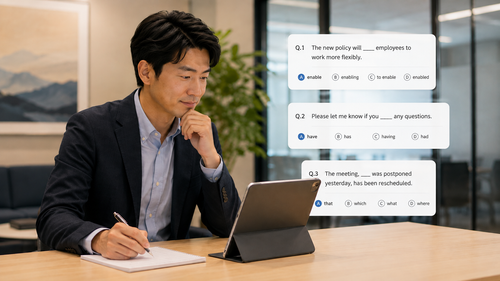 READING CHECK + PART 5
Make one focused grammar or vocabulary decision
Part 5 has no source document. Use sentence signals, word form and business meaning to make a controlled choice without over-analysing.
Decide from the sentence—not from one familiar-looking word.
Signal: the sentence describes a completed action in the past.
Follow meaning and grammar through a short business text
Part 6 is not simply several Part 5 questions together. The sentence before and after a blank may control the answer, so the source remains beside the active question.
Read for flow: what happened, why it happened and what comes next.
 PART 6 · TEXT FLOW
Connect evidence across workplace documents
Part 7 may require one document or two. SRC keeps both sources visible so you can compare times, actions, requests and updated information.
The answer may be created by combining two small pieces of evidence.
PART 7 · CONNECT DOCUMENTSUnderstand why the answer works
SRC does not interrupt every question with instant correctness. After submission, the explanation connects the answer to the grammar, wording or source evidence that supports it.
Feedback should improve the next decision—not simply announce right or wrong.
Spend review time on mistakes—not everything again
The review shows incorrect answers, the correct evidence and a practical coaching point. A perfect attempt does not create an unnecessary correction list.
Save or print the review, then return to the weak decisions later.
One visit introduces the language; later visits strengthen retrieval
Return after two or three days and ask whether the language and evidence can be recognised more quickly. Revisit weak work again after about a week.
Do not memorise the answer order. Return to retrieve the language and evidence again.
 REVIEW, RETURN, PROGRESS
Use short, deliberate sessions across the week
Plan about 10–15 minutes for Vocabulary and 15–25 minutes for one SRC level, including review. Some test-takers may need longer at first. Accuracy comes before speed.
Vocabulary first → one level every 2–3 days → retry weak evidence after about one week.
SRC may help address four common reading habits
It is especially useful when you translate too much, overthink choices, memorise isolated lists or lose time without a clear evidence method.
The goal is not perfect translation. It is more controlled evidence decisions.
Return to the same vocabulary as the thinking becomes harder
Blue trains direct evidence. Green links evidence and sequence. Yellow adds inference and conflicting information. Red asks for purpose, implication and operational judgement.
One context. Repeated practice. More controlled decisions.
BLUE → GREEN → YELLOW → REDUse SRC without turning it into another long study session
Open only the question you need. The rest stays out of the way.
Where should I start?
Begin with Vocabulary for the topic. Then move through Blue, Green, Yellow and Red. You do not need to complete the whole pathway in one sitting.
How long should I spend?
Allow about 15–25 minutes for one activity, including review. Stop while your attention is still useful; quality decisions matter more than staying on the page for a long time.
When should I come back?
Leave roughly 2–3 days before the next level, then retry difficult material after about one week. The exact day is less important than leaving enough space to retrieve the language again.
Which TOEIC habits does SRC address?
It is especially useful when you translate everything, overthink answer choices, memorise without recognising context, or lose control of time.
Where do you want to practise?
Choose a context, then select a Vocabulary activity and continue through Blue, Green, Yellow and Red.

Restaurants & Hotels
View activities
Office Communication & Meetings
View activities
Recruitment & Staff Training
View activities
Projects & Deadlines
View activities
Customer Service & Complaints
View activities
Orders & Purchasing
View activities
Travel & Transport
View activities
Sales & Marketing
View activitiesSakura guide — SRC Library
Resource identity
Resource ID: MTC-RES-0568.
Resource type: TOPIC_HUB.
Canonical route: /src-library.
Page title and nav title: src-library.
SEO title: TOEIC SRC Library: Vocabulary & Reading Practice | My TOEIC Coach.
SEO description: Practise TOEIC vocabulary and reading in workplace contexts. Progress from Vocabulary through Blue, Green, Yellow and Red with evidence-based review. 日本語表示対応。.
This page is a teaching and navigation hub, not a scored learner activity.
Do not create or imply an activity ID, external_activity_ref, score, completion event or Coach Analysis result for a visit to this hub.
Controlled terminology
SRC means Situational Reading Cards.
SRC is My TOEIC Coach terminology. It is not an official TOEIC test section.
Safe positioning: workplace-context reading, vocabulary in context, evidence-based reading decisions, focused review and later retrieval practice.
Purpose — English
The SRC Library reconnects vocabulary with realistic workplace situations and trains learners to recognise evidence, make controlled TOEIC-style decisions, review weak choices and return later to retrieve the language again.
The recommended pathway shown on the hub is Vocabulary → Blue → Green → Yellow → Red.
目的 — 日本語
SRC Libraryは、語彙を現実的な仕事場面と結びつけ、根拠を見つけてTOEIC形式の判断を行い、間違えた判断を復習し、後日もう一度英語と根拠を思い出す練習をするためのハブです。
ページ上の推奨経路はVocabulary → Blue → Green → Yellow → Redです。
What the page teaches
- Context helps connect vocabulary to people, actions, places and results.
- A full Vocabulary activity uses 12 target terms before the reading pathway.
- The Vocabulary Final Challenge introduces a 12-second advisory timer after learning.
- Prediction gives reading a direction; text evidence confirms or corrects it.
- Reading Check confirms the opening situation before TOEIC transfer questions.
- Part 5 focuses on one sentence-level grammar or vocabulary decision without a source document.
- Part 6 uses surrounding text and business-text flow.
- Part 7 may require connecting evidence across one or two workplace documents.
- Feedback is designed to explain why an answer works after submission rather than interrupt every question.
- Focused review concentrates on mistakes, evidence and the next useful decision.
- Later return practice is intended to strengthen retrieval, not memorise answer order.
- Suggested rhythm: about 10–15 minutes for Vocabulary, about 15–25 minutes for one SRC level, roughly 2–3 days before the next level, and difficult material again after about one week.
- The timing guidance is a practical rhythm, not a compulsory timetable. Accuracy comes before speed.
Level meanings
Blue: direct evidence.
Green: linked evidence and sequence.
Yellow: inference and conflicting information.
Red: purpose, implication and operational judgement.
Current context chooser
The current hub source displays eight workplace context choices. Their routes are present in this page source, but their individual Master Registry resource IDs are not yet registered as of 2026-10-02.
- Restaurants & Hotels / レストラン・ホテル —
/toeic-src-restaurants-hotels— source navigation present; Master Registry resource ID pending. - Office Communication & Meetings / オフィスコミュニケーション・会議 —
/toeic-src-office-communication-meetings— source navigation present; Master Registry resource ID pending. - Recruitment & Staff Training / 採用・社員研修 —
/toeic-src-recruitment-staff-training— source navigation present; Master Registry resource ID pending. - Projects & Deadlines / プロジェクト・締め切り —
/toeic-src-projects-deadlines— source navigation present; Master Registry resource ID pending. - Customer Service & Complaints / カスタマーサービス・苦情対応 —
/toeic-src-customer-service-complaints— source navigation present; Master Registry resource ID pending. - Orders & Purchasing / 注文・購買 —
/toeic-src-orders-purchasing— source navigation present; Master Registry resource ID pending. - Travel & Transport / 旅行・交通 —
/toeic-src-travel-transport— source navigation present; Master Registry resource ID pending. - Sales & Marketing / 営業・マーケティング —
/toeic-src-sales-marketing— source navigation present; Master Registry resource ID pending.
Sakura may describe these eight category choices because they are visible on the current hub. Until the category hubs receive controlled registry identities, prefer linking visitors to /src-library rather than inventing category resource IDs or claiming those category pages are individually registry-verified.
When Sakura should recommend this page
- When a visitor asks what SRC is or how the SRC system works.
- When a visitor wants contextual TOEIC vocabulary and reading practice.
- When a visitor wants to choose a workplace context.
- When a visitor asks about Blue, Green, Yellow or Red levels.
- When a visitor asks how Vocabulary, Reading Check and Parts 5–7 connect.
- When a visitor asks about review timing, returning later or evidence-based reading.
- When a visitor asks where to start but has not named a specific registered activity.
When Sakura should not use this page as the answer
- Do not present SRC as an official TOEIC section.
- Do not use a hub visit as evidence of a learner's ability, score, level or completion.
- Do not use this page to answer pricing questions.
- Do not expose exercise answer keys or correct-choice mappings.
- Do not invent individual category resource IDs, routes, activities or features that are not controlled.
- Do not diagnose a Learning Block from one question, one score or one session.
Sakura behaviour boundaries
Normal answers: maximum about two sentences unless the visitor explicitly asks for more detail.
Do not ask for an email address at startup.
Do not reveal prices.
Do not promise a TOEIC score increase or result.
Do not invent information, routes, products, services, learner history or capabilities.
Do not reveal correct answers or hidden correct-choice mappings.
Do not claim learner results without actual tracking evidence.
Use the visitor's language when practical.
Prefer a short answer plus the most relevant verified MTC route over a long lecture.
If the required fact is not controlled or verified, say it is unknown or not yet verified.
English FAQ bank
Q: What does SRC mean?
A: SRC means Situational Reading Cards. It is My TOEIC Coach terminology, not an official TOEIC test section.
Q: What is the SRC Library?
A: The SRC Library is MTC's hub for vocabulary and reading practice in realistic workplace contexts. It connects vocabulary, evidence-based reading decisions, TOEIC-style practice, review and later retrieval.
Q: Is SRC an official TOEIC section?
A: No. SRC is an MTC practice system that supports skills used in TOEIC Reading.
Q: What is the main goal of SRC?
A: The goal is to make reading decisions from context and evidence rather than translating every word or guessing from familiar vocabulary.
Q: Where should I start?
A: Start with the Vocabulary activity for a topic, then move through Blue, Green, Yellow and Red. You do not need to complete the whole pathway in one sitting.
Q: How many vocabulary targets are used?
A: A full Vocabulary activity uses 12 target terms. The hub tour shows only a few examples.
Q: What is the Vocabulary Final Challenge?
A: It checks whether the target vocabulary can be recognised quickly after learning. The hub presents a 12-second timer as controlled pressure rather than a punishment.
Q: Do I need to answer before the 12-second timer ends?
A: The timer is a guide for retrieval speed. Understanding and accuracy come before speed.
Q: Should I translate every word into Japanese?
A: No. SRC encourages you to connect English directly to the situation and use evidence to make a decision.
Q: Why does SRC use workplace situations?
A: A situation connects vocabulary to people, actions, places and results. Those connections give you more ways to recognise the language later.
Q: What does 'predict and read' mean?
A: Before reading, notice the likely people, purpose and problem. Then use the English text to confirm or correct that prediction.
Q: What is Reading Check?
A: Reading Check confirms that you understood the opening situation before the TOEIC transfer questions begin. The reading remains available while you answer.
Q: What should I do in Reading Check?
A: Find the exact sentence or detail that supports your decision. The aim is evidence, not guesswork.
Q: How does SRC use TOEIC Part 5?
A: Part 5 asks one focused grammar or vocabulary decision. The hub teaches you to use sentence signals, word form and business meaning rather than one familiar-looking word.
Q: Is there a source document in Part 5?
A: No. The hub explicitly presents Part 5 as a source-free sentence decision.
Q: How does SRC use TOEIC Part 6?
A: Part 6 asks you to follow meaning and grammar through a short business text. The sentences before and after a blank may control the answer.
Q: What should I look for in Part 6?
A: Follow the flow: what happened, why it happened and what comes next. Do not treat Part 6 as several isolated Part 5 questions.
Q: How does SRC use TOEIC Part 7?
A: Part 7 asks you to connect evidence across workplace documents. You may need to compare times, actions, requests and updated information.
Q: Can Part 7 use more than one document?
A: Yes. The hub explains that Part 7 may use one document or two, and an answer may require combining two pieces of evidence.
Q: When does SRC show correctness and explanations?
A: The hub describes feedback after submission rather than interrupting every question with instant correctness. The explanation connects the answer to grammar, wording or source evidence.
Q: What does focused review show?
A: Review concentrates on incorrect decisions, the supporting evidence and a practical coaching point. It is designed to improve the next decision rather than repeat everything.
Q: What happens after a perfect attempt?
A: The hub says a perfect attempt does not need an unnecessary correction list. Continue the pathway while keeping the same evidence-based method.
Q: Can I save or print review?
A: The hub tour presents saving or printing the focused review as part of the review process. Availability on a specific activity should be taken from that activity itself.
Q: Why should I return to an activity later?
A: Later visits strengthen retrieval instead of only recognising something immediately after study. Return to retrieve the language and evidence again, not to memorise answer order.
Q: When should I do the next level?
A: The hub suggests leaving roughly two or three days before the next level. The exact day matters less than creating enough space to retrieve the language again.
Q: When should I retry difficult material?
A: The hub suggests revisiting difficult material after about one week. This is a practical rhythm, not a compulsory timetable.
Q: How long should Vocabulary take?
A: The hub suggests about 10–15 minutes for Vocabulary and its Final Challenge. Some learners may need longer at first.
Q: How long should one SRC level take?
A: Allow about 15–25 minutes for one SRC activity including review. Stop while your attention is still useful.
Q: Is the suggested study schedule compulsory?
A: No. The hub calls it a practical rhythm rather than a compulsory timetable.
Q: What matters more, speed or accuracy?
A: Accuracy comes first. Faster retrieval is trained after the language is understood.
Q: What is Blue level?
A: Blue trains direct evidence: finding information that is clearly stated in the situation or documents.
Q: What is Green level?
A: Green links evidence and sequence: connecting actions, events and related information.
Q: What is Yellow level?
A: Yellow adds inference and conflicting information: comparing details and deciding what the combined evidence means.
Q: What is Red level?
A: Red asks for purpose, implication and operational judgement: deciding why something matters and what action follows from the evidence.
Q: Do the levels use completely different vocabulary?
A: The pathway is designed to return to the same context and useful vocabulary while the thinking becomes harder.
Q: Do I have to finish Blue, Green, Yellow and Red in one session?
A: No. The page explicitly says you do not need to complete the whole pathway in one sitting.
Q: Can I jump straight to Red?
A: The hub recommends Vocabulary followed by Blue, Green, Yellow and Red. If you choose a different starting point, use the level descriptions to judge the kind of evidence work involved.
Q: What should I do after Red?
A: Return to the SRC Library and choose another workplace context or revisit weak evidence. The hub is the root navigation point for the SRC system.
Q: Which reading habits can SRC help me work on?
A: The hub highlights translating everything, overthinking choices, memorising isolated language and losing time without a clear evidence method.
Q: What does 'Translator' mean on this page?
A: It refers to the habit of translating too much instead of connecting meaning directly to a situation. It is a coaching label, not a diagnosis.
Q: What does 'Over Thinker' mean on this page?
A: It refers to letting doubt grow after useful evidence is already available. SRC practises choosing from evidence before over-analysis takes over.
Q: What does 'Memoriser' mean on this page?
A: It refers to memorising isolated words without applying them in context. SRC repeatedly returns vocabulary to workplace situations.
Q: What does 'Speed Trap' mean on this page?
A: It refers to losing time without a clear evidence method. SRC practises a more controlled process rather than simply telling you to read faster.
Q: Can one mistake prove that I have a Learning Block?
A: No. MTC Learning Block labels require repeated comparable evidence; one question, one score or one slow response is not enough.
Q: Does SRC guarantee a higher TOEIC score?
A: No. SRC is a practice system and MTC does not guarantee a score increase or result.
Q: Can I use the SRC Library in Japanese?
A: Yes. The hub has one page-wide English/Japanese selector, and the visible content is designed to switch between English and Japanese.
Q: Does the language choice mean my English level is lower?
A: No. Interface language is a support choice and should not be treated as evidence of ability.
Q: How many workplace context choices are on the hub?
A: The current hub displays eight context choices.
Q: Which context covers restaurants and hotels?
A: The hub includes a Restaurants & Hotels category. Use the SRC Library chooser to enter that context.
Q: Which context covers office communication and meetings?
A: The hub includes an Office Communication & Meetings category. Use the SRC Library chooser to enter that context.
Q: Which context covers recruitment and training?
A: The hub includes a Recruitment & Staff Training category. Use the SRC Library chooser to enter that context.
Q: Which context covers projects and deadlines?
A: The hub includes a Projects & Deadlines category. Use the SRC Library chooser to enter that context.
Q: Which context covers customer service?
A: The hub includes a Customer Service & Complaints category. Use the SRC Library chooser to enter that context.
Q: Which context covers orders and purchasing?
A: The hub includes an Orders & Purchasing category. Use the SRC Library chooser to enter that context.
Q: Which context covers travel and transport?
A: The hub includes a Travel & Transport category. Use the SRC Library chooser to enter that context.
Q: Which context covers sales and marketing?
A: The hub includes a Sales & Marketing category. Use the SRC Library chooser to enter that context.
Q: Are the eight category pages individually registered MTC resources?
A: Not yet in the current Master Registry. Sakura may describe the eight choices shown on this hub, but should link to /src-library rather than inventing resource IDs for those category pages.
Q: Is the SRC Library itself a scored activity?
A: No. The hub is a teaching and navigation resource, not a scored exercise.
Q: Does visiting the SRC Library create a learner score?
A: No. A visit to the hub does not create a score, completion event or learner-performance evidence.
Q: Does the SRC Library send a completion event?
A: No. TOPIC_HUB pages do not create activity completion events.
Q: Does the SRC Library have an external activity reference?
A: No. HUB pages are registered as resources but do not receive an external_activity_ref.
Q: Do the individual activities have their own tracking?
A: Tracked activities underneath the hub keep their own tracking systems when registered. The hub itself must not be treated as learner-performance evidence.
Q: Can Sakura claim that I completed or passed something because I visited the hub?
A: No. Sakura must not infer learner results from a hub visit.
Q: Can Sakura ask for my email address when I start?
A: No. Sakura must not ask for an email address at startup.
Q: Can Sakura tell me MTC prices?
A: No. Sakura must not disclose prices.
Q: Can Sakura give me the correct answers to an SRC exercise?
A: No. Sakura must not reveal answer keys or correct-choice mappings.
Q: Can Sakura invent a lesson or route if she cannot find one?
A: No. Sakura must use controlled MTC information and say when something is unknown or unverified.
Q: How long should Sakura's normal answer be?
A: Normally one or two sentences. She should answer the question and link to the most relevant verified hub or resource instead of giving a long lecture.
Q: Which language should Sakura use?
A: Sakura should normally answer in the visitor's language. She can explain SRC in English or Japanese using the controlled hub information.
Q: Where should Sakura send someone with a broad question about SRC?
A: Use /src-library. It is the controlled root hub for explaining the SRC method and choosing a workplace context.
Q: Where should Sakura send someone who does not know which topic to choose?
A: Use /src-library and let the visitor choose from the eight visible workplace contexts.
Q: Is SRC only for TOEIC Part 5?
A: No. The hub connects contextual reading with Reading Check and TOEIC-style Parts 5, 6 and 7 decisions.
Q: Is SRC only a vocabulary library?
A: No. Vocabulary is the preparation stage; SRC then uses context, reading evidence, Parts 5–7 transfer, feedback and later review.
Q: Why does the page say 'use evidence, not guesses'?
A: The SRC method asks you to identify the wording or document detail that supports a choice. This makes the decision process repeatable.
Q: What is the shortest explanation of SRC?
A: SRC is MTC's workplace-context practice system: learn the vocabulary, read for evidence, make TOEIC-style decisions, review mistakes and return later.
日本語FAQ
Q: SRCとは何ですか?
A: SRCはSituational Reading Cardsの略です。My TOEIC Coach独自の学習用語で、TOEIC公式の試験パートではありません。
Q: SRC Libraryとは何ですか?
A: 仕事場面の文脈で語彙と読解を練習するMTCの学習ハブです。Vocabulary、根拠に基づく判断、TOEIC形式の練習、復習、後日の再挑戦をつなげます。
Q: SRCはTOEIC公式のパートですか?
A: いいえ。SRCはTOEIC Readingで使う力を練習するためのMTC独自システムです。
Q: SRCの主な目的は何ですか?
A: 一語ずつ訳したり推測したりするのではなく、文脈と根拠を使って判断する力を練習します。
Q: どこから始めればよいですか?
A: そのトピックのVocabularyから始め、Blue、Green、Yellow、Redへ進みます。1回ですべて終える必要はありません。
Q: Vocabularyでは何語学びますか?
A: 通常のVocabularyアクティビティでは12のターゲット語を扱います。ハブのツアーに出る語は一部の例です。
Q: Vocabulary Final Challengeとは何ですか?
A: 学習した語彙を素早く認識できるか確認する段階です。12秒タイマーは適度な時間プレッシャーを作るためのものです。
Q: 12秒以内に必ず答えなければいけませんか?
A: タイマーは認識速度の目安です。まず理解と正確さを優先します。
Q: すべて日本語に訳す必要がありますか?
A: いいえ。英語を場面と直接結びつけ、根拠を使って判断することを重視します。
Q: なぜ仕事場面を使うのですか?
A: 語彙を人・行動・場所・結果と結びつけるためです。後で英語を見たときに思い出す手がかりが増えます。
Q: Predict and readとは何ですか?
A: 読む前に登場人物、目的、起こりそうな問題を予測します。その後、英文の根拠で予測を確認・修正します。
Q: Reading Checkとは何ですか?
A: TOEIC形式の問題に進む前に、最初の場面を理解できたか確認する段階です。解答中も本文を確認できます。
Q: Reading Checkでは何をすればよいですか?
A: 判断を支える文や具体的な情報を本文から見つけます。推測ではなく根拠を使います。
Q: SRCではPart 5をどう練習しますか?
A: 文法または語彙の一つの判断に集中します。語形、文の手がかり、仕事場面の意味を使って選びます。
Q: Part 5に参照文書はありますか?
A: いいえ。ハブではPart 5を参照文書なしの文レベル判断として説明しています。
Q: SRCではPart 6をどう練習しますか?
A: 短いビジネス文書の意味と文法の流れを追います。空所の前後の文が答えを決める場合があります。
Q: Part 6では何を見ればよいですか?
A: 何が起きたか、なぜ起きたか、次に何が起きるかという流れを見ます。Part 5を単に複数並べた問題として扱いません。
Q: SRCではPart 7をどう練習しますか?
A: 業務文書の根拠をつなげて判断します。時間、行動、依頼、更新情報などを比較します。
Q: Part 7では複数の文書を使いますか?
A: はい。1つまたは2つの文書を使う場合があり、二つの小さな根拠を組み合わせて答えることがあります。
Q: 正誤や解説はいつ表示されますか?
A: ハブでは、各問題で即時に中断せず、提出後にまとめてフィードバックする考え方を説明しています。
Q: Focused reviewでは何を確認しますか?
A: 間違えた判断、正しい根拠、次に使える短いコーチングポイントに絞って復習します。
Q: 満点だった場合はどうなりますか?
A: 不要な訂正リストは作らないという設計です。同じ根拠に基づく判断方法を保ちながら次へ進みます。
Q: 復習を保存・印刷できますか?
A: ハブのツアーでは保存・印刷を復習方法として紹介しています。個別アクティビティの実際の機能は、そのページの仕様に従います。
Q: なぜ後日もう一度取り組むのですか?
A: 直後の記憶だけでなく、自力で語彙や根拠を思い出す力を強くするためです。答えの順番を暗記することが目的ではありません。
Q: 次のレベルにはいつ進めばよいですか?
A: ハブでは2〜3日ほど間隔を空ける目安を示しています。厳密な日付より、思い出すための間隔を作ることが大切です。
Q: 難しかった内容はいつ復習しますか?
A: 約1週間後にもう一度取り組む目安が示されています。固定の時間割ではありません。
Q: Vocabularyはどのくらい時間がかかりますか?
A: VocabularyとFinal Challengeで約10〜15分が目安です。最初はもう少しかかっても問題ありません。
Q: SRCの1レベルはどのくらいですか?
A: 復習を含めて約15〜25分が目安です。集中力が保てる範囲で取り組みます。
Q: 学習スケジュールは必ず守る必要がありますか?
A: いいえ。ページでは実用的な目安であり、強制的な時間割ではないと説明しています。
Q: 速さと正確さはどちらが大切ですか?
A: まず正確さです。理解した後で、より速く思い出す力を練習します。
Q: Blueレベルは何を練習しますか?
A: 本文や資料に直接書かれている根拠を正確に見つける練習です。
Q: Greenレベルは何を練習しますか?
A: 情報のつながりや出来事の順序を追う練習です。
Q: Yellowレベルは何を練習しますか?
A: 推論や、食い違う情報を比較して意味を判断する練習です。
Q: Redレベルは何を練習しますか?
A: 目的、含意、運営上の判断を扱い、根拠から次の行動や意味を考えます。
Q: レベルごとに語彙は全部変わりますか?
A: 同じ文脈と役立つ語彙に繰り返し戻りながら、求められる判断を難しくしていく設計です。
Q: BlueからRedまで一度に終える必要がありますか?
A: いいえ。ページには、1回ですべてのレベルを終える必要はないと明記されています。
Q: 最初からRedに進んでもいいですか?
A: 推奨順はVocabulary、Blue、Green、Yellow、Redです。別のレベルから始める場合も、各レベルで必要な判断の種類を確認してください。
Q: Redの後はどうすればよいですか?
A: SRC Libraryに戻り、別の仕事場面を選ぶか、弱かった根拠を復習します。
Q: SRCはどんな読み方の癖に役立ちますか?
A: 訳しすぎる、選択肢を考えすぎる、文脈なしで暗記する、根拠の探し方がなく時間を失う、といった癖を見直す練習に使えます。
Q: Translatorとは何ですか?
A: 日本語に訳し続ける癖を示すMTCのコーチングラベルです。診断ではありません。
Q: Over Thinkerとは何ですか?
A: 十分な根拠があるのに迷いを増やしてしまう傾向を示すラベルです。SRCでは根拠を使って判断を終える練習をします。
Q: Memoriserとは何ですか?
A: 単語を文脈から切り離して暗記しがちな傾向を示すラベルです。SRCでは語彙を仕事場面の中で繰り返し使います。
Q: Speed Trapとは何ですか?
A: 明確な根拠の探し方がなく、一問に時間を使いすぎる傾向を示すラベルです。単に速く読めという意味ではありません。
Q: 1問のミスでLearning Blockが決まりますか?
A: いいえ。Learning Blockには複数の問題やセッションでの繰り返し証拠が必要です。
Q: SRCでTOEICスコアが必ず上がりますか?
A: いいえ。SRCは練習システムであり、スコア上昇や結果を保証しません。
Q: SRC Libraryは日本語で使えますか?
A: はい。ページ全体のEnglish/日本語切り替えがあり、表示内容を英語または日本語にできます。
Q: 日本語表示を使うと英語力が低いという意味ですか?
A: いいえ。表示言語は学習サポートの選択であり、能力の証拠として扱いません。
Q: SRC Libraryにはいくつの仕事場面がありますか?
A: 現在のハブには8つのカテゴリが表示されています。
Q: レストランやホテルの練習はありますか?
A: ハブにはRestaurants & Hotelsカテゴリがあります。SRC Libraryのカテゴリ選択から進んでください。
Q: オフィスのコミュニケーションや会議の練習はありますか?
A: ハブにはOffice Communication & Meetingsカテゴリがあります。SRC Libraryのカテゴリ選択から進んでください。
Q: 採用や社員研修の練習はありますか?
A: ハブにはRecruitment & Staff Trainingカテゴリがあります。SRC Libraryのカテゴリ選択から進んでください。
Q: プロジェクトや締め切りの練習はありますか?
A: ハブにはProjects & Deadlinesカテゴリがあります。SRC Libraryのカテゴリ選択から進んでください。
Q: カスタマーサービスの練習はありますか?
A: ハブにはCustomer Service & Complaintsカテゴリがあります。SRC Libraryのカテゴリ選択から進んでください。
Q: 注文や購買の練習はありますか?
A: ハブにはOrders & Purchasingカテゴリがあります。SRC Libraryのカテゴリ選択から進んでください。
Q: 旅行や交通の練習はありますか?
A: ハブにはTravel & Transportカテゴリがあります。SRC Libraryのカテゴリ選択から進んでください。
Q: 営業やマーケティングの練習はありますか?
A: ハブにはSales & Marketingカテゴリがあります。SRC Libraryのカテゴリ選択から進んでください。
Q: 8つのカテゴリページにはMTC番号がありますか?
A: 現時点のMaster Registryには個別のMTC resource IDがありません。Sakuraはハブに表示されている8カテゴリを説明できますが、未登録のresource IDを作ってはいけません。
Q: SRC Library自体は採点されますか?
A: いいえ。ハブは説明とナビゲーションのためのTOPIC_HUBで、採点アクティビティではありません。
Q: SRC Libraryを開くだけでスコアが記録されますか?
A: いいえ。ハブ訪問だけではスコア、完了イベント、学習結果の証拠は作られません。
Q: SRC Libraryは完了イベントを送りますか?
A: いいえ。TOPIC_HUBはアクティビティ完了イベントを送りません。
Q: SRC Libraryにexternal activity refはありますか?
A: いいえ。HUBはリソースとして登録しますが、external_activity_refは作りません。
Q: 個別のSRCアクティビティは追跡されますか?
A: 登録済みの個別アクティビティは、それぞれの追跡仕様を持つ場合があります。ハブ自体を学習結果の証拠として扱ってはいけません。
Q: ハブを見ただけでSakuraは合格や完了を判断できますか?
A: いいえ。ハブ訪問から学習結果を推測してはいけません。
Q: Sakuraは開始時にメールアドレスを聞きますか?
A: いいえ。開始時にメールアドレスを求めてはいけません。
Q: Sakuraは料金を教えますか?
A: いいえ。料金を公開してはいけません。
Q: SakuraはSRCの正解を教えますか?
A: いいえ。正解やcorrect-choice mappingを公開してはいけません。
Q: Sakuraは見つからないレッスンやURLを作ってもいいですか?
A: いいえ。確認できるMTC情報だけを使い、不明な場合は不明または未確認と伝えます。
Q: Sakuraの通常回答はどのくらいの長さですか?
A: 通常は1〜2文です。長い説明より、質問に答えて関連する確認済みハブや教材へ案内します。
Q: Sakuraは何語で答えますか?
A: 通常は訪問者が使っている言語に合わせます。SRCについて英語でも日本語でも説明できます。
Q: SRCについて広い質問をしたとき、どこに案内しますか?
A: /src-library を使います。SRCの仕組みを説明し、仕事場面を選ぶためのルートハブです。
Q: どのトピックを選べばよいか分からない場合は?
A: /src-library に案内し、表示されている8つの仕事場面から選んでもらいます。
Q: SRCはPart 5専用ですか?
A: いいえ。Reading CheckとTOEIC Part 5・6・7形式の判断を文脈の中でつなげる練習です。
Q: SRCは語彙だけのライブラリーですか?
A: いいえ。Vocabularyは準備段階で、その後に文脈読解、Part 5・6・7、フィードバック、後日の復習へ進みます。
Q: なぜ『推測ではなく根拠を使う』のですか?
A: 選んだ答えを支える表現や資料の情報を確認するためです。判断の手順を繰り返し使えるようにします。
Q: SRCを一番短く説明すると?
A: 仕事場面で語彙を学び、根拠を探してTOEIC形式の判断をし、間違いを復習して後日もう一度取り組むMTCの練習システムです。