
Coaching Approach
Coaching vs Teaching: What Is the Difference?
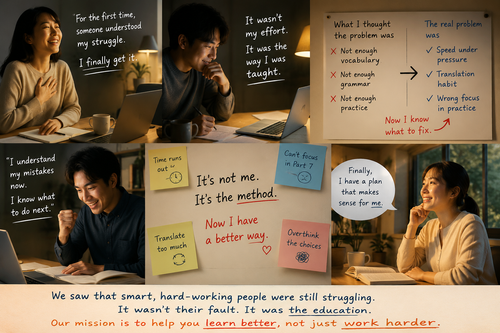
Teaching usually explains English. Coaching helps a test-taker change the way they prepare, review, and make decisions under TOEIC pressure.
Both teaching and coaching can be useful. But if you have already studied TOEIC for months and still feel stuck, another explanation may not be enough.
You may need someone to help you find the pattern behind your mistakes.
The key difference: teaching answers “What is correct?” Coaching asks “Why did this mistake happen, and what should change next?”
What teaching usually does
Traditional TOEIC teaching often focuses on content: grammar points, vocabulary lists, textbook units, listening practice, and model answers.
That can help when the learner lacks knowledge. But it may not solve deeper study problems.
What coaching does differently
Coaching still uses English knowledge, but the focus is broader. It looks at the test-taker’s habits, timing, confidence, review method, and decision pattern.
Teaching question vs coaching question
The difference becomes clearer when you compare the questions being asked.
Why this matters for TOEIC
TOEIC is not only a knowledge test. It is a timed decision test.
Many test-takers can understand the answer after review, but still miss similar questions during timed practice. That means the problem is not always grammar knowledge. It may be speed, scanning, attention, or confidence.
For TOEIC, the goal is not just to know more English. The goal is to use what you know quickly and reliably during the test.
ALT: the learning system behind the coaching
My TOEIC Coach uses Accelerated Learning for TOEIC, or ALT.
ALT is not a shortcut or guarantee. It is a practical approach that uses active recall, spaced review, visual memory, sentence-pattern recognition, and reflective review.
What we do not do
Coaching should not mean random encouragement or vague advice.
The goal: confidence and independence
A good TOEIC coach should help the test-taker understand what to study, how to review, and how to make better choices during the test.
The aim is not to keep learners in lessons forever. The aim is to help them build a study system they can continue using.
That is why My TOEIC Coach starts with diagnosis, then turns that diagnosis into a practical plan.