
Why It Works
Why My TOEIC Coach Works
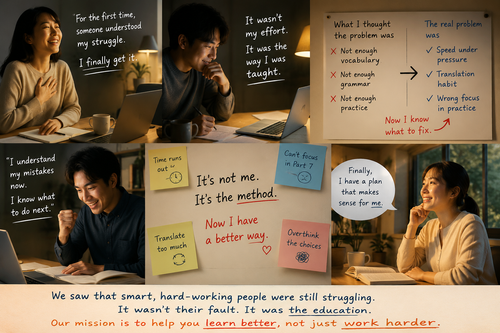
My TOEIC Coach works by changing the way test-takers notice mistakes, review patterns, and prepare for TOEIC under time pressure.
Many test-takers do not need another random list of grammar points. They need to know why they keep missing questions they can understand after review.
That is where coaching helps. We look at the mistake pattern first, then build a study plan around the real learning block.
Core idea: TOEIC progress improves when test-takers stop guessing what the problem is and start training the specific decision pattern that keeps breaking down.
We start with diagnosis
Most TOEIC preparation begins with content: vocabulary, grammar, listening practice, reading drills, or mock tests.
Those are useful, but they do not always explain why progress has stopped.
We train TOEIC decisions, not just English knowledge
TOEIC is partly an English test, but it is also a decision-making test. Test-takers must choose quickly, under pressure, with limited time.
That means preparation needs to train recognition, elimination, timing, review habits, and confidence.
Knowing the rule is not enough. The test-taker must be able to use the rule while tired, timed, and under pressure.
ALT: Accelerated Learning for TOEIC
ALT is our learning approach. It is not a shortcut, an app, or a guarantee.
It is a practical system that uses active recall, spaced review, visual memory, sentence-pattern recognition, and reflective review to help test-takers build more stable TOEIC habits.
Coaching adds the human layer
A textbook cannot always tell whether you are rushing, translating, losing confidence, avoiding review, or studying with an unrealistic plan.
A coach can watch the pattern, ask better questions, and adjust the next step.
From stuck to clearer
Before coaching, test-takers often feel lost in too many study options. They may not know whether to practise grammar, listening, reading speed, vocabulary, mock tests, or review.
After diagnosis, the next step becomes clearer. The learner can focus on the pattern that matters most now.
Why this matters
TOEIC study becomes more useful when test-takers can connect effort to a specific training purpose.
That does not remove hard work. It makes the work more focused.
My TOEIC Coach works best for learners who are ready to diagnose, practise, review, and adjust.