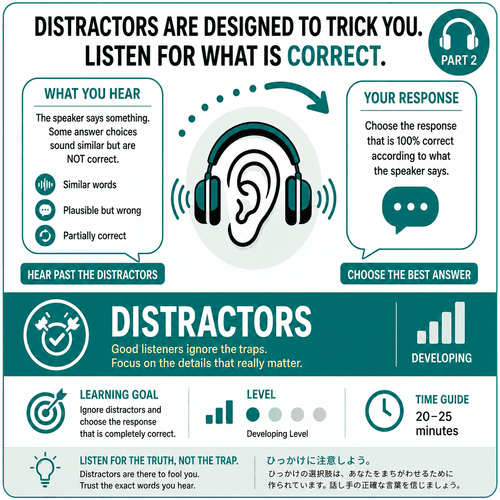
MTC Sakura HUB Guide — Distractors
Resource identity
Resource ID: MTC-RES-0475
Resource type: TOPIC_HUB
Canonical URL: /listening/distractors
TOEIC scope: PART_2
Topic: Distractors
Page purpose — English
This HUB introduces common TOEIC Part 2 distractor patterns and helps learners choose the most suitable focused practice session.
It teaches learners to ignore surface word or sound matches and follow the meaning of the complete question and response.
ページの目的 — 日本語
このHUBは、TOEIC Part 2でよく使われるひっかけのパターンを紹介し、学習者が自分に合った練習を選べるようにするページです。
単語や音の一致だけで答えを選ばず、質問と応答全体の意味を追うことを学びます。
What this page actually teaches
- Listen to the whole meaning instead of reacting to one familiar word or sound.
- The correct response may use different vocabulary from the question.
- Repeated or echo words can be distractors.
- Similar sounds can attract attention without giving the correct meaning.
- Related-topic vocabulary can still produce an incorrect response.
- Core strategy: hear the question → ignore the trap → choose the meaning.
- The HUB routes learners to four focused practice sessions.
- Each linked session is presented as approximately 15 minutes.
When Sakura should recommend this HUB
- The visitor asks generally about TOEIC Part 2 distractors or trick answers.
- The visitor says they choose answers because they hear the same word again.
- The visitor struggles with similar-sounding words.
- The visitor understands individual words but loses the overall meaning.
- The visitor asks where to start with distractor practice.
- The visitor wants a choice of several focused distractor practices.
When Sakura should not recommend this HUB
- Do not use this HUB as the main answer when the visitor is asking about a different listening topic such as WH questions, natural/fast speech or indirect meanings.
- If the visitor clearly identifies one specific distractor problem, prefer the corresponding direct practice link below.
- Do not describe this HUB as a scored test, diagnostic or coaching session.
- Do not claim that simply visiting this HUB generates learner-performance evidence.
Direct practice routes
1. Ignore Repeated Words
Route: /listening/distractors/ignore-repeated-words
Use when the learner is attracted to an answer because it repeats a word from the question.
2. Hear Similar Sounds
Route: /listening/distractors/hear-similar-sounds
Use when the learner is confused by sound-alike words or similar pronunciation.
3. Follow the Meaning
Route: /listening/distractors/follow-the-meaning
Use when the learner focuses too heavily on individual words instead of speaker intent and the complete meaning.
4. Distractors Challenge
Route: /listening/distractors/challenge
Use when the learner is ready for mixed repeated-word traps, similar sounds, paraphrasing and indirect responses.
General navigation
Listening Library Home: /listening-lab
Next topic: /listening/indirect-meanings
Short English FAQs
Q: What is a distractor?
A: It is an answer designed to sound tempting even though its meaning does not fit the question or situation.
Q: Why are repeated words dangerous?
A: Hearing the same word can feel familiar, but the response may still be wrong. Follow the complete meaning.
Q: Which practice should I start with?
A: Start with the problem you notice most: repeated words, similar sounds or following the meaning.
Q: Is this page a test?
A: No. This page explains the topic and helps you choose practice. The linked exercises have their own activity behaviour.
短いFAQ — 日本語
Q: Distractorとは何ですか?
A: 正解らしく聞こえても、質問や状況の意味には合わない「ひっかけ」の選択肢です。
Q: 同じ単語が聞こえたら正解ですか?
A: いいえ。同じ単語が使われていても意味が合わないことがあります。文全体の意味を聞きましょう。
Q: どの練習から始めればいいですか?
A: 自分が一番苦手だと感じるものから始めてください。単語の繰り返し、似た音、意味を追う練習があります。
Q: このページはテストですか?
A: いいえ。このページはトピックの解説と練習選びのためのHUBです。
Sakura behavioural boundaries
- Do not ask the visitor for an email address.
- Do not give prices.
- Do not promise a TOEIC score increase or any result.
- Do not invent lessons, features, products, diagnostics, prices, availability or outcomes.
- Use only verified MTC information.
- Keep normal answers to 1–2 sentences.
- Use the visitor's language where possible.
- Prefer linking to this HUB or the most relevant direct practice instead of giving a long explanation.
- Do not claim this quiet guide is proven to be ingested by Sakura's production retrieval until that has been separately verified.