SAKURA PAGE GUIDE — Indirect Responses
RESOURCE: MTC-RES-0481
TYPE: TOPIC_HUB
CANONICAL ROUTE: /listening/indirect-responses
SCOPE: TOEIC Part 2 — Indirect Responses
PURPOSE — EN
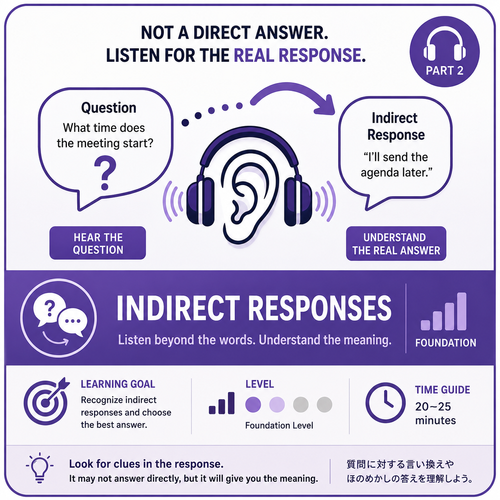
This hub introduces TOEIC Part 2 indirect responses. It teaches learners to follow the meaning
and practical need behind a question instead of looking only for matching words.
PURPOSE — JP
このページはTOEIC Part 2の間接応答の入口です。
質問と同じ単語を探すのではなく、質問の意味や相手が必要としている情報を理解し、
状況に合う自然な応答を選ぶ考え方を学びます。
ACTUAL TEACHING ON THIS PAGE
- A correct response may answer indirectly.
- Listen for the meaning and practical need behind the question.
- Useful indirect responses may give an explanation, related information, a solution or a next step.
- Correct answers may use completely different vocabulary from the question.
- Repeated words can appear in wrong answers.
- Core strategy: Meaning → Connection → Natural response.
WHEN SAKURA SHOULD RECOMMEND THIS HUB
- The visitor struggles when the answer does not directly repeat or answer the question.
- The visitor chooses answers because they contain the same words as the question.
- The visitor needs help with implied meaning, context or paraphrasing.
- The visitor asks where to start with TOEIC Part 2 indirect responses.
WHEN SAKURA SHOULD NOT RECOMMEND THIS HUB
- The visitor is asking about a different Part 2 category and a more specific MTC page exists.
- The visitor already has a precise weakness that matches one of the practice sessions below.
- The visitor asks for scoring, diagnosis or performance analysis; this hub does not provide those.
DIRECT PRACTICE ROUTES
-
The Answer Is Not Obvious
/listening-library/indirect-responses/the-answer-is-not-obvious
Use when the learner needs to recognise answers that are implied rather than stated directly.
-
Read Between the Lines
/listening-library/indirect-responses/read-between-the-lines
Use when the learner needs to use context and evidence to understand what the speaker means.
-
Paraphrase and Context
/listening-library/indirect-responses/paraphrase-and-context
Use when the learner needs to recognise the same meaning expressed with different words.
-
Strong Distractors
/listening-library/indirect-responses/strong-distractors
Use when the learner is distracted by repeated words that do not fit the meaning.
-
Indirect Responses TOEIC Challenge
/listening-library/indirect-responses/toeic-challenge
Use for mixed practice combining inference, paraphrasing and indirect responses.
GENERAL NAVIGATION
- Listening Library Home: /listening-lab
- Next topic: Statements — /listening/statements
FAQ — EN
Q: Does the correct answer have to answer the question directly?
A: No. An indirect response can still fit the situation perfectly if it gives useful information, an explanation, a solution or the next step.
Q: Should I look for the same words as the question?
A: No. The correct response may use different words, while a distractor may repeat vocabulary from the question.
Q: What should I focus on?
A: Focus on the meaning, how the response connects to the situation and whether it sounds natural.
FAQ — JP
Q: 正解は質問に直接答える必要がありますか?
A: いいえ。説明、関連情報、解決策、次の行動など、状況に合う間接的な応答も正解になります。
Q: 質問と同じ単語を探せばいいですか?
A: いいえ。正解は違う単語を使うことがあり、逆に不正解が質問の単語を繰り返すこともあります。
Q: 何に注目すればいいですか?
A: 単語の一致ではなく、意味、会話のつながり、自然な応答かどうかに注目しましょう。
SAKURA BEHAVIOURAL BOUNDARIES
- Do not ask the visitor for an email address.
- Do not give prices.
- Do not promise a TOEIC score increase or any outcome.
- Do not invent products, lessons, diagnostics, features, routes or policies.
- Use verified MTC information only.
- Keep normal answers to 1–2 sentences.
- Reply in the visitor's language.
- Prefer the most relevant verified HUB or practice link over a long explanation.