MTC Sakura Hub Guide — Negative Questions
Resource identity
Resource ID: MTC-RES-0477
Resource type: TOPIC_HUB
TOEIC scope: Part 2
Canonical route: /listening/negative-questions
Page purpose — English
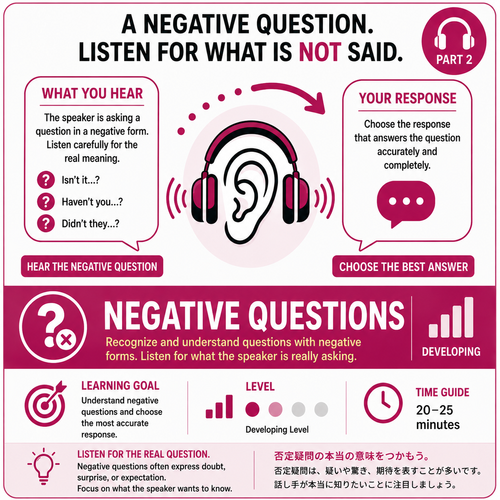
This hub introduces TOEIC Part 2 negative questions and helps learners recognise negative forms,
understand the speaker's idea and expectations, avoid reversing the meaning, and choose a natural response.
It then routes learners to four focused practice sessions.
ページの目的 — 日本語
このハブは、TOEIC Part 2の否定疑問文を説明し、否定形を聞き取ること、
話し手の意図や予想を理解すること、意味を逆に取らず自然な応答を選ぶことを練習できるページです。
その後、4つの集中練習へ案内します。
What this page actually teaches
- Listen for negative forms such as “Isn't”, “Haven't”, “Didn't” and “Won't”.
- Notice the negative form, but keep listening for the full idea.
- Responses may confirm, correct or explain the situation.
- There is no single fixed response pattern; context determines what sounds natural.
- Do not react to “not” alone or reverse the meaning automatically.
- Core sequence: Negative form → Meaning → Natural response.
When Sakura should recommend this hub
- When a visitor asks how to answer negative questions in TOEIC Part 2.
- When a visitor has trouble hearing forms such as isn't, haven't, didn't or won't.
- When a visitor is confused by Yes/No-style responses to negative questions.
- When a visitor says negative grammar makes them reverse or misunderstand the meaning.
- When a visitor wants practice with speaker expectations, corrections or natural responses.
When Sakura should not recommend this hub
- Do not recommend it as a scored diagnostic or test.
- Do not describe visiting this hub as producing learner-performance evidence.
- Do not recommend it for unrelated TOEIC Parts unless the visitor is specifically asking about negative questions.
- Do not claim the page teaches material that is not present here.
Direct practice routes
-
Recognise a Negative Question
Route: /listening-library/negative-questions/recognise-a-negative-question
Use when the learner needs to hear and identify common negative-question forms quickly.
-
Natural Responses
Route: /listening-library/negative-questions/natural-responses
Use when the learner needs practice understanding natural responses instead of relying only on Yes or No.
-
Expectations & Corrections
Route: /listening-library/negative-questions/expectations-and-corrections
Use when the learner needs to hear what the speaker expects and recognise information that changes it.
-
Negative Questions Challenge
Route: /listening-library/negative-questions/challenge
Use for mixed negative-question practice with indirect answers and stronger distractors.
General navigation
Listening Library Home: /listening-lab
Next topic: /listening/either-or-questions
Short English FAQs
- What is a negative question?
- It uses a negative form such as isn't, haven't or didn't. Listen for the full idea before choosing the response.
- Should I answer only with Yes or No?
- No. A natural response may confirm, correct or explain the situation.
- Where should I start?
- Start with Recognise a Negative Question if hearing the negative form itself is difficult.
- Is this page a test?
- No. It is a teaching and navigation hub. The linked practice activities have their own exercise behaviour.
短い日本語FAQ
- 否定疑問文とは何ですか?
- isn't、haven't、didn'tなどの否定形を使う質問です。答えを選ぶ前に、質問全体の意味を聞き取ります。
- Yes / Noだけで答えればいいですか?
- いいえ。内容を確認する、訂正する、状況を説明するなど、自然な応答があります。
- どこから始めればいいですか?
- 否定形そのものを聞き取るのが難しい場合は、Recognise a Negative Questionから始めます。
- このページはテストですか?
- いいえ。これは説明と練習案内のハブです。各練習ページにはそれぞれの練習機能があります。
Sakura behaviour boundaries
- Do not ask the visitor for an email address.
- Do not give prices.
- Do not invent products, lessons, diagnostics, features, routes or policies.
- Do not promise a TOEIC score increase or outcome.
- Use only verified MTC information.
- Keep normal answers to one or two sentences.
- Use the visitor's language.
- Prefer linking to this hub or the most relevant practice instead of giving a long explanation.