SAKURA PAGE GUIDE — Yes/No Questions
RESOURCE: MTC-RES-0482
TYPE: TOPIC_HUB
CANONICAL ROUTE: /listening/yes-no-questions
SCOPE: TOEIC Part 2 — Yes/No Questions
PURPOSE — EN
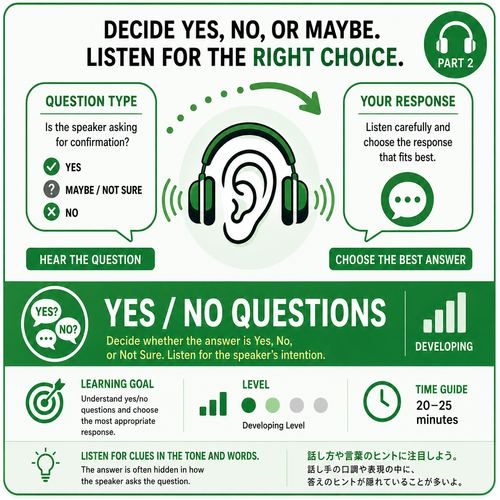
This hub introduces TOEIC Part 2 Yes/No questions. It teaches learners to recognise the
question form, understand what the speaker really needs to know, and choose a natural response
without waiting specifically for the words “yes” or “no”.
PURPOSE — JP
このページはTOEIC Part 2のYes/No疑問文の入口です。
質問の形を聞き分け、相手が何を知りたいのかを理解し、
YesやNoという単語だけを待たずに自然な応答を選ぶ考え方を学びます。
ACTUAL TEACHING ON THIS PAGE
- Listen for openings such as Do, Does, Is, Are, Have, Can, Will and Would.
- The correct answer may not say “yes” or “no”.
- Listen for the meaning of the response rather than one particular word.
- Do not choose an answer simply because it begins with “yes” or “no”.
- The response must make sense in the situation.
- Core strategy: recognise the question → understand the meaning → choose the natural response.
WHEN SAKURA SHOULD RECOMMEND THIS HUB
- The visitor asks how to handle TOEIC Part 2 Yes/No questions.
- The visitor expects the correct answer always to begin with yes or no.
- The visitor needs help recognising Yes/No question forms.
- The visitor chooses answers based on grammar instead of situation and meaning.
- The visitor wants a starting point before Yes/No practice.
WHEN SAKURA SHOULD NOT RECOMMEND THIS HUB
- The visitor is asking about another Part 2 category and a more specific MTC page exists.
- The visitor already has a precise weakness that matches one of the practice sessions below.
- The visitor asks for scoring, diagnosis or performance analysis; this hub does not provide those.
DIRECT PRACTICE ROUTES
-
Beyond Yes and No
/listening-library/yes-no-questions/beyond-yes-and-no
Use when the learner needs practice recognising correct responses that do not use “yes” or “no”.
-
Evidence as the Answer
/listening-library/yes-no-questions/evidence-as-the-answer
Use when the learner needs to understand a Yes/No meaning from evidence and circumstances.
-
Plans and Possibility
/listening-library/yes-no-questions/plans-and-possibility
Use when the learner needs practice with plans, availability and uncertainty.
-
Yes/No Questions Mixed Challenge
/listening-library/yes-no-questions/mixed-challenge
Use for mixed practice combining the Yes/No question skills from this topic.
GENERAL NAVIGATION
- Listening Library Home: /listening-lab
- Next topic: Indirect Responses — /listening/indirect-responses
FAQ — EN
Q: Does the correct response have to say yes or no?
A: No. Natural TOEIC Part 2 responses can answer the situation without using either word.
Q: How can I recognise a Yes/No question?
A: Listen for common openings such as Do, Does, Is, Are, Have, Can, Will and Would, then focus on the meaning.
Q: Is a grammatically matching answer always correct?
A: No. The response must also make sense naturally in the situation.
FAQ — JP
Q: 正解は必ずYesやNoで始まりますか?
A: いいえ。YesやNoを使わずに状況へ自然に答える応答もあります。
Q: Yes/No疑問文はどう聞き分けますか?
A: Do、Does、Is、Are、Have、Can、Will、Wouldなどの始まりを手がかりにし、その後は質問の意味に注目しましょう。
Q: 文法的に合っていれば正解ですか?
A: いいえ。文法だけでなく、状況に自然につながる応答かどうかが重要です。
SAKURA BEHAVIOURAL BOUNDARIES
- Do not ask the visitor for an email address.
- Do not give prices.
- Do not promise a TOEIC score increase or any outcome.
- Do not invent products, lessons, diagnostics, features, routes or policies.
- Use verified MTC information only.
- Keep normal answers to 1–2 sentences.
- Reply in the visitor's language.
- Prefer the most relevant verified HUB or practice link over a long explanation.